


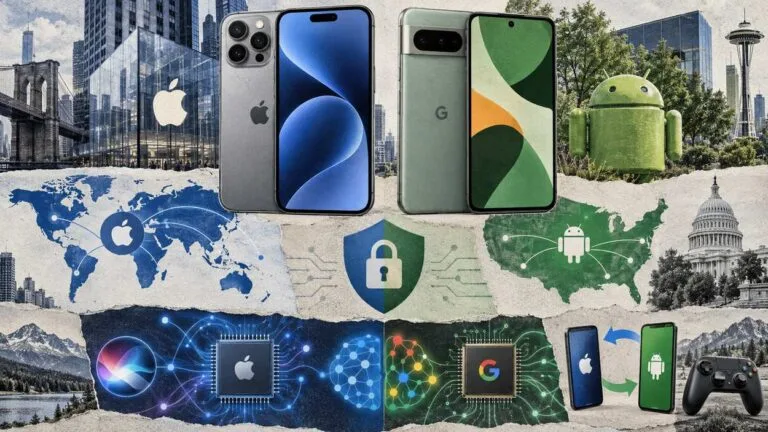


Android holds 67.61% of mobile operating system market share worldwide and iOS holds 32.36% in August 2026, according to StatCounter, yet the split flips in the United States, where iOS leads with 60.68% to Android’s 39.29%. That reversal is the first clue that “iPhone vs Android” has no single winner: it depends on where you live, what you pay and what you already own.
The current releases make the choice sharper. iOS 27 is compatible with iPhone 11 and every newer model on Apple’s list, while Android 17 is available on most supported Pixel devices. Below, both platforms are compared on the questions buyers actually search for: update years, price, privacy, app installs, AI features, gaming and switching, with a verdict for each type of buyer at the end.
Key Takeaways
- Android accounts for 67.61% of mobile OS market share worldwide. The picture then flips: iOS accounts for 60.68% in the United States.
- Pixel 8 and later phones get 7 years of OS and security updates per Google, and the Galaxy S26 FE gets up to seven generations of OS upgrades and seven years of security updates, per Samsung.
- Apple introduced the iPhone 11 Pro in 2019, and iOS 27 is still compatible with iPhone 11 Pro.
- Apple Intelligence and Siri AI in iOS 27 are available on iPhone 16 models or later, iPhone 15 Pro and iPhone 15 Pro Max, so an iPhone 11 Pro introduced in 2019 runs iOS 27 without its headline AI features.
- Android developer verification has a regional deadline of September 30, 2026 in Brazil, Indonesia, Singapore, and Thailand for participating app stores, per Google, ahead of a global rollout in 2027.
- Pixel 10a costs $499 and iPhone 17e starts at $599 with 256GB of storage.
- Quick Share works with AirDrop, starting with the Pixel 10 family on November 20, 2025, so Pixel 10 family owners can share files with iPhone users through AirDrop.
Editor’s Choice
- Worldwide share leader: Android at 67.61% in August 2026.
- US share leader: iOS at 60.68% in August 2026.
- Published update term: 7 years of OS and security updates for Pixel 8 and later.
- Lower entry price, maker’s own phones: Pixel 10a at $499.
- Top Pro model starting price: iPhone 18 Pro Max starts at $1,299.
- Developer verification starts: September 30, 2026 in Brazil, Indonesia, Singapore, and Thailand.
iOS 27 at a Glance: What iPhone Owners Get
Apple unveiled iOS 27 at WWDC26 in a June 8, 2026 press release, and iOS 27 is compatible with iPhone 11, iPhone 11 Pro and iPhone 11 Pro Max plus every later model on Apple’s support list.
- The headline change is an assistant rebuilt from scratch: in Apple’s words, “Siri AI is an entirely new version of Siri deeply integrated into iPhone, iPad, Mac, Apple Watch, and Apple Vision Pro”.
- Apple says iPhone and iPad apps launch up to 30% faster, photos load up to 70% faster after being taken, and AirDrop transfers are up to 80% faster.
- Apple ran the app launch testing in April and May 2026 using iPhone 11 Pro Max with iOS 26.4.2 and prerelease iOS 27, so the app-launch gain was measured on a phone from the oldest supported generation.
| iOS 27 task | Apple-measured speed gain |
|---|---|
| App launch | up to 30% |
| Photo load after capture | up to 70% |
| AirDrop transfer | up to 80% |
Source: Apple Newsroom, June 2026
The catch is that “supported” and “fully featured” are two different lists on the iPhone side, a split covered in the AI section below.
- Runs on every iPhone on Apple's support list, back to the oldest supported generation
- Apps launch up to 30% faster in Apple's own testing on the oldest supported hardware
- Apps must ask permission before tracking you across other companies' apps and websites
- AirDrop transfers up to 80% faster in Apple's own testing
- Siri AI and Apple Intelligence need an iPhone 15 Pro or Pro Max, or an iPhone 16 or later
- iPhone 17e ($599) costs $100 more than Pixel 10a ($499)
Android 17 at a Glance: What Android Owners Get
Google released Android 17 and made it available on most supported Pixel devices, according to the Android Developers Blog. Google frames the release around large screens and AI: “Android 17 marks the start of our transition to an intelligence system, putting your apps at the center.”
The practical changes land in multitasking. With App Bubbles, users can transform any app into a floating bubble by long-pressing its icon on the launcher, on phones, foldables and tablets, and on tablets and foldables the taskbar includes a dedicated Bubble Bar to organize and dock those bubbles. Android 17 introduces mandatory large-screen resizability, and Google counts over 580 million large screen devices in the hands of users, which is why apps other than games can no longer lock themselves to a phone-shaped window on a tablet.
The weakness is the one Android has always had: Google’s Android 17 release covers most supported Pixel devices, so owners of other brands’ phones should check their maker’s plans. Customization is the counterweight, from App Bubbles to third-party Android launchers.
- App Bubbles turn any app into a floating window on phones, foldables and tablets
- Mandatory resizability for apps on large screens
- Published 7-year update terms on Pixel 8 and later
- Phones from many hardware makers
- Pixel 10a starts at $499, $100 below the iPhone 17e
- Google's Android 17 release covers most supported Pixel devices
- Developer verification checks installs from participating app stores in Brazil, Indonesia, Singapore and Thailand first, then all apps distributed to certified Android devices
- Update terms vary by maker: 7 years on Pixel 8 and later, up to 7 generations on the Galaxy S26 FE
iPhone vs Android: Side-by-Side Comparison
iPhones run Apple’s iOS and most other smartphones run Google’s Android. iOS 27 is compatible with iPhone 11 and newer models on Apple’s support list, while Android 17 is available on most supported Pixel devices. The table sets both releases side by side on figures each company or StatCounter publishes, with no scores of our own.
Factor | iPhone (iOS 27) | Android (Android 17) |
|---|---|---|
Support evidence | iOS 27 runs on iPhone 11 (2019 generation) and later | Pixel 8 and later: 7 years of OS and security updates |
Entry price, maker’s own phone | $599 (iPhone 17e) | $499 (Pixel 10a) |
Worldwide share, August 2026 | 32.36% | 67.61% |
US share, August 2026 | 60.68% | 39.29% |
File sharing | AirDrop | Quick Share works with AirDrop on the Pixel 10 family |
Headline privacy control | Per-app permission prompt before cross-app tracking, since iOS 14.5 | Session-based contact picker in Android 17 |
Source: Apple Support 2026, Apple Newsroom 2026, Google Pixel Help 2026, Google Keyword blog February 2026 and November 2025, Android Developers Blog 2026, StatCounter Global Stats August 2026
What’s the difference between iPhone and Android?
The core difference is control. Apple’s iOS 27 runs on iPhone models such as iPhone 11 and later, while Google’s own Pixel 8 and later phones get 7 years of OS and security updates and other brands set their own terms. One company ships every iPhone update; Android depends on the phone maker.
Is Android the OS used in iPhone?
No. iPhones run iOS, not Android: Apple’s iOS 27 compatibility guide is the reference, and Apple’s support guide lists iOS 27 as compatible with iPhone 11, iPhone 11 Pro and iPhone 11 Pro Max and later models. Android is Google’s operating system, and Android 17 reached most supported Pixel devices.
iPhone vs Android Market Share in 2026
Android leads worldwide and iPhone leads the United States. Android holds 67.61% of worldwide mobile OS market share and iOS 32.36% in August 2026, StatCounter’s data shows, while in the United States iOS holds 60.68% and Android 39.29%. A US buyer choosing an iPhone is picking the majority platform at home.
Mobile OS | Worldwide share (%) | US share (%) |
|---|---|---|
Android | 67.61 | 39.29 |
iOS | 32.36 | 60.68 |
KaiOS | 0.01 | 0.02 |
Source: StatCounter Global Stats, August 2026
By the numbers: StatCounter’s figures put Android at 67.61% of mobile OS share worldwide against 32.36% for iOS in August 2026, while the United States reads 60.68% iOS and 39.29% Android. The same two platforms swap places depending on the market, so “most popular” is always a regional answer.
Share also shapes the software you get; for how quickly iPhone owners move to a new release, see the iOS 26 adoption rate figures.
Software Updates and EU Rules: How Many Years Each Phone Gets
Google states a term for its own phones: Pixel 8 and later phones get updates for 7 years from when the device first became available on the Google Store in the US, according to Google’s Pixel Help page. Samsung’s newsroom says the Galaxy S26 FE gets up to seven generations of OS upgrades and seven years of security updates. On the iPhone side, Apple’s record is the evidence:
- Apple introduced the iPhone 11 Pro in 2019, and iOS 27 is compatible with iPhone 11 Pro.
- That puts the iPhone 11 Pro on a new major iOS release 7 years after its introduction.
| Phone line | Support evidence |
|---|---|
| Pixel 8 and later, including Pixel 10a | 7 years of OS and security updates |
| Galaxy S26 FE | up to seven generations of OS upgrades and seven years of security updates |
| iPhone 11 Pro (introduced 2019) | compatible with iOS 27 |
| Any new phone sold in the EU | OS updates for at least 5 years from the date the last unit model is sold |
Source: Google Pixel Help 2026, Samsung Newsroom 2026, Apple Support 2026, European Commission June 2025
The EU rules go further than updates. New EU ecodesign and energy labeling rules apply to smartphones placed on the EU market, per the European Commission, and both Apple and Android phone makers must meet them.
| EU requirement | Minimum |
|---|---|
| Battery endurance | at least 800 charge cycles while retaining at least 80% of initial capacity |
| Spare parts delivery | within 5-10 working days |
| Spare parts availability | at least 7 years after the model is no longer sold in the EU |
| Operating system updates | at least 5 years from the date the last unit model is sold |
| Repairability score | A (most repairable) to E (least repairable) |
Source: European Commission, June 2025
Worth noting: The European Commission’s rules require batteries capable of at least 800 charge cycles while retaining at least 80% of their initial capacity, and spare parts for at least 7 years after the product model is no longer sold in the EU. Phones placed on the EU market now show an A to E repairability score, which gives buyers a like-for-like repair comparison across both platforms.
How long do iPhones and Android phones get updates?
Pixel 8 and later phones get 7 years of OS and security updates, and the Galaxy S26 FE gets up to seven years of security updates. On the iPhone side, iOS 27 still supports iPhone 11 models. In the EU, operating system updates must stay available at least 5 years from the date the last unit model is sold.
iPhone vs Android Price: What Current Models Cost
Android starts cheaper when you compare Google’s and Apple’s own hardware. Google’s Pixel 10a costs $499, while Apple’s iPhone 17e starts at $599 with 256GB of storage, per Apple’s newsroom release. The entry iPhone costs $100 more than the entry Pixel.
iPhone 18 Pro starts at $1,199 and iPhone 18 Pro Max starts at $1,299 in the US, and both come in 256GB, 512GB, 1TB and 2TB storage capacities. Apple says iPhone 17e doubles the entry storage from the previous generation at the same starting price, which narrows the value gap with the Pixel at the low end.
Why it matters: iPhone 17e at $599 sits $100 above the $499 Pixel 10a, and iPhone 18 Pro Max starts at $1,299.
Privacy Controls on iOS 27 vs Android 17
On the iPhone, the control is a prompt from each app: Starting in iOS 14.5, apps must ask for permission before tracking your activity across other companies’ apps and websites, Apple Support says. Apple adds that if you choose Ask App Not to Track, the app developer can’t access the system advertising identifier (IDFA).
Google’s newest release works at the level of each data request instead. Android 17 continues the shift toward privacy-preserving choices that grant temporary, session-based access only to the data the user explicitly selects, and its system-level contact picker lets apps request temporary access only to specific fields, such as an email or phone number, chosen by the user.
The two approaches solve different problems. Apple’s prompt limits what advertisers can join up across apps, while Android’s pickers limit how much of your phone an individual app can read. A privacy-minded buyer gets real controls on both, and the iPhone’s per-app tracking prompt is the simpler one to understand.
Android Developer Verification: What Changes on September 30, 2026 and in 2027
Starting September 30, 2026, developer verification protections go live for users in Brazil, Indonesia, Singapore, and Thailand, according to Google’s Android developer verification help page. Google will expand these protections globally in 2027 for all apps distributed to certified Android devices.
- The new protections require verified developers to register apps that they want to distribute to certified Android devices.
- Google describes the check narrowly: “we will be confirming who the developer is, not reviewing the content of their app or where it came from”.
- In the first phase, the system verifies app installations from stores including Google Play, Samsung’s Galaxy Store and Xiaomi’s GetApps.
- Google’s timeline also lists a power user advanced flow launched in August 2026.
Unverified app risk: Google says it added developer verification to better protect users from the spread of malware and scams. Google names an advanced flow for power users; treat any APK from outside a store as unverified. A reputable antivirus app for Android adds a second check on anything installed that way.
The September 30 phase checks installs from participating app stores in four countries, so most buyers who get apps from Google Play or a phone maker’s store see little change. The 2027 global rollout widens the check to all apps distributed to certified Android devices, which is the phase hobbyists and power users who install niche or modified apps should plan for.
Siri AI vs Gemini: Which Phones Get the New AI Features
Apple unveiled Siri AI at WWDC26 in a June 8, 2026 press release, and on the iPhone side AI support is narrower than OS support. Apple Intelligence and Siri AI in iOS 27 are available on iPhone 16 models or later, iPhone 15 Pro and iPhone 15 Pro Max, per Apple’s announcement, while iOS 27 itself is compatible with iPhone 11 and later. An iPhone 11 through 14, or an iPhone 15 or 15 Plus, installs iOS 27 but does not get Siri AI.
Google is building hooks that let any assistant act inside apps. AI agents and assistants like Google Gemini can discover and execute AppFunctions to perform workflows on behalf of the user, and the Gemini integration is in a private preview with trusted testers according to Google’s release post.
The takeaway: Apple ties Siri AI in iOS 27 to iPhone 16 models or later, iPhone 15 Pro and iPhone 15 Pro Max, so a phone that runs the new OS can still miss the new assistant.
iPhone vs Android for Gaming
The newest iPhone chip leads on Apple’s own numbers, while Android offers far more hardware choice. Apple says the A20 Pro’s new 7-core GPU design is up to 40% faster than A19 Pro, and A20 Pro has 50% more memory bandwidth than A19 Pro, according to Apple’s announcement.
On Android, games get special treatment in the new windowing rules. Games, based on app category in Google Play, remain exempt from the new mandatory resizability on large screens, so a game can keep its fixed layout on a tablet or foldable.
For gaming, the iPhone 18 Pro is the safer high-end pick on Apple’s measured gains, while Android is the better choice if you want a gaming-focused phone, a controller-friendly foldable or a lower price for the same class of games.
Switching Between iPhone and Android
Moving files and data between iPhone and Android now takes fewer steps. Google introduced a way for Quick Share to work with AirDrop, rolling out to the Pixel 10 family on Nov 20, 2025, and Google frames the feature as better compatibility between operating systems, following its work on RCS and unknown tracker alerts.
Switching phones is also simpler. With Samsung Smart Switch, whether switching from an Android or iOS device, users can scan a QR code to wirelessly transfer data from passwords and passkeys to call history and eSIM data, per Samsung’s announcement.
The lock-in that remains is mostly about accessories and Apple services subscriptions rather than files: the Apple ecosystem lock-in statistics show how much of it comes from owning several Apple devices at once. A single-phone household can move in either direction with little lost.
Which Is Better, iPhone or Android? Verdict by Use Case
Neither iOS nor Android wins for every buyer. Android holds 67.61% of mobile OS share worldwide and starts cheaper, since Pixel 10a costs $499, while iOS holds 60.68% in the United States and supports phones back to the iPhone 11 generation. Pick by the job the phone has to do.
Best for long support on a budget: Android, specifically the Pixel 10a. Pixel 10a costs $499 and Pixel updates run for 7 years from when the device first became available on the Google Store in the US.
Best for keeping an older phone current: iPhone. iOS 27 is compatible with iPhone 11, and the iPhone 11 Pro was introduced in 2019.
Best for AI features on a new phone: a recent iPhone if you want Siri AI, because Apple Intelligence and Siri AI in iOS 27 are available on iPhone 16 models or later, iPhone 15 Pro and iPhone 15 Pro Max.
Best for customization and multitasking: Android. App Bubbles let users transform any app into a floating bubble on phones, foldables and tablets.
Best for high-end gaming: Apple’s newest Pro iPhone, on Apple’s own figures: the new 7-core GPU design is up to 40% faster than A19 Pro.
Best for mixed iPhone and Android households: a Pixel 10 family phone, because Quick Share works with AirDrop starting with the Pixel 10 family.
Conclusion
Android leads worldwide with 67.61% of mobile OS share and iOS leads the United States with 60.68%, and the current releases give each side a clear case. Android wins on entry price, with the Pixel 10a at $499 against $599 for the iPhone 17e, and on multitasking, and Google gives 7 years of OS and security updates for Pixel 8 and later. The iPhone wins on simple privacy controls and on keeping old phones current, though Siri AI needs a recent model.
The next change to watch is on the Android side, where Google will expand developer verification globally in 2027. If you install apps outside the stores, factor that in now; if you do not, the choice comes down to budget, the devices you already own, and how long you plan to keep the phone. The Android version names list tracks each release as it lands.

Ayush Agrawal
I can’t DISAGREE more on the Stability Point!!
Anyways good comparison, I am happy with my iPhone.
Ness
I’d still go for iOS. Haha!
Rajesh Namase
We’ve not asked you to go for Android, choice is yours :)
Rubina
It’s been a really interesting comparison to read. Wish it would have helped in choosing any one out of the two :)
Jaikee Jaiswal
Android is definitely better then iPhone OS. At least when it comes to creating apps or customizing the firmware. phone is such a thing that you get bored seeing the same interface and thems.
With Custom ROM you can customize the look and feel as well add new features to your phone.
Raviraj
I am using Android 4.0ICS on my HTC Desire X.. Android seems to be a coool OS for me.. But I never used iOS so far.. I read the whole article and many of Android features are cool and even its lacking many things from iOS .. And I liked your way of expressing via info graphics the most!!
Jessie
We know that these two OS are the leading OS in the market today. But I still choose Android because it has many features and you can customize it and install new ROMs but before that you must root your phone first. There’s a new rooting software today.
Kathy
Hi there. Now iOS6 has come with highly improved apps and features. Then why should anything else!!!
Rajesh Namase
Many people love Android OS because number of free apps available in Google Play market :)
Gaurav Vichare
I love android because android devices are not costly , no bluetooth problems , support to flash and open source ! Android is future of mobile industry !
SiennaAmelia
Dam sure. Android is better than iPhone. There are tons of features available in android. I have mentioned few points that have noticed android have and iPhone doesn’t.
Android can Run Multiple Apps at the Same Time
Android Lets You Choose Your Hardware
Android Keeps Information Visible on Your Home Screen.
Fabi daps
I really love Andriod OS. i have been using Andriod OS for a while. i have used Iphone but had to sell it due to the interface. Andriod Rocks while IOS sucks
Esther Paul
Both are good… when it comes to security point of view IOS is good but Android leads coz of free apps available.
One can get anything or everything for free in Android Market which is cool.
Great Comparison.
Esther
MattY
Thanks for taking the time to compile this helpful comparison. I’m not sure I’ll ever be completely convinced one way or the other, even after I buy my next phone! But seeing it laid out like this helps. I think I’m leaning toward android (probably S4) after several years with an iPhone, although that certainly might change after the upcoming WWDC. :)
Nemanja
From my point of view iOS is better for simple users, who wants its OS to always run smoothly and flawlessly, but even though Android can be laggy from time to time it is definitely better for advanced users because of its open source nature and customization possibilities.
John
Great article, what I love about android is efforts it has taken let users and manufacturers do what they want to. The flexibility to do things with android is what is making it popular. Whereas with iOS, Apple brand and simplicity to do things which are needful at the best way helps lot of not geeky users.
John
I believe both of the OS are in their own respective worlds, whereas maybe apple fanboys wont like to shift to Android phones like Galaxy S4 or HTC One but it all comes to user’s own choice. Me being apple fanboy swapped my iPhone 5 for Galaxy S4 just because of widgets, the OS which is so advanced right now what iOS gives. Android gives most of flexibility which I liked the most. I think nerds like us like Android more than iOS.
Try reading this article, it in reality shows what iOS 7 will provide you which Android 4.2 version has already got last year.
http://s4tips.com/tips-and-tricks/apple-has-given-us-ios-7-compared-to-android/
p.s. not a spam..
Array Steven
Choice is completely ours. I always prefer Android OS. Although I am not much familiar with iPhone OS, but used it for 2 or 3 months. However, after all I am very pleased with Android features and apps.
Nikhil
Android is the king. Although iOS is popular because it’s fluid interface but if we buy a good device with high hardware specification then Android is good too.
vishal
Please no compare apple with android, Apple always give their quality to their customer.
Mujtaba P
Actually, many of us still prefer android gadgets, according to survey. This is due to the fact that it is simple to use, there are more number of free apps available as compared to iOS. U can do much more with android gadgets :)
Rupak
I started my story with symbian powered gadgets by Nokia and ended up with Android devices. I’ve also windows phone from Nokia. The good thing I like about Android us the avaibility of free apps for different purposes. whereas when we take top class apps on iTunes they are always premium bundled with pricetags. If I don’t find any app of my need I look for other android developers. Some of the premium apps are also available off the android play store. I’ve been using android since the I left symbian and I love its flexibility of customization. Great side to side comparison. But, literally, I like iPhone’s design and look.
Sourya Kharb
Apple’s iOS is my favorate for its performance & smooth
1ghz processor with 512mb ram on Iphone 4 performance is more better than Samsung galaxy s2 with dualcore chip and 1gb of ram and also the battery backup…:D
But the good thing about Android is its customization
Android is my favorite for its really cool features
I love both of these OS and also using both :D
james blackhill
great article, I prefer android over iOS, thanks for you very detailed article
Harman
Android and iOS they both stand strong at their respective place. Andriod user finds iPhone insane and vice versa. I have used both these products but find iPhone much easy and effective.
ahmed
nice article,informative one,you clear the confusion and misconception about android os and iphone os.i use android but i prefer iphone os earlier and but by this precious review i like android because there is no boundary and limitation.Thanks for sharing.Great job.
ajay
I will prefer iPhone OS why because iPhone OS provides high security than Android and also the hardware configuration and overall performance were much better than Android OS
Ansh Yadav
Nice article Rajesh namase. I think you are Indian. I had been reading your each article from past 6 months. You write very well. I am having both Iphone and smartphone. But then also i will go for Smartphone main thing about them is that we got a diversity thier. and can choose according to our budget.
I am having a blog on which I write about games and apps. Just the recent article Best android email client
Noname
They are both smartphones idiot! And you call them both “phones” only, you guys don’t always have to use the word *smart before the word “phone”, because 80% of the people have phones with touch interfaces today!
Jerry
To each his own. iPhone and iOS work best for my preferences so in my opinion, it is better. I have friends who use android phones though so I know it’s also good. There’s really nothing to get mad about whether you’re using one or the other, it’s all about what works best for you. Anyway, great comparison Rajesh!
Lakshman Teja
As i have used both the mobiles i am more comfortable with android as we can customise our own Android phone as we like by doing a little bit of hardwork. As the opensource Android helps several enthusiasts to develop the platform.As the people can create their own Roms. I will go with Android.
John
The iOS 7 i expect to be game changer. We have already heard the rumour that Apple is releasing iphone 5s and iphone 5c soon..so lets wait to find what’s coming!
tahir
I used iPhone 4 first time in my life and I will not use other phone than iOS iPhone in my entire llife.
kuldeep
Android is the future os of next upcoming market so its very wide field where we can easily see our future but these are also facts that android boom is sudden in market and many companies like apple is the constant player in the market so its very difficult to say that how much time it will remain but in the current position its the main leader of mobile os market.
cruz werner
Apple and Android both are very powerful OSs. Apple set the standards with its experienced team and their innovation and quality. Android has also done a great job taking its opportunity and I think Android can only get better with time
Krunal
I think android is one of the best because I have used both and like android more than ios…
Hugh
It’s two different mindsets, basically. Android is for people who like to customize things and tweak settings. iOS is for people who want to keep it simple. I prefer the latter, but Android is a good OS. I used to have Windows Phone when it first came out and at the time, it was so ahead of everything else. Too bad they never improved it.
Marry
I feel android is better in terms of comfort in terms of OS updates but if you want the iphone was exclusive expert
John Jevon
While features are important, at the end of the day, the smart phone is a style statement and what you choose very much depends on snob value of what you perceive to be better, the iPhone or the Android. Also this is the era of apps. So what your peers use and how to stay connected with them is very much important while selecting a smart phone.
Anurag Jain
I will vote for Android ! iOS definitely have many good features but Android is also not behind :)
Neha
i am android lover because of their open source many applications are getting free where in iphone most of apps are paid. Great comparison.
Jeeten
I am a android n IOS Developer from surat, love android OS and IOS7 (latest OS). Developing IOS & Android Apps.
gaurav
great artical rajesh…. such kind of comparison make very clear image of product…….keep sharing :)
Jerry
I love Android OS, Its a open source OS,Cheap and Best.. Thanks For Sharing
Govt Jobs
iphone is the best…..I feel android is better in terms of comfort in terms of OS updates but if you want the iphone was exclusive expert
Prajwal
Well though iOS’s simplicity and great usability attracts more and more users, people will never stop loving android as they provide more customization and more user friendly interface.
Rehmat
Nice comparison Rajesh, it answered some of my questions. I haven’t used any iPhone yet. Android OS is attractive and simple and I love it :)
Sathish
Nice Comparison between two best OS in the smartphone market. But don’t forget that Google the owner of Android is still developing and incorporating new things into a smartphone for free of cost than the Apple. Just by comparing the differences between Eclairs and Gingerbread we can feel it, Apple is a bit slow in development when compared to Google.
Renuka Reddy
In my country India Android is ruling and iPhone is lagging… But the OS was will go on to capture world…
Shanjei
Whatever iOS has, it can’t beat Android when it comes to gaming and range :D
Ross Kirwan
We’ve come a long way over the last few years… When I first switched to Android, I have to say, that I was lost with iOS, but with the release of Jelly Bean and now Kit-Kat, I have to say I could never go back to iOS…
The features in Android imo far outstrip iOS… For me, a power user, I’m Android All the way!
parthiban
Hey Rajesh Namase,
Really superb comparison about android OS and iPhone OS, Recently I moved my self to android smartphone from iPhone..
Actually my opinion is comparing android os nad iOs android have lot of free apps, and and also low cost apps.
One of my favorite App is available for android just 3 dollars, but at iPhone it’s cost is 15 dollars ..
Thank you very much for this nice comparison..
abhilash
the new version of iOS, Apple come with many new features like Healthbook, Better Map App, multitasking, and it easy to use. Android has good number of Apps and we can free to customize. wait for iOS 8.
NAyAN
iOS offers freequent updates while it takes too much time to get update to Android, but also the fact is Android is an open source OS, so it is highly customizable compared to iOS.
Marcus
The never ending discussion..android or apple..
Had them both and its really a difficult pick…apple is extremely stable and offers a whole lot of great apps, for example they have more useful applications for aviation than android has.
But than again android really is dynamic!
Great comparison! thanks
Regards
Ayo Deji
Nice post. I will go for the Android OS instead of the iOS … Thanks.
Jimmy
I’m using an iPhone 4S and my wife using Samsung S4. Even our choice different; 4S vs S4, but we always love each other.. hahaha.. Sounds great, eh? :D
Priya Kamdi
This article is superb and the discussion can’t end but as we see this article the security and interface is good at iPhone whereas Android is open source and in that too many apps are available and we only want apps. Do we?
Bryan
Great points on both Android and iPhone! Although, as a user, I much more prefer using Android over iPhone.
Ash
However, I use Android because it is open source and it’s a not ending discussion between Apple and Android that which is better?
The choice is always belongs to the user and everyone happy with their choice.
Thanks, for sharing.
Kksilvery
Apple iPhone is all about feel of richness, however Android is made for exploring and trying out different apps. If you like exploring “say me” go for Android.
Sai Charan
Android Vs. iPhone is never ending debate. I often see people waging war against each other on Facebook and Twitter debating about the best mobile operating system. You really mentioned some awesome points :)
Gaurav Dutt
One can’t simply say which one is better.
Syed
Very nice Article Rajesh !
My vote is always for Android because it works best for personal use!
Thanks !
Dian
We know that these two OS are the leading OS in the market today. But I still choose Android because it has many features and you can customize it and install new ROMs but before that you must root your phone first. There’s a new rooting software today.
Jayesh
I feel iOS is for who don’t have brain and just wasting his money for logo of Apple only whereas Android is for who are really smart try to do new things like upgrade firmware, hacking passwords and many more customizations. Also, I noticed that iOS user has an ego I can’t understand why you have an ego? You’re one of the dumbass people in the world who use iOS and waste your money for small screen irritating device.
Shashank
There is no comparison between Apple and Android OS, Apple always give their quality to their customer.
John Crook
Hi,
These days both platforms are very popular for mobile computing, but as compared to iOS Android is very cheap and feature oriented and lots of optional products are available into Android. Here you can choose any suitable product for which you feel comfortable for you. These days I am using Samsung smartphone. Good work.
Regards,
John
Jyoti
Well iOS is the best coz i haven’t faced any issue since last 2 years.
Somya Sharma
Nice comparison Rajesh between Android and iOS. We know that Android and iOS, both are having their own benefits according to user preference. In India, most of smartphone users prefer Android handsets because it is available in a low price segment with more features. Thanks to share more information on both operating systems.
Vito
The one thing that differentiates and iOS and Android OS is the smoothness of touch and hanging problems. iOS never hangs and touch quality is way much better than Android. Also the iOS looks professional while Android looks childish to me, sorry no offense.
Heru
I really like the Android because it’s easier and more updated operating system. More simple and easy to operate.
Jack
It’s not the first time someone’s made this comparison. I remember back then, iOS was giving a tough time in terms of market share. Today, it seems the world has finally given into the customization features of Android, albeit Apple still has a big chunk of that pie.
Sangeeth
Quite a good comparison. Android is good when it comes to customization whereas iOS has good security and doesn’t lag . Thats why iOS is loved by many.
Munish
Android means freedom from restrictions on such basic things which can make a person pull his hair!! And you don’t have to be a hacker to realize that. I use Android and I got frightened by the very idea that iOS doesn’t support file transfer over Bluetooth, which for me is a single reason enough to not have an iPhone, It’s like paying someone (much!) to keep you chained :D
Constantinos Tiphas
I don’t know why, but I feel that Android is more restricted than iOS, and it’s only “Pure Google” (the unmodified Android on Nexus Devices) that is restricted. It doesn’t have features like “allow access when locked” or Multitasking Gestures, the wallpaper you set is both on the lock screen and home screen, etc. and THAT’S why everyone hates Nexus (“Pure Google”) devices because their system is sluggish, ugly, and the most restricted operating system I have ever seen on the planet.
Note: This is my real name!
Mahesh Dabade
I personally prefer Android because of the UI, it’s multitasking features, Play Store and most importantly the price. But thanks for sharing the difference, it helped me enrich my knowledge. Keep up the good work.
Elf Sur
Really great post, I got some correction after reading the post and watching the video sir.
Android vs iPhone always competition to be the best.
Shais
I prefer to use Android instead of annoying iOS feature.
Do you know, what to do if you need to transfer a music track to an iPhone? Connect your iPhone a computer (preferably Mac), the computer must be connected to the internet, your internet connection should be DSL, iTunes must be installed, iTunes must be updated. OK, finally the file will transfer. But android, just connects to a simple Pentium 2 PC, copy all your files using Windows file explorer.
Faran Khalid
Well, I was reading out this complete article but I love Android just because of Google Play Store. In an Android, there is a lot of collection of applications for Android.
Doddridge Warner
I don’t know anything about the two OS because I use a stupid Windows phone ?. Its really limited.
Pankaj Sehoriya
iPhone is bad OS according to me only graphic feature and icons are best everything purchase. Android is best. 100 Point.
Mak
I would like to go with Android as it is open source. If you are developer then you hit like Android OS is maximum chance :)
Vishnu Sharma
Great article Rajesh, such kind of comparison makes very clear image about the product. Keep sharing.
Everett Huffine
Great post. I was checking continuously this blog and I’m impressed! Very helpful information specially the last part :) I care for such info a lot. I was looking for this certain info for a long time. Thank you and best of luck.
Biplab
Thank you Rajesh for disclose the comparison between iPhone and Android. I really love the way you have described. It makes everything very neat and clean. Keep posting like this, thumbs up :)
Subhnish
Android is at top, not by a big margin but it beats every other OS’.
Good comparison.
Rakhi
Thanks for this post. I really like to use Android most. But through this article you have put a great comparison between IPhone and Android
Jerry Aguilar
I prefer Apple tablets over android tablets for business purposes. But I carry an android phone because I prefer Android. This was a great article!
Himesh
Android is GOD ! I can choose any company any mobile. But with IOS I need to go for Apple only. BTW I like Mango instead Apple :p
Swaraj Nandedkar
Hello Rajesh,
Both Mobile operating systems are wonderful for the users. I used both of these operating systems, and i like the Android most. As the Android is Open Source, there is room for improvement in the performance of the OS.
Shivang
Android is best, as we can play lots of games and use latest apps but iPhone is not so great.
Sameer Sharma
I was not an iOS lover. Due to its overpricing and certain useless constraints. But after I bought iPhone 5C 2 years back, it changed my perspective completely. The menu is quite simple and clean. The camera is outstanding, the battery is quite good and the best part is touch. Amazing touch response.
Annie Lobo
Hello,
I personally don’t like iPhone because I think iPhone is just for show off, no use, no function, no Bluetooth. But I love MacBook Pro because of its shape size and functions also, no hang problem in mac.
Thank you,
Annie Lobo
Anny
I was not an iOS fan. Due to its heavy cost and many restrictions. But after I bought iPhone 6S a year back, it changed my way of thinking towards iOS completely. The menu is very simple and clean. The camera is extraordinary, the battery is awesome and I totally flood for its responsive touch.
John
I love iPhone but in the usage, all the apps are not supported by it. Mainly on iPhone, there’s no memory for songs, some apps are needed to be downloaded. I hate that.
Anderson James
Thanks Rajesh for sharing this wonderful post. Very well differentiate between Android OS vs iPhone OS. This information will useful for all Android and iPhone users.
Ramees Kaztro
In my opinion, Android is the best. iPhone, we can’t customize by our wish. Android is the top and easy customizable smartphone OS ever.
Sachin
For personal use, In US areas iPhone is preferred for everyone, but like in India there are a lot of Android users. And Android has too many features than iPhone. So I preferred to use Android than iPhone.
Hari
Hey, I recently read your post and I really liked It. Because I am learning about blogging.Thank you and please post latest data for us.
I am also writing a blog related to tech niche.
Richard Anderson
I personally think that iOS is better for personal use.
Due to increasing number of exploits in Android phones, it’s recommended to use a smartphone in which your data will be kept safe. But on the order hand, if you are looking for more control over your smartphone, then you should consider Android phone. So overall, I think it varies from person to person.
Sophie Cal
Hey dear, great post. I Personally like Android, their apps, and support, I never had iPhone, but I know I still feel this that android phones are best. But seriously I loved your post, it would be more attractive for a person like me, I love visuals with this, seriously, you need to put some images in this to catch more audience.
Mahesh Dabade
Hey Sophie, thanks for the suggestion, we will surely add the images and make it visually appealing :)
Shaowei Xu
Android OS always occupies large amounts of phone memory over time, like Huawei, OPPO, Vivo, you can hardly free them. That’s really hateful!