



Enterprise IT teams now evaluate devices based on long-term value, not just upfront price. Macs have gained traction because they reduce IT overhead, improve employee productivity, and lower security risks across distributed workforces. From software development teams running cloud-based workflows to finance teams prioritizing secure endpoints, organizations increasingly factor TCO into device decisions. Let’s break down the latest data shaping enterprise Mac adoption and cost comparisons.
Editor’s Choice
- Mac devices save enterprises an average of $843 per device over a three-year lifecycle compared to PCs.
- Enterprises reported up to $12.4 million in IT support savings tied to Mac deployments over three years.
- Mac adoption reached 11% share of the U.S. enterprise market in 2025, up 2.4 percentage points YoY.
- 96% of CIOs expect Mac investments to grow in the next 12–24 months.
- Mac users show 5% higher productivity and 20% better retention rates than PC users.
- Macs reduce data breach risk by up to 50% per device compared to PCs.
- Enterprises report one-third fewer IT admins needed to manage Mac fleets.
Recent Developments
- Apple achieved 11.2% enterprise growth in 2025, outpacing the industry average of 3.3%.
- Macs accounted for 15.7% market share across all segments in late 2025.
- 93% of CIOs reported increased Apple device usage over the past two years.
- Nearly 77% of enterprises actively use Mac cloud infrastructure, such as AWS EC2 Mac.
- AI workloads now drive adoption, with 73% of enterprises using Macs for AI processing.
- PC hardware prices increased 15–20% due to supply chain pressure, narrowing cost gaps.
- Mac deployments increasingly support AI, cloud computing, and DevOps workflows across enterprises.
- Enterprises report 65% easier device management on macOS compared to Windows/Linux.
Enterprise Mac Adoption Trends
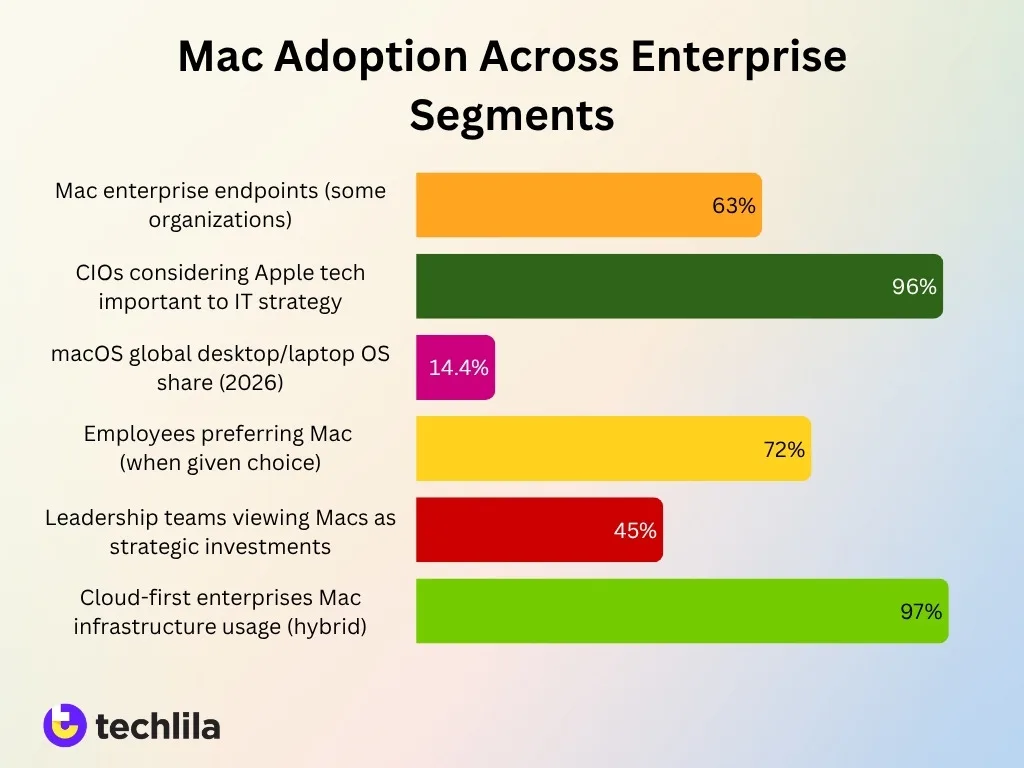
- Macs now represent 63% of enterprise endpoints in some organizations, reflecting rapid adoption.
- 96% of CIOs consider Apple technologies important to their IT strategy.
- macOS holds 14.4% of global desktop/laptop OS share as of 2026.
- In the U.S., macOS commands 31.94% of the desktop/laptop market share, highlighting strong regional adoption.
- 72% of employees prefer Mac when given a choice in enterprise environments.
- SMB Mac adoption increased from 24% to 27% between 2024 and 2025.
- 45% of leadership teams view Macs as strategic investments rather than optional tools.
- Cloud-first enterprises report 97% Mac infrastructure usage in hybrid environments.
Mac vs PC Upfront Costs
- MacBook pricing typically ranges from $999 to $2,500+, while Windows laptops average $500–$1,200.
- In some enterprise comparisons, MacBook Air costs $1,499 vs $2,500 for comparable PCs.
- Windows Pro licensing adds $199 per device, increasing the total upfront cost.
- Many enterprises add third-party security tools to PCs, raising initial investment.
- Macs include native encryption and security tools at no extra cost.
- Rising component shortages have increased PC hardware costs by 15–20% since 2023.
- Mac pricing stability improves budgeting predictability for enterprises.
- Enterprises report fewer add-on tools needed for Macs, lowering hidden upfront costs.
Hardware Longevity Stats
- Macs typically last 5–8 years, outlasting PCs at 3–5 years on average.
- Enterprises treat Macs as six-year assets, versus three-year refresh cycles for PCs.
- 11.5% of Macs last over six years in businesses, compared to just 2% of Windows devices.
- Windows systems have 3.1× more forced shutdowns and 2.2× more app crashes than Macs.
- App freezes occur 7.5× more often on Windows than on macOS in enterprise data.
- Apple silicon delivers up to 44.6 PPW in Cinebench, over 2× Intel’s efficiency.
- M4 MacBook Pro offers up to 24 hours of battery life, far exceeding most Windows laptops.
- Macs retain 30% residual value after four years, double that of PCs at 15%.
- Enterprises save 20% overall costs per Mac via lower support and longer lifespans.
- Mac support tickets cost 25% less with 60% fewer IT interventions than PCs.
Overall TCO Comparisons
- Macs deliver $1,448 total savings per device over three years in some enterprise models.
- Cisco analysis shows $148–$395 savings per Mac device compared to PCs over three years.
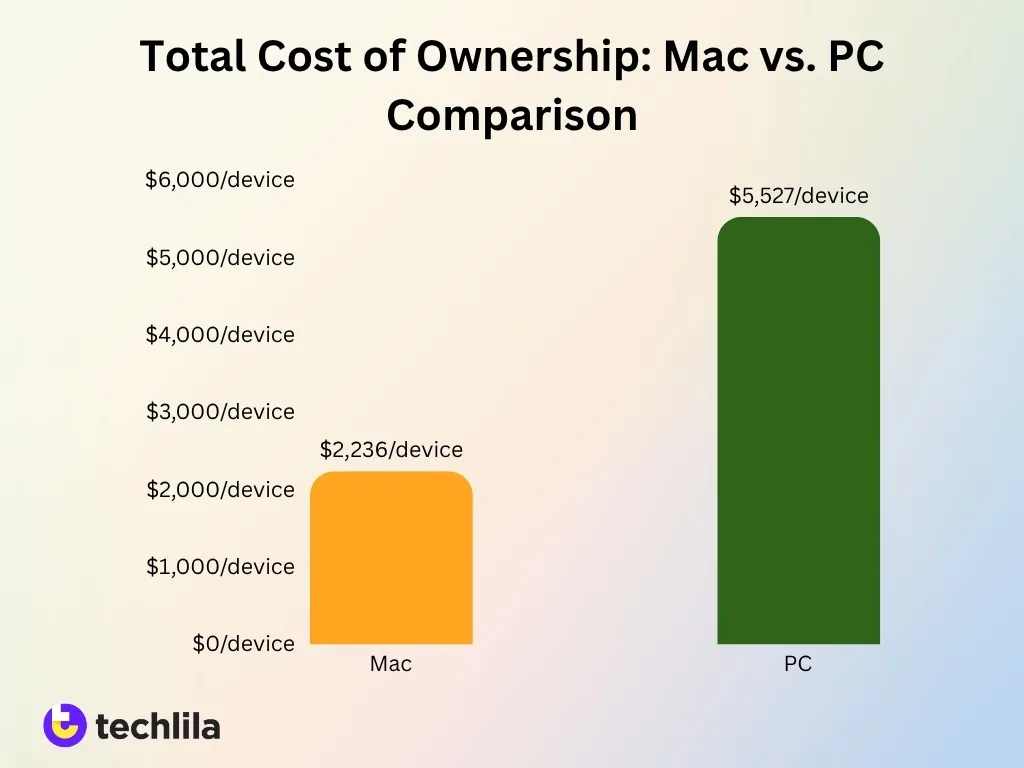
- Four-year TCO estimates show Mac cost at ~$2,236 vs PC at ~$5,527 per device.
- Mac users experience 4 hours of downtime annually vs 12 hours for PC users.
- Macs reduce security incident costs to ~$67 vs $167 on PCs per device lifecycle.
- Enterprises report 30–40% resale value retention for Macs vs 20–30% for PCs.
- IT support savings range from $273 to $543 per Mac device compared to PCs.
- Mac lifecycle savings are driven by longer hardware lifespan and reduced maintenance costs.
IT Support Savings
- Enterprises report $273–$543 lower IT support costs per Mac device compared to PCs.
- IBM found Macs require 5× fewer help desk tickets than Windows PCs.
- Only 5% of Mac users needed IT support, compared to 40% of PC users in enterprise environments.
- Mac fleets reduced IT workload by up to 50%, freeing teams for strategic work.
- Enterprises saved $12.4 million in IT support costs across large Mac deployments.
- Mac devices generate lower incident rates due to OS stability, reducing troubleshooting time.
- IT teams report 20–30% faster issue resolution times on macOS devices.
- Fewer drivers and compatibility issues reduce hardware-related support tickets significantly.
Device Management Costs
- Organizations using Macs save $843 per device over a three-year lifecycle compared to PCs.
- Mac deployments reduce device support and management costs by nearly one-third.
- Enterprises achieve 60% fewer support tickets per Mac device annually versus PCs.
- IT teams manage twice as many Macs (600 per FTE) as PCs (300 per FTE).
- Zero-touch deployment cuts provisioning time by 60–70% for devices.
- Macs require 5% in-person IT visits versus 27% for PCs, slashing support costs.
- Organizations save $7.3 million in support costs over five years with 13,125 Macs.
- Macs consume 56% less energy than comparable PCs, reducing infrastructure expenses.
- Automated macOS updates enable fewer patch cycles, easing IT vulnerability management.
Admin Staffing Efficiency
- Enterprises require one-third fewer IT administrators to manage Mac fleets compared to PCs.
- Mac deployments reduce IT staffing costs by 15–25% annually through lower support needs.
- IT teams manage twice as many devices per employee with Macs (600 Macs vs 300 PCs).
- 60% fewer support tickets per Mac device per year versus PCs.
- Mac users generate four times fewer support tickets than non-Mac users.
- One IT FTE manages 2,500 Mac devices in healthcare enterprises.
- Mac provisioning takes 5 minutes versus 60 minutes for PCs.
- 50% fewer service tickets opened by Mac users due to reliability.
- Enterprises save $628 per Mac in three-year support and operational costs.
Why Employees Prefer Mac at Work
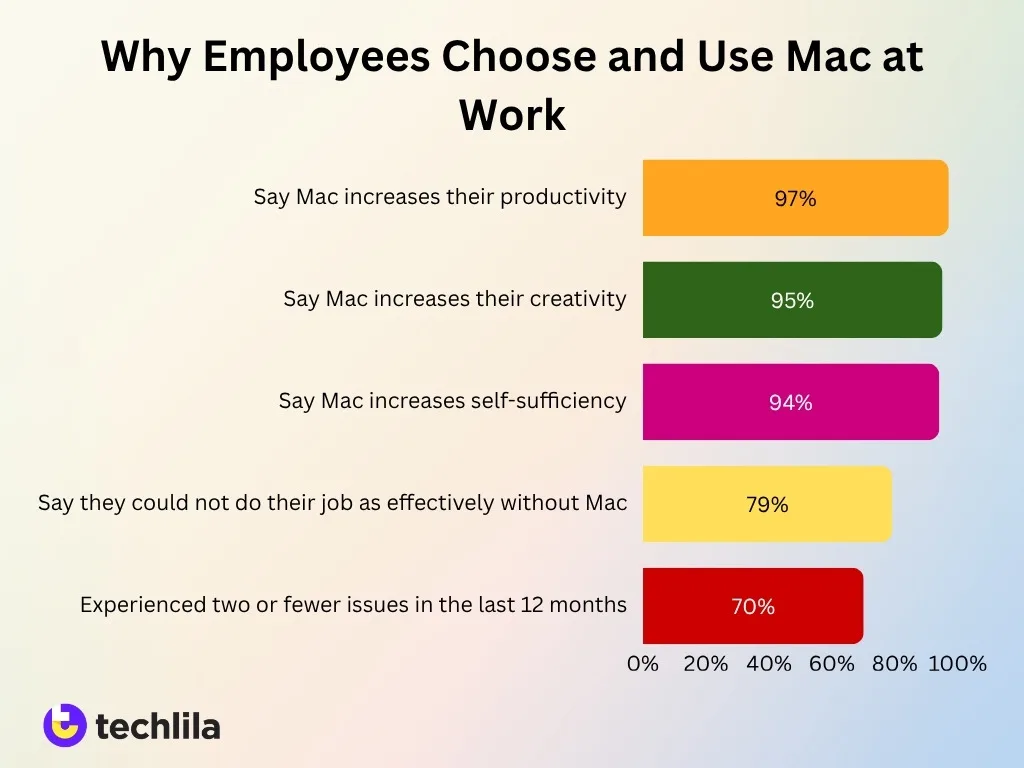
- 97% of employees report that using a Mac increases their productivity, indicating strong performance and efficiency gains in daily tasks.
- A significant 95% say Mac boosts creativity, suggesting it supports better design, innovation, and problem-solving workflows.
- Around 94% of users feel more self-sufficient, meaning they rely less on IT support and can resolve issues independently.
- 79% of employees state they could not perform their job as effectively without a Mac, highlighting its critical role in workplace efficiency.
- 70% experienced two or fewer issues in the past 12 months, demonstrating high reliability and fewer disruptions compared to alternatives.
Security and Risk Reduction
- Macs report 47% fewer malware detections per endpoint than Windows PCs in enterprise settings.
- macOS experiences 12.6% of total malware cases versus 87.4% for Windows in 2025 antivirus data.
- macOS malware detections are 7 times lower than Windows despite growing threats.
- Enterprises using Mac fleets see up to 65% fewer successful cyber attacks than mixed environments.
- Apple’s T2 chip enables hardware-encrypted FileVault, protecting 100% of data at rest.
- macOS delivers automatic security patches within days, reducing zero-day exposure by 50%.
- Finance firms with Mac-only deployments cut compliance audit failures by 30% annually.
- Reduced Mac attack surface lowers incident response costs by 40% compared to PC fleets.
- Gatekeeper and XProtect block 99% of known macOS malware without third-party tools.
Endpoint Security Expenses
- Enterprises spend $67 per Mac vs. $167 per PC on endpoint security lifecycle costs.
- Mac environments reduce the need for multiple endpoint security licenses, saving costs.
- Built-in macOS security tools eliminate additional antivirus expenses.
- Enterprises report a 20–30% reduction in security tool spend after Mac adoption.
- Fewer vulnerabilities reduce incident remediation costs significantly.
- Mac endpoints require less frequent security audits, lowering compliance costs.
- Automated encryption reduces the need for third-party data protection tools.
- Enterprises report lower cyber insurance premiums tied to Mac deployments.
Software Licensing Fees
- Windows 11 Enterprise E3 adds $84–$120 per device annually via subscription licensing.
- macOS provides free lifetime OS upgrades, eliminating $0 recurring fees per device.
- Enterprises save up to 20% on software licensing overhead by switching to Macs.
- Windows requires $150/year per device for licensing and endpoint security like CrowdStrike.
- Mac ecosystems cut software licensing to $0, reducing TCO by $750 over 5 years per device.
- IBM reports 186% fewer admins needed for Macs vs Windows, simplifying licensing management.
- Subscription Windows Enterprise tools raise long-term costs by $1,000 per device over 5 years vs macOS.
- Forrester finds Macs cost $207 less in hardware/software over 3 years, lowering integration expenses.
- 56% of software audits hit Windows enterprises with extra licensing charges due to under-licensing.
- macOS native tools reduce third-party utility dependency, avoiding 30% unused license waste.
Industry-Wise Adoption Trends
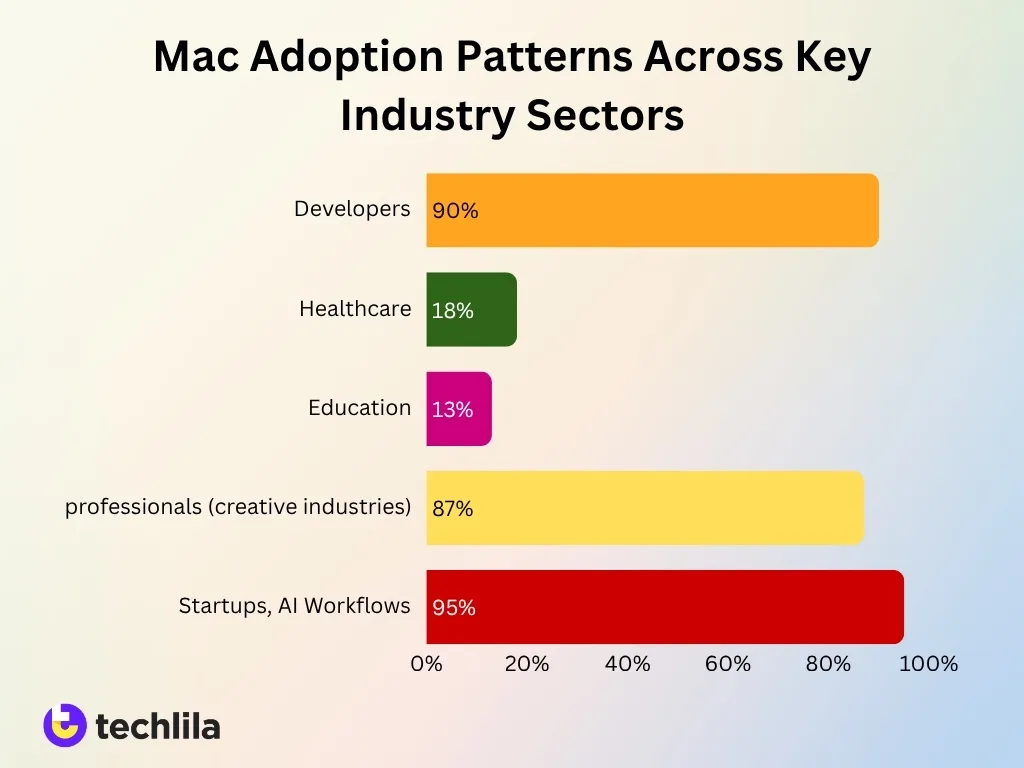
- Technology companies lead Mac adoption, with over 70% usage among developers.
- Financial services firms see 50% lower breach risk with Macs for secure endpoints.
- Healthcare enterprise Mac deployment rose 18%, prioritizing compliance and security.
- Education shipments of Macs grew 13% globally, aiding ecosystem integration.
- Creative industries show 87% Mac usage among professionals.
- Startups achieve 95% developer Mac usage for AI workflows.
- US enterprises report 11% Mac market share in 2025.
- 93% of CIOs note rising Mac adoption across the public sector.
Deployment and Onboarding Costs
- Zero-touch deployment reduces device setup time by up to 50%, accelerating onboarding.
- Enterprises report $200–$350 savings per device in onboarding costs with Macs.
- Mac devices ship with pre-configured profiles, cutting manual provisioning time by 30–40%.
- Automated enrollment reduces IT intervention during onboarding by 40%.
- Employees become operational within hours instead of days with Mac deployment workflows.
- Mac onboarding reduces training time by 20–30% due to intuitive UI.
- Enterprises report fewer onboarding errors, lowering rework and support costs.
- Remote onboarding efficiency improves significantly for distributed teams using Macs.
Resale Value Retention
- Macs retain 30–40% of their original value after 3 years, compared to 20–30% for PCs.
- High resale value contributes to lower effective lifecycle cost per device.
- Enterprises recover $300–$600 per Mac device during resale cycles.
- Apple hardware demand keeps secondary market prices stable over time.
- Macs depreciate more slowly than PCs due to longer usability and OS support cycles.
- Refurbished Mac markets grow annually, improving liquidation opportunities for enterprises.
- Enterprises report 15–20% higher asset recovery rates with Macs.
- Trade-in programs further enhance residual value realization for Mac fleets.
ROI and Savings Metrics
- Enterprises achieve ROI within 6–12 months of Mac deployment in many cases.
- Mac fleets deliver $843–$1,448 savings per device over three years.
- Cisco reported $395 savings per Mac device compared to PCs.
- Reduced downtime and support costs contribute to 20–30% overall IT savings.
- Employee productivity gains add $300–$500 per user annually in value.
- Security cost reductions contribute $100+ savings per device lifecycle.
- Lower staffing and management costs improve enterprise IT efficiency by up to 25%.
- Mac deployments show higher ROI in remote and hybrid work environments.
Enterprise Case Studies and ROI Metrics
- IBM reported $273–$543 savings per Mac device over its lifecycle.
- IBM saved $12 million annually in support costs after Mac adoption.
- SAP reported 20% lower IT support costs for Mac users.
- Cisco found Mac users required fewer support tickets and lower maintenance costs.
- Capital One reduced device provisioning time significantly with Mac deployment.
- Deloitte reported improved employee satisfaction and retention with Mac programs.
- Enterprises using Macs reported higher developer productivity and faster project delivery.
- Case studies consistently show positive ROI within the first year of deployment.
Frequently Asked Questions (FAQs)
Enterprises can save $843 to $1,448 per device over a 3-year lifecycle.
Around 96% of CIOs expect to grow Mac investments within the next 1–2 years.
Macs reduce IT support costs by $273–$543 per device on average.
Mac’s last about 6 years, while Windows PCs average around 3–4 years.
Conclusion
Enterprise Mac adoption continues to rise as organizations shift from upfront pricing to long-term value metrics. The data shows consistent savings across IT support, security, and device management, while also improving employee productivity and retention. Moreover, real-world case studies from companies like IBM and Cisco reinforce the financial and operational benefits of Mac fleets.
As hybrid work models expand and security risks evolve, enterprises increasingly prioritize devices that reduce complexity and cost over time. Macs now stand out not just as premium hardware, but as strategic assets in enterprise IT planning. With measurable ROI, lower lifecycle costs, and strong employee preference, Mac adoption will likely accelerate further in the coming years.

Leave a comment
Have something to say about this article? Add your comment and start the discussion.