





VLC ships two different default keymaps, and which one applies depends on the operating system. According to VideoLAN, the project behind VLC, its published hotkeys table covers the Qt interface used on Windows and Linux.
On macOS, VLC 3.0.23 instead binds fullscreen to Command+F, next track to Command+Right and the subtitle track cycle to S. The Qt interface puts fullscreen on F, next track on N and the subtitle track cycle on V. Most VLC shortcut articles publish one list, label a column “Mac” and fill it with the Windows keys. Every binding below is separated by platform and traced either to VideoLAN’s published QtHotkeys table or to VLC’s own shipped defaults.
Key Takeaways
- VLC uses a different default keymap on macOS than on Windows and Linux.
- VideoLAN publishes a bindings table for the Qt interface only, which covers Windows and Linux.
- On macOS, most VLC shortcuts take the
Commandkey rather thanCtrl. - Three chords,
Ctrl+M,Ctrl+PandCtrl+N, do different things on each platform. - The Hotkeys panel inside VLC Preferences always shows the bindings for that installation.
Why the macOS Column Is Wrong Nearly Everywhere
VideoLAN publishes exactly one hotkeys table, and according to VideoLAN that page covers the Qt 4 interface. Qt is what VLC runs on Windows and Linux. VLC on macOS uses a native Mac interface instead, with its own separate defaults, and no macOS bindings table exists on the wiki at all.
The wiki page describes itself as a reminder of the hotkeys in the Qt 4 Interface. A page called “Hotkeys table” does exist, but it redirects to that same Qt page. A writer building a four column table therefore has nothing official for the Mac column, and copying the Windows values across is the path of least resistance.
The macOS values below came from VLC itself. VLC 3.0.23 stores its defaults in its own configuration file, and that file carried 111 key bindings with 94 of them set to a default value. No configuration file is needed to check them. Per VideoLAN, the same list is visible in the application: on macOS open the VLC menu and choose Preferences, then select the Hot keys panel, while on Windows and Linux the same panel sits under Tools and then Preferences.
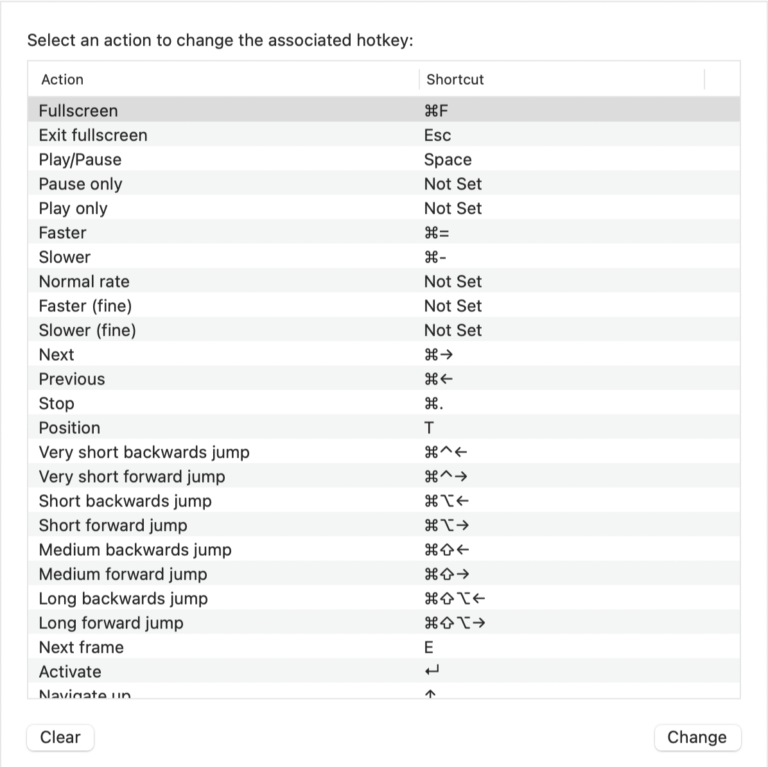
Key finding: VideoLAN’s only published hotkeys table covers the Qt interface, which VLC on macOS does not use. No macOS bindings table exists on the wiki at all. Every Mac binding in this reference was read from VLC 3.0.23’s own shipped defaults rather than inferred from the Windows list.
Platform matters more for VLC than for most desktop software. macOS now holds a double-digit share of the desktop market, as our macOS market share statistics show, so a wrong Mac column misleads a large minority of readers rather than a rounding error.
A note for Mac readers: Command (⌘), Control (⌃) and Option (⌥) are three different keys. In the macOS column below, Control means the Control key, not Command, and Option is the key a Windows keyboard labels Alt.
Playback Controls
Seven core playback actions carry a default binding, and four of them differ between Windows and macOS. Play or pause stays on Space everywhere. Fullscreen, stop, faster and slower all move to Command based chords on a Mac, according to VLC’s own shipped defaults, so a Windows habit transfers on only three of the seven.
Action | Windows and Linux | macOS |
|---|---|---|
Play or pause | Space | Space |
Toggle fullscreen | F | Command+F |
Leave fullscreen | Esc | Esc |
Stop | S | Command+. |
Play faster | + | Command+= |
Play slower | - | Command+- |
Next frame | E | E |
Source: VideoLAN QtHotkeys for Windows and Linux; VLC 3.0.23 shipped defaults for macOS.
The Qt interface adds fine speed steps on ] and [, and a return to normal rate on =. The macOS build leaves normal rate unbound by default. Stepping back down on a Mac therefore means repeating Command+- rather than resetting in a single key.
Volume and Muting
Three volume actions carry defaults on both Windows and macOS, and mute is the one that catches people out. Volume up and down simply swap Ctrl for Command on a Mac.
Action | Windows and Linux | macOS |
|---|---|---|
Volume up | Ctrl+Up | Command+Up |
Volume down | Ctrl+Down | Command+Down |
Mute | M | Command+Option+Down |
Source: VideoLAN QtHotkeys for the Windows and Linux bindings; VLC 3.0.23 shipped defaults for macOS.
The Qt interface mutes on a single M, while the macOS build maps mute to Command+Option+Down. The two platforms share no key on this row, so the Windows reflex has no Mac equivalent to fall back on.
Seeking and What Each Jump Actually Moves
VLC names its seek keys by size rather than by duration, and the four sizes map to settings that ship at 3, 10, 60 and 300 seconds. Per VideoLAN, the Qt interface places them on Shift, Alt, Ctrl, and Ctrl with Alt, each combined with a left or right arrow key.
View the data
Swapping Right for Left jumps backward on every row. The four default durations ship as 3, 10, 60 and 300 seconds.
Worth noting: The extra short jump is the one row where VideoLAN’s documentation and the shipped application disagree. The wiki describes Shift and an arrow as a 5-second jump, while VLC 3.0.23 ships an extra short jump size of 3 seconds. The wiki page is the older Qt 4 document, so the running application governs.
Tracks and Chapters Are Not the Same Thing
Confusing tracks with chapters is the single most copied error in VLC shortcut lists, because N and P do not move between chapters. Those two keys move between tracks, which are separate files in the playlist. Chapters are markers inside one file, and they sit on Shift plus N and Shift plus P.
Action | Windows and Linux | macOS |
|---|---|---|
Next track | N | Command+Right |
Previous track | P | Command+Left |
Next chapter | Shift+N | Control+D |
Previous chapter | Shift+P | Control+U |
Next title | Shift+B | Control+N |
Previous title | Shift+O | Control+P |
Disc menu | Shift+M | Control+M |
Source: VideoLAN QtHotkeys for the Windows and Linux bindings; VLC 3.0.23 shipped defaults for macOS.
On the Qt interface, N and P move between tracks, while chapters move on Shift+N and Shift+P. Skipping ahead in a ripped disc is a chapter operation, which is why the distinction matters in practice.
Subtitles and Audio
Eight subtitle and audio actions carry defaults on Windows and macOS, and only one of the eight uses the same key on each. This is where a Windows list does the most damage on a Mac, because several keys exist on both platforms while pointing at completely different actions.
Action | Windows and Linux | macOS |
|---|---|---|
Cycle subtitle track | V | S |
Toggle subtitles on or off | Shift+V | Shift+S |
Subtitle delay up | H | J |
Subtitle delay down | G | H |
Cycle audio track | B | L |
Audio delay up | K | G |
Audio delay down | J | F |
Cycle audio device | Shift+A | Shift+A |
Source: VideoLAN QtHotkeys for the Windows and Linux bindings; VLC 3.0.23 shipped defaults for macOS.
On the Qt interface, H raises the subtitle delay and G lowers it, V cycles the subtitle track and Shift+V toggles subtitles on or off. The macOS build puts those same four actions on J, H, S and Shift+S.
The overlap is what makes this section dangerous. H exists on both platforms and lowers the subtitle delay on Windows while raising it on a Mac. J lowers the audio delay on Windows and raises the subtitle delay on a Mac. A Windows list fails quietly here, adjusting the wrong thing in the wrong direction. Readers fighting subtitle files rather than delays may find our guide to downloading subtitles more useful than any keybinding.
Video Adjustments
Six video adjustment actions carry defaults, and the four plain letter keys survived the move from Windows to macOS unchanged. Aspect ratio, crop, deinterlacing and zoom sit on A, C, D and Z on every platform. Only the two actions that write a file to disk, snapshot and record, take different chords on a Mac.
Action | Windows and Linux | macOS |
|---|---|---|
Cycle aspect ratio | A | A |
Cycle crop | C | C |
Toggle deinterlacing | D | D |
Zoom | Z | Z |
Take a snapshot | Shift+S | Command+Option+S |
Record | Shift+R | Command+Shift+R |
Source: VideoLAN QtHotkeys for the Windows and Linux bindings; VLC 3.0.23 shipped defaults for macOS.
The Qt interface puts snapshot on Shift+S and record on Shift+R, with aspect ratio on A, cropping on C and deinterlacing on D. Keeping file operations on Command matches the wider Mac convention.
Playlist and Interface
Three playlist actions carry a documented default on Windows and Linux, and clearing the playlist is bound there while the macOS build leaves it unbound. Shuffle and repeat both exist on each platform, but neither uses the same key, so this is another section where a Windows habit transfers badly.
Action | Windows and Linux | macOS |
|---|---|---|
Shuffle or random | R | Command+Z |
Loop or repeat | L | Shift+L |
Clear the playlist | Ctrl+W | not bound |
Source: VideoLAN QtHotkeys for the Windows and Linux bindings; VLC 3.0.23 shipped defaults for macOS.
On the Qt interface, R turns on random playback and L cycles normal, loop and repeat, while Ctrl+X loads a playlist and Ctrl+Y saves one.
Shortcuts Commonly Listed Incorrectly
Six bindings appear across VLC shortcut lists, including the earlier version of this reference, attached to actions they do not perform. Ctrl and M is the most repeated of them. It does not minimize VLC on either platform, and what it does instead depends entirely on which operating system is running.
| Commonly claimed | What it actually does |
|---|---|
Ctrl+M minimizes VLC | opens the Messages window on the Qt interface. opens the disc menu on macOS |
Ctrl+P opens the playlist sidebar | opens Preferences on the Qt interface. goes to the previous DVD title on macOS |
Ctrl+S saves a playlist | opens the streaming dialog |
R repeats the playlist | turns on random playback, while L cycles normal, loop and repeat |
A cycles audio devices | cycles the aspect ratio. Audio device is Shift+A |
Ctrl and + resize the interface | Not a VLC binding on either platform |
Source: VideoLAN QtHotkeys and Documentation: Hotkeys; VLC 3.0.23 shipped defaults for the macOS column.
Ctrl+M and Ctrl+P cause the most confusion, because both are bound on both platforms and to unrelated features. Pressing Ctrl+P on a Mac while expecting Preferences jumps to the previous DVD title instead.
How do I see my own VLC shortcuts?
The Hotkeys panel inside Preferences lists every action with its current binding. VideoLAN documents both routes: the VLC menu on macOS, and Tools then Preferences on Windows and Linux. Double clicking a row records a new key. That panel is the authority for any single installation, because any binding in any article can be overridden locally.
Do these shortcuts work in VLC on Android and iOS?
No. The mobile apps use touch gestures rather than a keyboard, so a swipe or a tap is not a shortcut in the sense this reference uses. Attaching a hardware keyboard to a tablet does not restore the desktop keymap either.
If you also run Kodi, see our best Kodi skins.
Conclusion
VLC keyboard shortcuts repay learning, provided the list matches the platform in use. On Windows and Linux most controls sit on single letters. On macOS most of them moved to Command, and several single letters were reassigned to different actions entirely.
The safest habit is to treat any published VLC shortcut list as a starting point, then confirm the handful used most often in the Hotkeys panel. Readers who enjoy reshaping VLC further can carry on with VLC skins, and anyone moving from playback into editing can compare lightweight video editors.

Leave a comment
Have something to say about this article? Add your comment and start the discussion.