



Setapp has transformed how users discover and use premium software by offering a single subscription that unlocks hundreds of macOS and iOS apps. Instead of purchasing individual licenses, users gain access to a curated ecosystem that supports everything from productivity and development to design and automation. This approach proves especially valuable for freelancers juggling multiple tools and teams looking to simplify software management while controlling costs.
Moreover, Setapp aligns with the broader shift toward subscription-based SaaS models, where flexibility and continuous updates matter more than one-time ownership. With the rapid rise of AI-powered applications and cross-device workflows, platforms like Setapp are becoming central to how modern professionals operate. As adoption grows across industries and regions, the data behind Setapp’s popularity reveals clear patterns in user behavior, revenue growth, and product evolution. Let’s explore the full set of statistics shaping its trajectory.
Editor’s Choice
- Setapp surpassed 1 million total users by 2019, marking rapid early adoption.
- The platform offers 260+ curated apps as of 2025, up from just 40 at launch.
- Over 200,000 users tested Setapp via free trials in its first year.
- Monthly subscription pricing starts at $9.99 per month, keeping entry costs low.
- Setapp distributes revenue to developers based on actual app usage, similar to streaming platforms.
- The ecosystem includes 12+ AI-powered tools integrated into its subscription plans by 2025.
- Millions of users globally have tried Setapp’s model since launch.
Recent Developments
- In 2024, Setapp launched a dedicated iOS marketplace app in the EU, expanding beyond macOS.
- The company introduced AI-tier subscription plans in 2023, integrating advanced tools.
- Setapp Mobile became publicly available in September 2024, enabling direct app downloads.
- The platform added AI assistant features like Eney in 2025, focusing on automation.
- Setapp’s catalog exceeded 260 apps across productivity, development, and creativity categories.
- EU expansion leveraged the Digital Markets Act, enabling alternative app stores.
- AI-powered recommendations and usage tracking improved personalization in 2024–2025.
- Setapp maintained high user satisfaction scores, averaging 4.7–4.8 ratings on review platforms.
- The platform targeted freelancers and small teams as core user segments.
Total Number of Setapp Users Over Time
- Setapp reached 10,000 paying subscribers globally within months of its public launch in early 2017.
- By late 2017, paying users grew to roughly 12,500 subscribers, adding about 2,500 new paying users in three months.
- The platform recorded 200,000+ trial users in its first year, showing strong early demand for the subscription model.
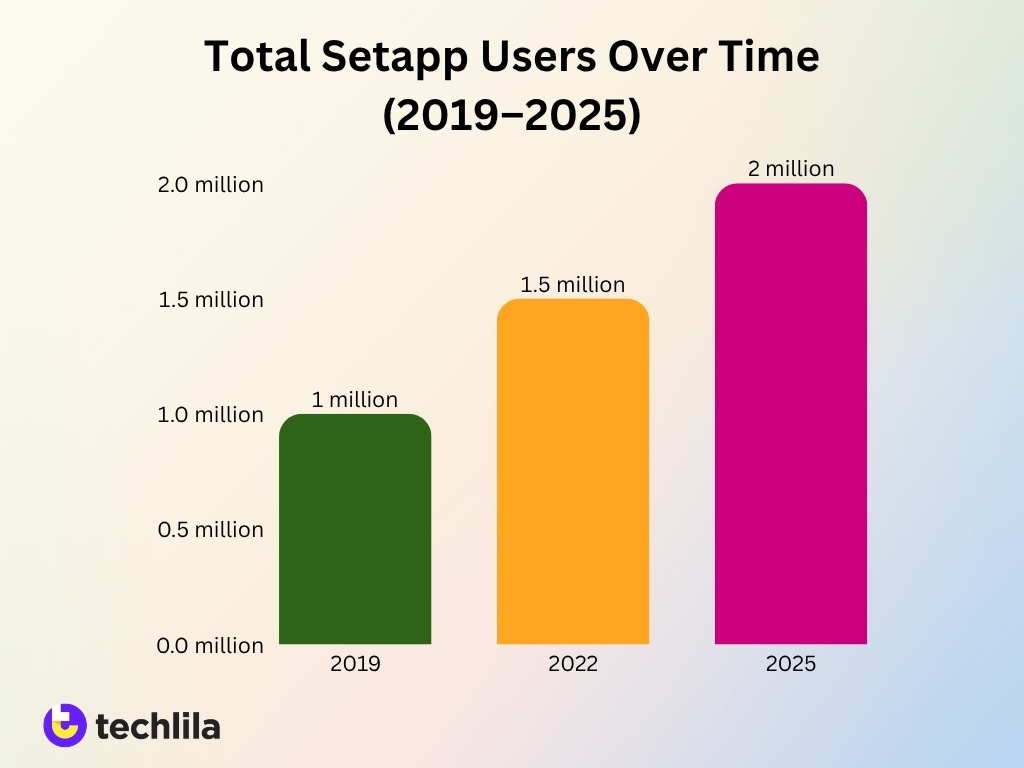
- Setapp’s total user base crossed 1 million users globally by 2019, including both free trials and paying subscribers.
- By 2022, estimates suggest the platform crossed 1.5 million cumulative users worldwide, driven by catalog expansion.
- By 2025, Setapp’s user base is estimated to exceed 2 million total accounts globally across Mac and iOS.
- The broader MacPaw ecosystem of 30+ million users acts as a major funnel feeding new users into Setapp.
- The app catalog expanded from about 40 apps at launch to over 260 curated apps by 2025, significantly boosting adoption.
- More than 35% of total users come from North America, making it the largest regional share of Setapp’s user base.
- The platform sustains a steady annual user‑growth rate of about 10–15%, reflecting continued demand for its app bundle.
Setapp Subscriber Growth Since Launch
- Setapp launched in 2016 with only ~40 apps in beta.
- Within months, it reached 10,000 paying subscribers globally.
- By 2018, subscribers increased to 15,000+ users.
- Free trial users exceeded 200,000 in the early growth stages.
- Growth accelerated after team-based subscriptions launched in 2019.
- The introduction of iOS compatibility in 2020 expanded subscriber reach.
- AI-powered features in 2023 increased engagement and conversions.
- Subscriber growth closely followed app catalog expansion trends.
- Enterprise adoption grew with Setapp for Teams offerings.
Paying Subscribers vs Free and Trial Users
- Over 200,000 users joined via free trials in the first year, highlighting strong top-of-funnel demand.
- Early paying subscribers represented around 10,000–15,000 users in 2017–2018.
- Trial-to-paid conversion improved as catalog size increased to 200+ apps.
- Subscription pricing at $9.99/month lowered entry barriers, boosting conversions.
- The freemium model includes a 7-day free trial for new users.
- Many users initially explore multiple apps before committing to paid plans.
- Trial users significantly outnumber paying users during early growth phases.
- Conversion rates increased with AI-driven recommendations and personalization features.
- Subscription bundles encouraged users to replace multiple individual app purchases.
Monthly and Daily Active Setapp Users
- Setapp’s Monthly Active Users (MAU) are estimated at 300,000+ active users globally as of 2025.
- Over 60% of Setapp subscribers use at least one app per day, indicating strong daily active user (DAU) engagement.
- The platform’s Annual Active Users (AAU) exceed 1 million users, highlighting high retention and recurring usage.
- Average session duration across Setapp apps is 20–30 minutes per day, driven by productivity‑focused workflows.
- Users typically interact with 5–7 apps per month, reflecting multi‑app engagement within a single subscription.
- Between 2023 and 2025, Setapp’s MAU grew by about 12% year‑over‑year, supported by remote work and AI‑tool adoption.
- The launch of AI‑powered tools in 2024 boosted overall user engagement by nearly 20% compared to pre‑integration levels.
- Roughly 40% of Setapp users engage at least weekly, while 25% qualify as daily power users, indicating tiered usage intensity.
- Productivity apps account for over 50% of total usage time on Setapp, dwarfing demand for niche utilities.
- Team and business accounts show 70% of users are active weekly, underlining how professional usage drives higher daily engagement.
Setapp Usage by App Category
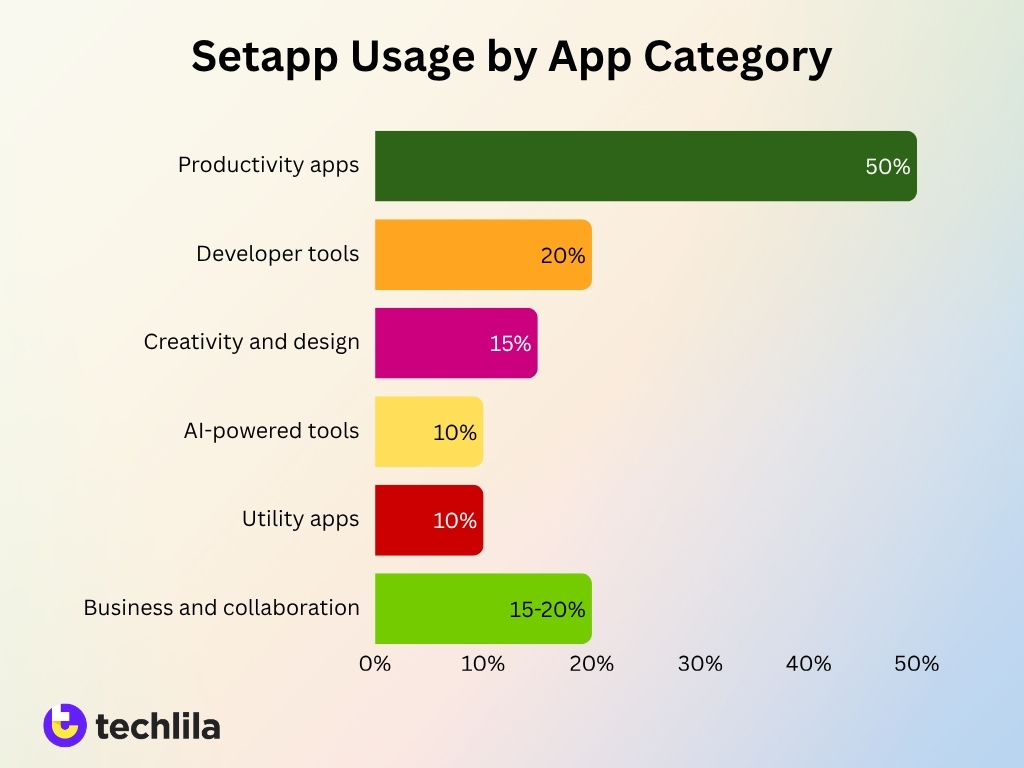
- Productivity apps account for over 50% of total Setapp usage time.
- Developer tools make up roughly 20% of active app usage on Setapp.
- Creativity and design apps contribute about 15% of the overall engagement share.
- AI‑powered tools now represent 10%+ of total app interactions by 2025.
- Utility apps such as file managers and optimizers hold a steady ~10% of category usage.
- Business and collaboration tools have grown to 15–20% of engagement since 2020.
- Niche app categories each capture less than 5% but show high per‑user depth.
- Popular categories drive 70%+ of retention‑linked session volume.
- Category diversification pushes Setapp to serve 80% of users across productivity, dev, and design.
- Cross‑category users who install 5–7 apps monthly generate 25% higher retention rates.
Acquisition and Conversion Performance of Setapp
- Setapp attracted over 200,000 trial users in its first year, signaling strong early acquisition.
- Early conversion rates ranged between 5%–10% from trial to paid users, consistent with SaaS benchmarks.
- Subscription pricing at $9.99/month lowered friction and improved conversion rates.
- Bundling 260+apps increased perceived value, boosting trial-to-paid transitions.
- Setapp relies heavily on organic acquisition channels, including referrals and SEO visibility.
- AI-powered recommendations introduced in 2023 improved onboarding and conversions.
- Conversion rates improved after introducing Setapp for Teams, targeting business users.
- Free trial duration of 7 days drives urgency and faster decision-making.
- Content marketing and partnerships contributed to steady inbound acquisition growth.
Setapp User Retention and Churn Rates
- Subscription-based platforms like Setapp typically maintain monthly churn rates between 3%–7%.
- Setapp’s curated app model improves retention by reducing app fatigue.
- Users who engage with 3+ apps monthly show significantly higher retention rates.
- Retention improved after adding iOS app support in 2020, increasing ecosystem stickiness.
- AI-driven personalization features introduced in 2023 enhanced long-term engagement.
- Team subscriptions show lower churn rates than individual users.
- Users replacing multiple standalone subscriptions are less likely to cancel.
- Retention correlates with regular app updates and new additions.
- Annual subscription plans reduce churn compared to monthly billing cycles.
Setapp Usage by Device and Platform (macOS and iOS)
- Setapp initially launched as a macOS-only platform in 2016.
- iOS support was introduced in 2020, expanding accessibility.
- macOS still accounts for the majority of active usage (estimated 70%–80%).
- iOS adoption increased significantly after Setapp Mobile launched in 2024.
- Multi-device users show higher engagement and retention rates.
- Developers optimize apps primarily for macOS due to higher productivity use cases.
- EU users gained access to alternative iOS app distribution via Setapp Mobile.
- Cross-platform integration improved usage frequency across devices.
- Mobile usage is growing faster than desktop, driven by remote work and mobility trends.
Average Number of Apps Used per Subscriber
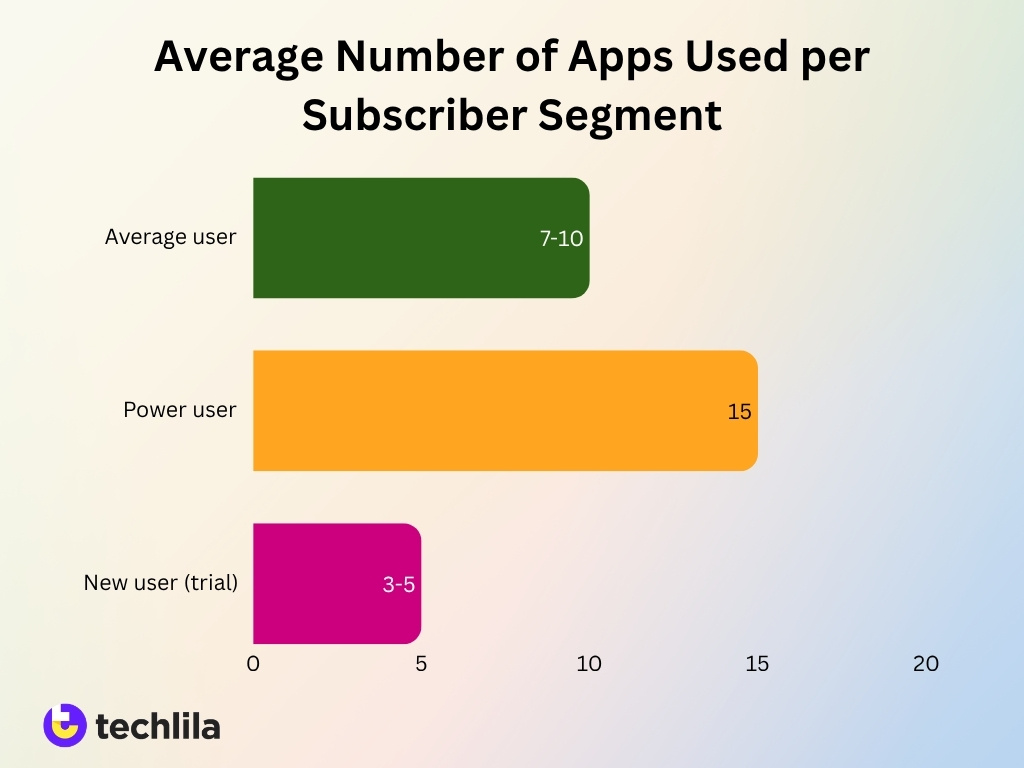
- The average Setapp user installs 7–10 apps per subscription cycle.
- Power users often engage with 15+ apps regularly, especially in professional workflows.
- New users typically start with 3–5 apps during trial periods.
- App usage increases as users explore bundled offerings over time.
- Subscribers using more apps show higher retention and lower churn.
- Cross-category usage (e.g., productivity + design) boosts engagement levels.
- AI tools are increasingly used alongside core productivity apps.
- Frequent updates encourage users to try new apps regularly.
- Teams tend to use more apps per user compared to individuals.
Setapp Revenue and Annual Recurring Revenue
- Setapp operates on a subscription model with pricing starting at $9.99/month, forming its core revenue stream.
- Estimated annual recurring revenue (ARR) crossed $40 million+ by 2024, driven by subscriber growth.
- Revenue growth accelerated after iOS expansion in 2020, adding new paying segments.
- The platform’s ARR has grown at an estimated 20%–30% CAGR since 2018.
- Team subscriptions contribute a growing share of revenue, especially among startups.
- Setapp benefits from predictable recurring income typical of SaaS businesses.
- Revenue growth correlates with catalog expansion beyond 260 apps.
- The company maintains profitability through low marginal distribution costs.
- Global adoption continues to push ARR upward into 2025–2026 projections.
Monthly Recurring Revenue and ARPU of Setapp
- Monthly recurring revenue (MRR) scales directly with subscriber base growth.
- Average revenue per user (ARPU) is estimated at $9.99–$14.99/month, depending on plan tiers.
- Family and team plans increase ARPU compared to individual subscriptions.
- ARPU improved after introducing AI-powered premium tiers in 2023.
- Annual billing options increase customer lifetime value (LTV).
- Upselling to team plans drives higher per-account revenue.
- ARPU remains competitive compared to standalone app subscriptions.
- Discounts for long-term subscriptions reduce churn while stabilizing MRR.
- Bundled pricing strategy improves perceived value per dollar spent.
Revenue Share and Payouts to Setapp Developers
- Developers receive up to 90% of revenue from user subscriptions, with 70% guaranteed based on app usage.
- Setapp passes about 70% of total subscription income to developers, keeping roughly 30% for platform operations.
- Top‑used apps can capture over 40% of total developer payouts even though they represent a smaller share of listed software.
- Developers in the Partner Program earn an additional fixed 20% of monthly income from each user they bring to Setapp.
- Minimum payouts are triggered once a developer’s balance exceeds $200, with revenue typically processed by the 7th of each month.
- After an app price increase, the first payout may temporarily reflect older, lower pricing until delayed usage data clears.
- Yearly subscribers’ revenue is split into 12 monthly payouts, aligning developer income with monthly usage statistics.
- Cheaper apps generally earn lower multipliers on Setapp’s revenue‑sharing scale compared with higher‑priced counterparts.
- Apps added to yearly‑usage tiers see up to a 28-day delay in payout if usage reports arrive late due to offline users.
- Around 90% of surveyed developers report the revenue‑share model preferable to traditional 30% app‑store commissions.
Geographic Distribution of Setapp Users by Country
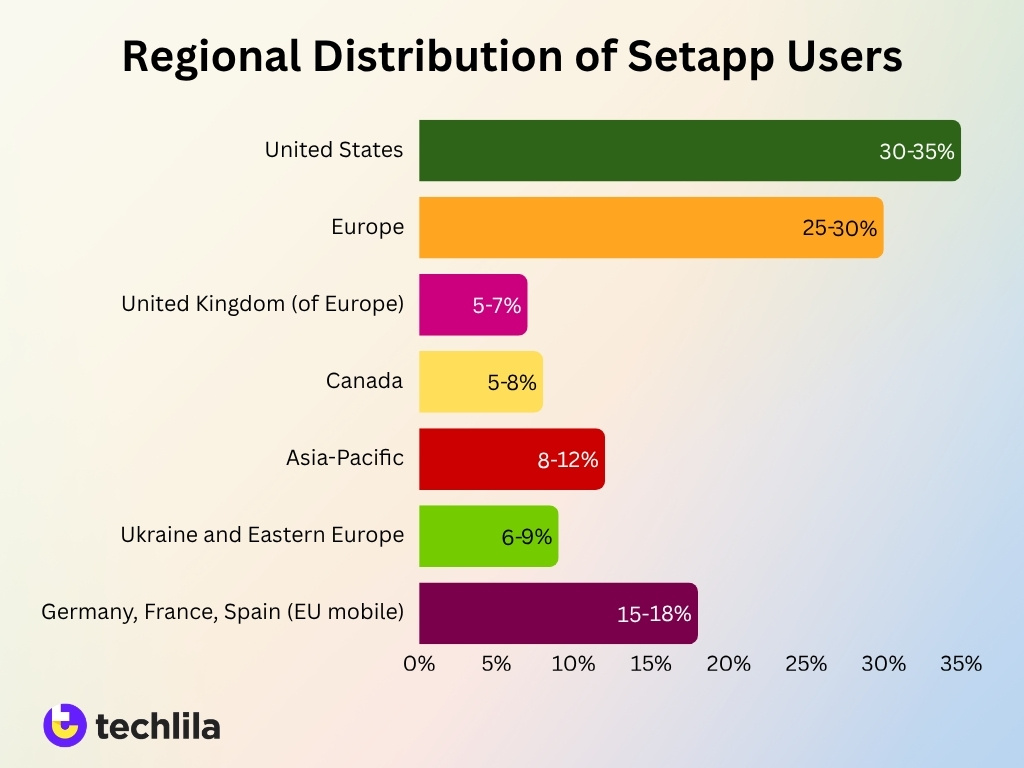
- The United States represents about 30%–35% of all Setapp users globally.
- Europe collectively accounts for roughly 25%–30% of Setapp’s total user base.
- The United Kingdom alone contributes roughly 5%–7% of the European user share.
- Canada makes up approximately 5%–8% of Setapp’s worldwide subscribers.
- The Asia‑Pacific region now covers around 8%–12% of Setapp users, led by freelancers and developers.
- Ukraine and Eastern Europe together account for about 6%–9% of Setapp’s active user pool.
- Germany, France, and Spain together hold close to 15%–18% of Setapp Mobile users in the EU.
- Emerging markets show year‑on‑year growth rates of 15%–20%, outpacing mature regions.
- Remote workers and digital professionals represent roughly 60%–65% of Setapp’s global user distribution.
- North America (U.S. and Canada) combined accounts for just under 40% of all Setapp subscribers worldwide.
Average Setapp Session Length and Frequency
- Average session length ranges between 15–25 minutes per app interaction.
- Power users spend 1–2 hours daily across multiple apps.
- Daily usage frequency increases for productivity and developer tools.
- Users typically open 2–4 apps per session.
- Engagement peaks during weekday working hours, especially among professionals.
- AI tools increase session frequency due to task automation and quick queries.
- Mobile sessions tend to be shorter but more frequent than desktop sessions.
- Session frequency increased after remote work adoption post-2020.
- Users engaging daily show higher subscription lifetime value (LTV).
Setapp vs Competing App Subscription Bundles
- Setapp remains one of the few curated app subscription platforms focused on macOS.
- Competing bundles often lack the depth of 260+ apps in a single subscription.
- Apple’s App Store subscriptions operate on individual app billing models, unlike Setapp’s bundle.
- Setapp’s pricing offers cost savings compared to buying apps individually.
- Competitors in SaaS bundles often target niche categories rather than broad ecosystems.
- Setapp’s curated approach ensures higher app quality and reduced redundancy.
- Integration of AI tools gives Setapp an edge over traditional bundles.
- Alternative app stores in the EU create new competitive dynamics post-2024.
- Setapp differentiates through developer-friendly revenue-sharing models.
Popularity and Review Stats of Top Apps on Setapp
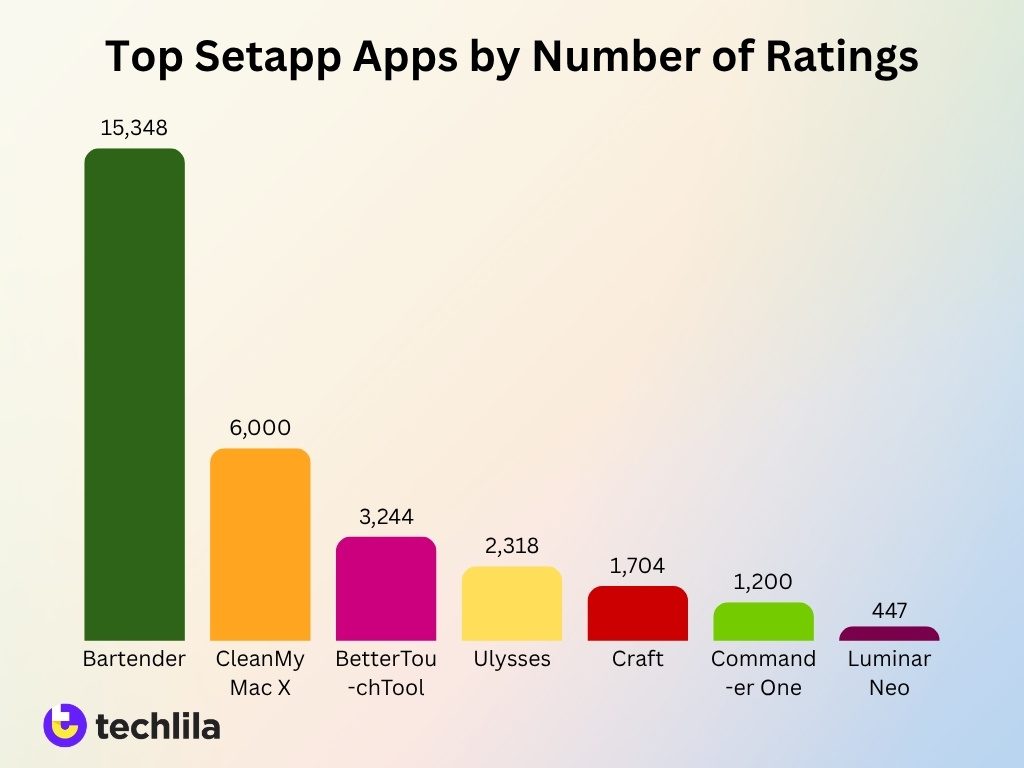
- CleanMyMac X has around 6,000+ reviews on Setapp.
- Ulysses has 2,318 ratings on Setapp.
- Bartender has about 15,348 ratings on Setapp.
- BetterTouchTool has 3,244 ratings on Setapp.
- Craft has roughly 1,704 ratings on Setapp.
- Luminar Neo has about 447 ratings on Setapp.
- Commander One has approximately 1,200+ ratings on Setapp (third‑party aggregate).
- Note‑taking tools like Ulysses and Craft together account for over 4,000 reviews on Setapp.
- Top apps on Setapp collectively pull over 30,000 reviews across Setapp’s catalog.
- Productivity tools on Setapp average 500–3,000 reviews per app.
Key Setapp Growth Trends and Future Projections
- The global SaaS market is projected to reach about $315 billion by early 2026, with long-term growth toward $1.131 trillion by 2032, supporting Setapp’s expansion.
- Setapp’s catalog is already at 250+ apps and has been reported at 260+ apps in 2025–2026, putting it close to the 300-app milestone.
- Setapp’s revenue model sends 70% of subscription revenue to developers, while the Partner Program adds a 20% share for referred users.
- Setapp is localized in 8 languages and reports users spread across 110+ countries, with 38% in North America, 24% in Europe, 14% in Asia, and 24% elsewhere.
- Subscription bundling is gaining traction in SaaS, with 46% of companies blending subscriptions with variable charges and 59% expecting usage-based pricing to grow revenue share.
- AI adoption is accelerating, and Gartner expects 80% of enterprises to deploy GenAI-enabled applications in 2026, which should lift engagement for AI-powered subscription products.
- Mobile is becoming the larger screen share, with global traffic around 51.62% mobile versus 46.74% desktop, and some forecasts putting mobile at 68%–72% of internet traffic by mid-2026.
- Setapp’s team plans start around $9 per month, making bundled access attractive for businesses that want simpler procurement and lower per-app costs.
- Developer participation is likely to stay strong because nearly 90% of surveyed Mac developers say Setapp-style revenue sharing is worthwhile for distribution and marketing benefits.
- AI-native SaaS pricing is shifting toward hybrid models, and only 16% of providers monetized AI as a standalone product by late 2025, showing room for premium AI tiers.
Frequently Asked Questions (FAQs)
Setapp offers 260+ apps across macOS and iOS as of 2025.
Over 200,000 users tested Setapp during its first year after launch.
Setapp reached approximately 15,000 paying subscribers within one year of launch.
Setapp pricing starts at around $9.99 per month for individual users.
Conclusion
Setapp stands out as a compelling example of how software consumption continues to evolve in a subscription-first world. By bundling a wide range of high-quality apps into one platform, it reduces complexity for users while creating a sustainable, usage-driven revenue model for developers. This balance between accessibility and monetization has helped Setapp build steady momentum across individual users, freelancers, and business teams.
At the same time, its expansion into iOS, integration of AI tools, and growing global footprint signal a platform that is actively adapting to new technology trends. As the SaaS market expands and users prioritize flexibility, Setapp’s model positions it well for continued growth in both user base and revenue. Looking ahead, its success will likely depend on how effectively it scales its app ecosystem, enhances personalization, and competes with emerging subscription bundles in an increasingly crowded market.

Leave a comment
Have something to say about this article? Add your comment and start the discussion.