


Apple’s Mac lineup continues to reshape the global PC market, driven by in-house silicon and premium positioning. Businesses rely on Macs for creative workflows like video editing and app development, while enterprises adopt them for security and long-term cost efficiency. As shipments grow and market share expands, Mac sales offer a clear lens into broader PC industry trends. Let’s explore the data in detail.
Editor’s Choice
- Apple shipped 25.6 million Macs in 2025, up from 23.0 million in 2024 (11.1% growth).
- Mac’s global market share reached ~9.0% in 2025, rising from 8.7% in 2024.
- Apple shipped 7.1 million Macs in Q4 2025, holding 9.3% share.
- Q2 2025 Mac shipments grew 21.4% YoY, the fastest among major PC brands.
- Mac sales revenue reached $8.7 billion in a single quarter (Q4 2025).
- Apple held 4th position globally, behind Lenovo, HP, and Dell.
- Mac sales accounted for ~8.3% of Apple’s total revenue in 2025.
Recent Developments
- Apple introduced M4-powered MacBook Pro and MacBook Air models (2024–2025 cycle), boosting demand.
- Mac shipments increased 14.1% in Q1 2025, outperforming most competitors.
- Apple’s Mac business grew 6.7% YoY in fiscal Q2 2025, reaching $7.95 billion.
- Q3 2025 Mac shipments hit 6.8 million units, up from 6.0 million in 2024.
- Mac growth reached 13.7% YoY in Q3 2025, outpacing overall PC growth.
- Apple’s share rose to 9.1% in Q2 2025, up from 8.0% the previous year.
- Growth slowed in late 2025, with only 0.2% YoY increase in Q4 shipments.
- Apple saw double-digit growth earlier in 2025 but plateaued post-holiday cycle.
Apple Mac Q1 Revenue Trends
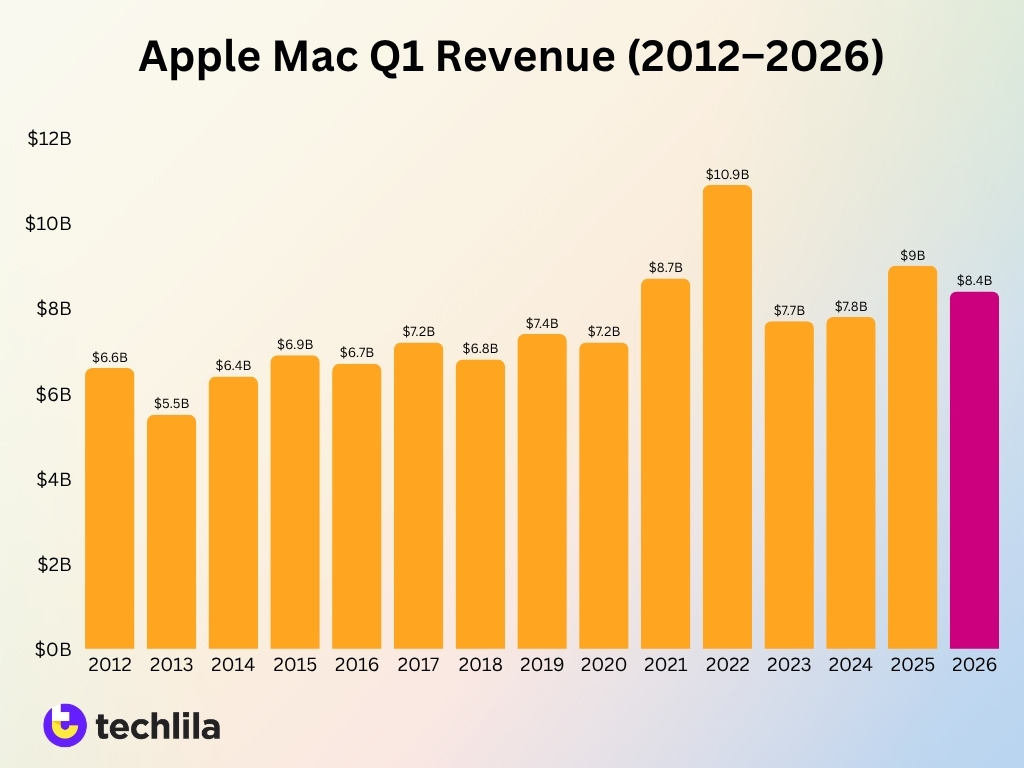
- Apple’s Mac Q1 revenue shows a long-term upward trajectory, rising from $6.6B in 2012 to $8.4B in 2026, reflecting sustained growth despite fluctuations.
- The lowest revenue point occurred in 2013 at $5.5B, followed by a steady recovery phase over the next few years.
- Between 2014 and 2019, Mac revenue remained relatively stable, fluctuating within the $6.4B to $7.4B range, indicating a mature but consistent product segment.
- A major growth surge began in 2021, with revenue jumping to $8.7B, driven by increased demand and product innovation.
- The peak performance was recorded in 2022 at $10.9B, marking the highest Q1 Mac revenue in the entire period.
- Post-peak, revenue saw a decline to $7.7B in 2023, indicating a market correction after the surge.
- Recovery signs appeared in 2024 and 2025, with revenues rising to $7.8B and $9.0B, respectively.
- However, 2026 shows a slight dip to $8.4B, suggesting moderation after recent growth momentum.
- Overall, Mac revenue demonstrates a cyclical growth pattern, with periodic spikes and corrections, rather than linear growth.
- The data highlights that Apple’s Mac segment is resilient, maintaining a baseline above $6B annually while achieving occasional breakout years exceeding $9B+.
Desktop vs Laptop Sales Breakdown
- MacBooks account for approximately 75–80% of Apple’s total Mac sales globally, with desktop Macs representing the remaining 20–25% share.
- Apple shipped 25.6 million Macs in 2025, representing an 11.1% year-over-year growth from 23.0 million units in 2024.
- MacBook Air M3 delivers up to 18 hours of battery life, weighs just 2.7 lbs, and starts at $1,299, making portability a key differentiator for laptop-segment growth.
- HP holds 32% of consumer laptop brand preference, followed by Apple at 28%, demonstrating MacBooks’ dominance in the premium segment.
- Desktop models like Mac mini and Mac Studio together comprise approximately 1% of total Mac sales, while the Mac Pro accounts for roughly 3% of sales.
- Apple’s Mac segment generated $7.5 billion in Q1 2024, reflecting 20.6% year-over-year growth driven by premium-priced models like the 15-inch MacBook Air with M2.
- TrendForce projects Apple’s notebook shipments will grow 7.7% in 2026, lifting macOS market share to 13.2% globally.
- Windows maintains 68.27% of the global desktop and laptop market share, while macOS commands 31.94% of the U.S. market alone, indicating strong educational and enterprise laptop adoption in America.
Mac Market Share Analysis
- Apple held ~9.0% global PC market share in 2025, up from 8.7% in 2024.
- Mac share peaked at 9.3% in Q4 2025, reflecting strong holiday demand.
- In Q2 2025, Apple reached 9.1% share, driven by M-series upgrades.
- Mac market share grew steadily from ~7.6% in 2022 to ~9% in 2025, showing long-term expansion.
- Apple ranked 4th globally among PC vendors in 2025.
- The U.S. market shows higher penetration, with Macs reaching ~15–17% share in some quarters.
- Apple gained share while the overall PC market grew ~8.1% in 2025, indicating above-market performance.
- Mac share growth correlates with Apple silicon adoption and ecosystem integration.
Mac Market Position vs Competitors
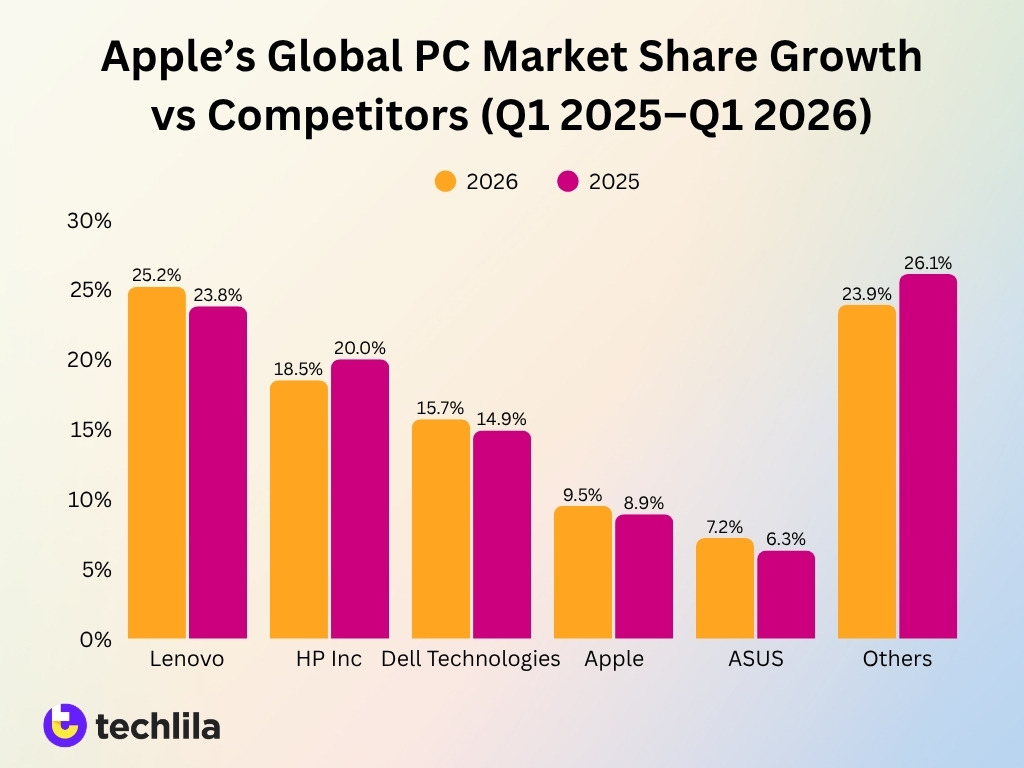
- Apple increased its market share to 9.5% in Q1 2026, up from 8.9% in Q1 2025, reflecting a +0.6 percentage point gain.
- Among the top 5 PC vendors, Apple recorded one of the strongest growth trajectories, outperforming major competitors like HP Inc (down to 18.5% from 20.0%).
- Lenovo remains the market leader with 25.2% share in Q1 2026, widening its lead from 23.8% in Q1 2025, maintaining a dominant position over Apple.
- Dell Technologies also grew moderately, increasing from 14.9% to 15.7%, but it still stays significantly ahead of Apple in total market share.
- Apple continues to hold a niche but growing premium segment, with its 9.5% share placing it 4th globally, ahead of ASUS (7.2%).
- The gap between Apple and Dell (~6.2 percentage points) highlights Apple’s position as a strong but not yet top-tier volume player in the global PC market.
- ASUS saw notable growth (6.3% → 7.2%), but still trails Apple, reinforcing Apple’s competitive edge in the mid-to-premium segment.
- The “Others” category declined significantly (26.1% → 23.9%), indicating market consolidation toward top brands, which benefits players like Apple.
- Overall, Apple is gaining share in a competitive market, strengthening its position as a premium-focused PC manufacturer with steady upward momentum.
MacBook Revenue Trends
- MacBook sales drive the majority of Mac revenue contribution annually (~75%).
- MacBook demand surged after the M-series chip transition (2020–2025).
- MacBook Pro models contribute higher revenue due to premium pricing tiers.
- MacBook Air remains the top-selling Mac device globally.
- Revenue growth aligns with enterprise upgrades and developer adoption.
- MacBook shipments grew double digits in multiple 2025 quarters.
- AI-capable chips (M4) are expected to drive the next upgrade cycle in 2026.
- MacBook revenue benefits from higher ASP compared to Windows laptops.
Mac Desktop Revenue Trends
- Desktop Macs contribute ~20–25% of total Mac revenue.
- Mac Studio and Mac Pro boosted high-end desktop revenue segments.
- iMac remains a key all-in-one product for education and business users.
- Desktop revenue grows more slowly than laptops due to lower upgrade frequency.
- Professional desktops maintain high margins due to premium configurations.
- Desktop demand is concentrated in creative and enterprise workstation use cases.
- Mac mini drives entry-level desktop adoption due to affordability.
- The desktop segment remains stable despite overall PC market fluctuations.
Mac Revenue by Region
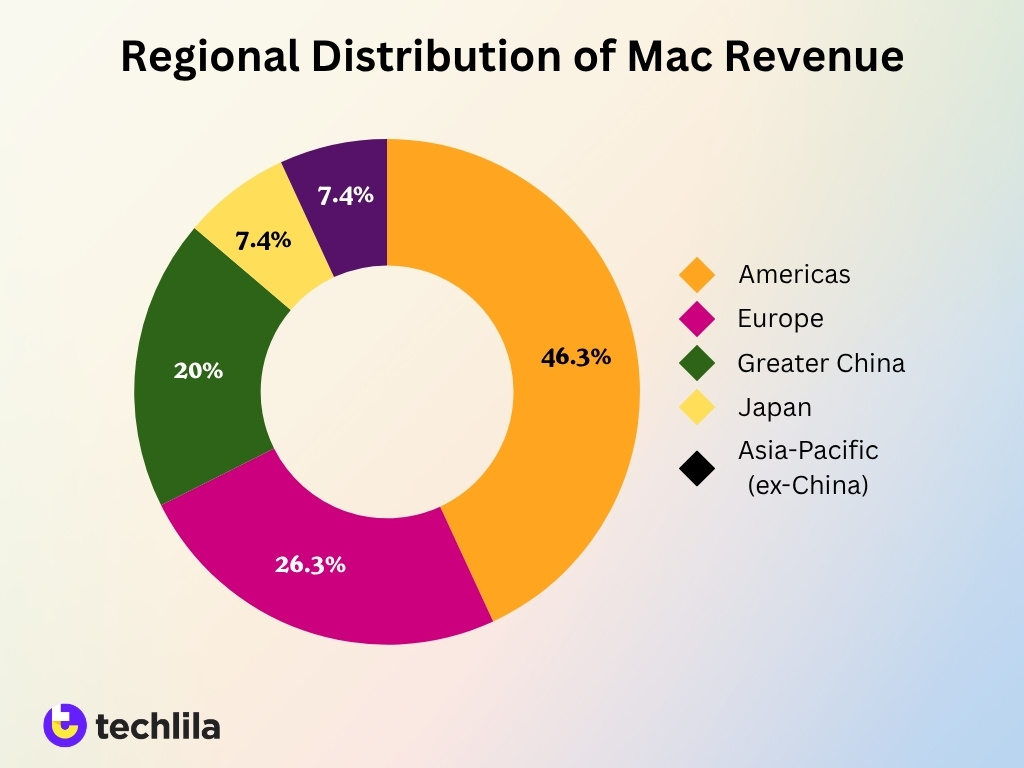
- The Americas accounted for 46.3% of Apple’s total revenue in 2025, with North America remaining the largest Mac market by both revenue and shipments.
- Europe contributed 26.3% of Apple’s total revenue in H1 2025, with enterprise adoption of Mac growing 17% YoY, particularly in software development and media sectors.
- Greater China generated 20.0% of Apple’s global revenue in H1 2025, showing a 5.5% YoY increase in sales recovery from late 2024.
- Mac revenue in Q1 2025 reached $9.0 billion, marking a 16% growth compared to the prior year, driven by M3-powered MacBook Pro and iMac demand.
- Japan contributed 7.4% of Apple’s total revenue in 2025, though revenue declined by 2.3% YoY largely due to currency fluctuations and inflationary pressure.
- The Asia-Pacific region (excluding China) accounted for 7.4% of Apple’s revenue, reflecting steady growth in emerging markets with strong MacBook adoption across universities and government sectors.
- MacBook Air M3 became the best-selling laptop in the US education market in early 2025, with Apple selling 6.7 million Mac units in Q1, the highest since 2022.
- Emerging markets showed faster Mac growth but smaller absolute volumes, with Australia and New Zealand reporting stable growth with a 6.2% increase in Mac sales fueled by university and government purchases.
- Mac market share in the US reached 17.1% in Q4 2024, with Apple selling over 3 million Macs, marking an increase from 2.6 million units in the same quarter of 2023.
- The Mac category represents $110B of Apple’s 2025 revenue, with -2% YoY change, indicating enterprise and education sectors are driving regional variation despite overall product category softness.
Regional Market Variations
- The U.S. holds a 15.7% Mac market share across all segments in Q4 2025, far exceeding the global average of around 10–13%.
- Europe accounts for 30.2% of global Mac users, with moderate adoption driven by markets like the UK, Germany, and France.
- China achieved 6% Mac market share in Q4 2025, up from 5% the previous year amid competition from local brands.
- Japan shows strong Mac loyalty, with ARM-based Macs like MacBooks leading in professional adoption for battery life and integration.
- North America‘s education sector sees 71% of higher education students preferring or using Macs, boosting MacBook adoption.
- India‘s MacBook share stands at 5.6% of the notebook market in 2025, limited by price sensitivity in emerging markets.
- Enterprise IT policies propelled Macs to 11% share in the U.S. in 2025, with 93% of CIOs reporting increased usage.
- Asia-Pacific retail expansion and financing drove 38% growth in Apple’s Mac and iPad revenue in India to $1.78 billion in 2025.
Quarterly Mac Revenue Performance
- Apple reported $8.7 billion in Mac revenue in Q4 2025, one of its highest quarters.
- Q2 2025 Mac revenue stood at $7.95 billion, reflecting steady growth.
- Q1 2025 Mac revenue was ~$7.8 billion, boosted by new product launches.
- Q3 2025 revenue remained stable in the $7–8 billion range.
- Mac revenue typically peaks in the holiday quarter (Q4) each year.
- Quarterly fluctuations reflect product release cycles and seasonal demand.
- Mac revenue growth outpaced iPad in multiple 2025 quarters.
- Apple maintained consistent quarterly revenue above $7 billion across 2025.
Mac Sales Growth Rate
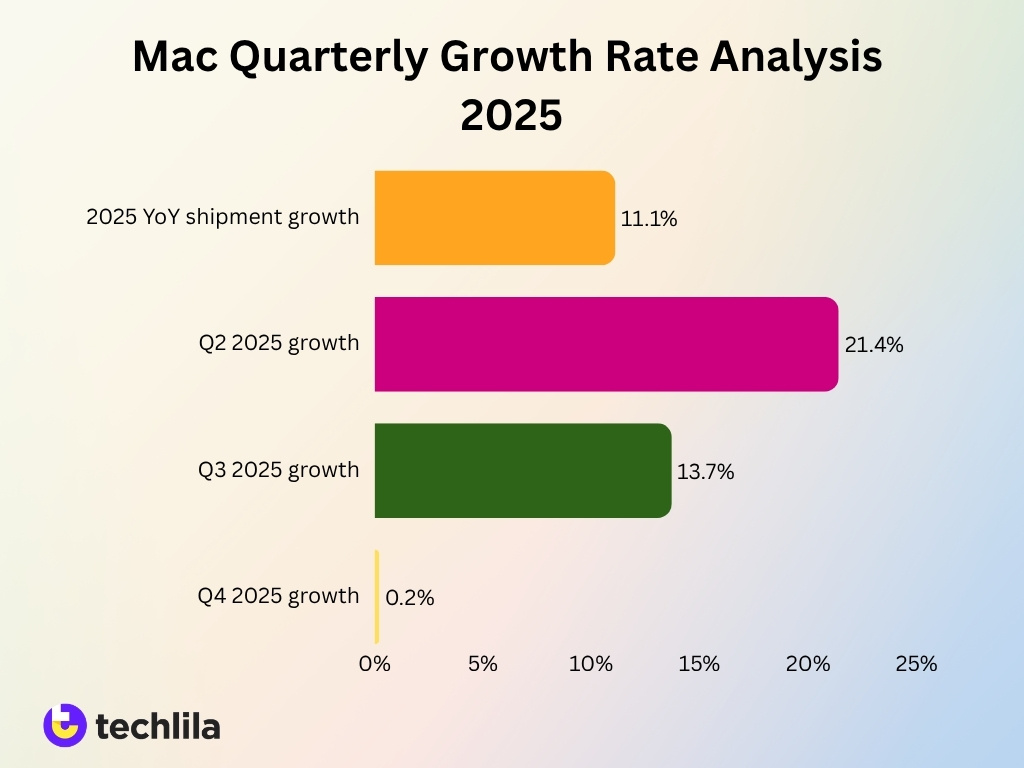
- Apple’s Mac shipments grew 11.1% YoY in 2025, reaching 25.6 million units.
- Q2 2025 recorded 21.4% growth, the fastest quarterly increase among top PC brands.
- Q3 2025 growth remained strong at 13.7% YoY, indicating sustained demand.
- Growth slowed to 0.2% in Q4 2025, reflecting post-holiday normalization.
- Apple outperformed the global PC market, which grew ~8.1% in 2025.
- Mac growth rebounded after declines in 2022–2023, driven by Apple silicon adoption.
- Enterprise adoption contributed to double-digit growth in early 2025.
- Apple maintained positive growth in 3 out of 4 quarters in 2025, signaling resilience.
Year-Over-Year Revenue Growth
- Mac revenue grew ~12% YoY in FY 2025, signaling recovery from earlier declines.
- Q2 2025 showed 6.7% YoY growth, reaching $7.95 billion.
- Q3 2025 shipments increased 13.7% YoY, supporting revenue gains.
- Q2 2025 shipment growth hit 21.4% YoY, one of Apple’s strongest quarters.
- Q4 2025 saw near-flat growth (~0.2%), indicating market stabilization.
- Mac growth outperformed the overall PC market (~8.1%) in 2025.
- Apple’s Mac segment rebounded from declines in 2022–2023 to strong growth in 2025.
- Growth is driven by Apple silicon upgrades and enterprise adoption trends.
Unit Shipments and Volume
- Apple shipped 25.6 million Macs globally in 2025.
- Shipments increased from ~23 million units in 2024, showing steady recovery.
- Q4 2025 shipments reached 7.1 million units, the highest quarterly volume.
- Q3 2025 shipments stood at 6.8 million units, up from 6.0 million in 2024.
- Q2 2025 shipments exceeded 6.2 million units, reflecting strong demand.
- Apple consistently ranked 4th globally in shipment volume.
- Mac shipments represent ~10% of the total premium PC segment globally.
- Shipment growth is closely tied to new chip releases and product refresh cycles.
Average Selling Price Comparison
- Mac’s average selling price (ASP) is estimated at $1,300–$1,500 globally.
- This is significantly higher than Windows PC ASP, typically $700–$900.
- MacBook Pro models can exceed $2,000+, boosting overall ASP.
- Apple maintains 30–50% higher ASP vs competitors, reinforcing premium positioning.
- Higher ASP contributes to strong margins despite lower unit share.
- Enterprise buyers often choose higher-spec Macs, increasing average transaction value.
- Mac ASP remained stable in 2025 despite broader PC price declines.
- Apple’s pricing strategy prioritizes value perception over volume growth.
Price Range and Product Tiers
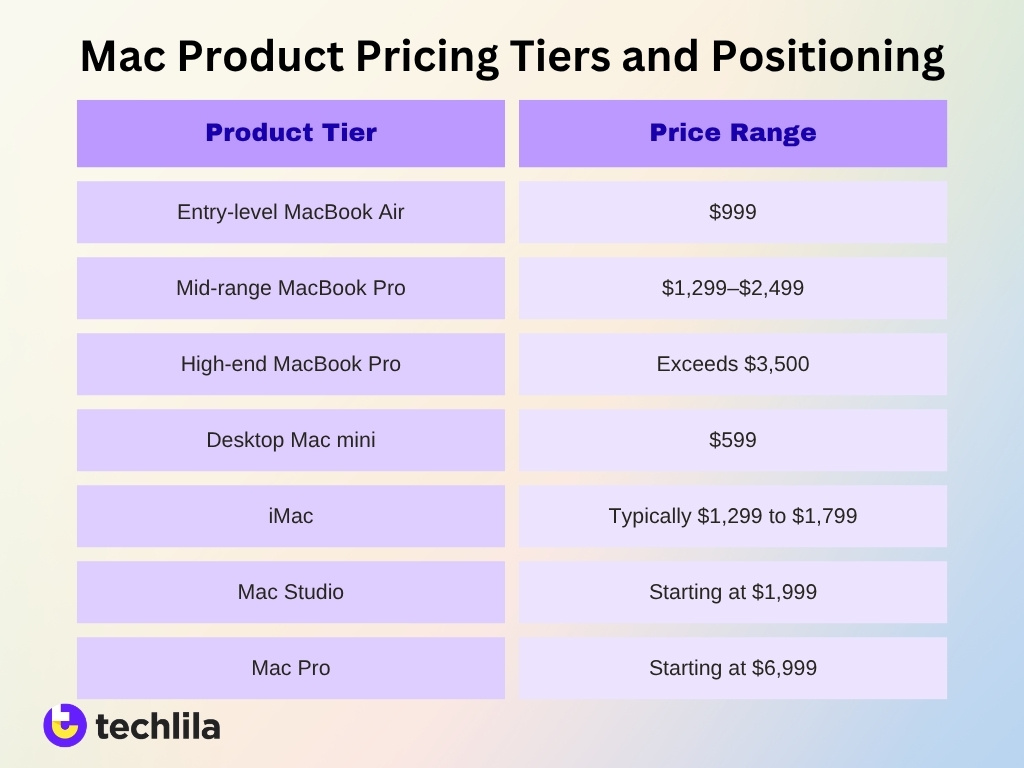
- Entry-level MacBook Air starts at ~$999, targeting students and casual users.
- Mid-range MacBook Pro models are priced between $1,299–$2,499.
- High-end MacBook Pro configurations exceed $3,500, especially for professionals.
- Desktop Mac mini starts at ~$599, making it the most affordable Mac.
- iMac pricing typically ranges from $1,299 to $1,799.
- Mac Studio and Mac Pro cater to premium users with prices starting at $1,999 and $6,999, respectively.
- Apple offers education and enterprise discounts, expanding accessibility.
- Product tiering allows Apple to capture both entry-level and high-end segments effectively.
MacBook Popularity and Preference
- MacBook Air is the best-selling Mac model globally, accounting for a large share of shipments.
- Laptops make up ~70–80% of total Mac sales, reflecting portability demand.
- MacBooks dominate in education and student segments in the U.S.
- Developers prefer MacBooks due to macOS compatibility with iOS development tools.
- Enterprise adoption of MacBooks increased in 2024–2025 due to security and performance benefits.
- MacBook Pro is favored in creative industries such as video editing and design.
- Battery life and performance efficiency are key factors driving consumer preference.
- AI-ready chips (M4) are expected to further boost MacBook upgrade cycles in 2026.
Mac Desktop Popularity and Preference
- Desktop Macs account for ~20–30% of total Mac sales volume.
- iMac remains popular in education and office environments.
- Mac mini drives adoption among budget-conscious users and developers.
- Mac Studio and Mac Pro dominate high-performance workstation markets.
- Desktop Macs are preferred in video production, 3D rendering, and design industries.
- Desktop upgrade cycles are longer, typically 4–6 years vs 3–4 years for laptops.
- Enterprise use of desktops remains stable despite growth in laptop adoption.
- Desktop Macs maintain strong demand in specialized professional workflows.
Frequently Asked Questions (FAQs)
Apple shipped 25.6 million Macs in 2025, up from 23.0 million in 2024, marking 11.1% year-over-year growth.
Apple held approximately 9.0% global PC market share in 2025, increasing from 8.7% the previous year.
Apple’s Mac segment generated around $29.9 billion in revenue in 2024, recovering from $29.2 billion in 2023.
Mac sales accounted for about 8.3% of Apple’s total revenue in fiscal 2025.
Conclusion
Apple’s Mac business continues to evolve as a premium yet fast-growing segment within the global PC market. While overall market share remains below 10%, consistent double-digit growth in key quarters shows strong momentum, especially with Apple silicon driving performance gains.
At the same time, MacBooks dominate sales due to portability and enterprise adoption, while desktops retain relevance in specialized workflows. Higher average selling prices and strategic product tiering allow Apple to prioritize profitability over volume, setting it apart from competitors focused on scale.
Looking ahead, the rise of AI-powered PCs and continued ecosystem integration position Macs for sustained growth.

Leave a comment
Have something to say about this article? Add your comment and start the discussion.