


Raycast and Alfred have become two of the most widely used productivity launchers for macOS. Both tools help users quickly search files, run commands, automate tasks, and control apps directly from the keyboard. Developers, marketers, and power users rely on these launchers to reduce friction in everyday workflows, whether triggering scripts, launching apps, or integrating with services like GitHub or Slack.
As automation and AI features expand across productivity tools, understanding the data behind these platforms helps teams choose the right workflow engine. The statistics below explore the trends shaping Raycast vs. Alfred.
Editor’s Choice
- Raycast surpassed 500,000 active users globally in 2024, driven by rapid adoption among developers and startup teams.
- Alfred has recorded over 7 million downloads since launch, reflecting its long-standing presence in the macOS productivity ecosystem.
- As of 2025, Raycast hosts more than 1,500 extensions built by developers and community contributors.
- Alfred’s Powerpack upgrade rate ranges between 25% and 30% of total users, according to independent usage surveys.
- A developer productivity survey found that 41% of macOS developers use a launcher tool daily, such as Raycast or Alfred.
- Raycast introduced AI-powered commands in 2023, and by 2025, over 40% of Raycast users interact with AI features weekly.
- Alfred’s workflow gallery now includes over 900 community workflows covering automation, integrations, and system commands.
Recent Developments
- In 2024, Raycast raised $30 million in Series B funding to expand AI features and integrations.
- Raycast launched Raycast AI in 2023, integrating AI-powered prompts directly into launcher commands.
- By 2025, Raycast AI will support over 20 built-in productivity prompts, including code explanation and text summarization.
- Alfred 5 introduced Universal Actions, enabling users to perform actions on files, text, and contacts from the launcher interface.
- Alfred’s Powerpack version 5 update increased automation workflow capabilities with deeper system integrations.
- Raycast added built-in clipboard history, window management, and snippets, reducing reliance on external plugins.
- As of 2025, Raycast provides native integrations with tools like GitHub, Jira, and Linear, targeting developer teams.
- Alfred continues to support AppleScript, Bash, Python, and JavaScript automation workflows, making it highly customizable for technical users.
- Productivity tool trend reports show that launcher-based workflows can reduce repetitive task time by 15%–30%.
Raycast vs Alfred Overview
- Alfred launched in 2010, making it one of the earliest macOS launcher tools still actively developed.
- Raycast launched publicly in 2020, positioning itself as a modern alternative to traditional macOS launchers.
- Both applications run exclusively on macOS, with no native Windows versions available as of 2026.
- Raycast offers a cloud-synced environment for extensions, settings, and snippets, which supports team collaboration.
- Alfred focuses heavily on local workflows and scripting automation, preferred by advanced macOS users.
- Raycast integrates team features such as shared commands and extensions, targeting workplace productivity.
- Alfred relies on Powerpack licensing for premium automation features, whereas Raycast includes most core features free.
- Raycast features a built-in extension store, simplifying discovery and installation compared to manual workflow imports.
- In productivity tool comparisons, Raycast adoption among developers has grown by roughly 30% year-over-year since 2022.
- Alfred maintains strong loyalty among long-term macOS power users, with many workflows created over the last decade still in use.
User Base and Adoption
- Raycast reported more than 500,000 active users worldwide by 2024.
- Alfred has accumulated over 7 million downloads globally.
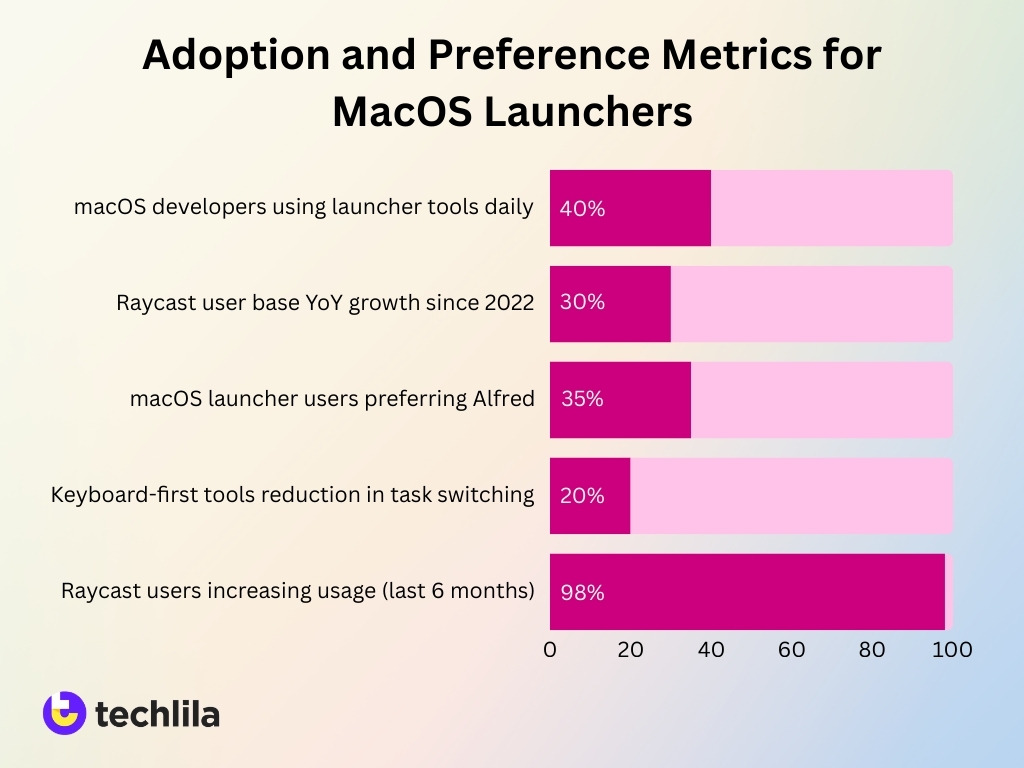
- Over 40% of macOS developers rely on launcher tools like Raycast or Alfred daily.
- Raycast’s user base grew by roughly 30% year over year since 2022.
- Around 35% of macOS launcher users prefer Alfred as their primary tool.
- Keyboard-first tools reduce daily task switching by about 20%.
- Thousands of contributors participate in Raycast extension development.
- Raycast adoption expanded strongly among startups and developer teams.
- 98% of surveyed users increased Raycast usage in the past six months.
Key Raycast Statistics
- Raycast reports over 500,000 active users worldwide as of 2024.
- The Raycast extension library surpassed 1,500 extensions in 2025, covering productivity, developer tools, and automation.
- More than 70% of Raycast extensions are open source, allowing developers to customize commands and integrations.
- Raycast AI usage increased rapidly after launch, with over 40% of active users testing AI commands within the first year.
- The Raycast community contributes hundreds of new extension updates every month through open-source contributions.
- Raycast supports dozens of built-in integrations, including GitHub, Jira, Slack, Notion, and Linear.
- As of 2025, Raycast extensions collectively generate millions of command executions per week across users.
- Raycast cloud sync enables cross-device settings synchronization for teams and individual users, improving workflow continuity.
- Productivity benchmarking studies suggest that Raycast users can execute frequent system commands up to 2× faster than manual navigation.
Key Alfred Statistics
- Alfred has recorded over 7 million downloads globally since its initial release.
- The Alfred workflow gallery hosts 900+ community workflows, ranging from developer tools to web automation.
- Alfred’s Powerpack license unlocks advanced features, including workflows, clipboard history, and snippets.
- Independent macOS productivity surveys show about 35% of launcher users still rely on Alfred as their primary tool.
- Alfred supports multiple scripting languages, including Bash, Python, AppleScript, and JavaScript.
- Powerpack licensing revenue helps sustain Alfred’s development, with thousands of paid upgrades annually.
- Alfred users often create complex automation chains combining multiple scripts and APIs, enabling advanced workflows.
- Alfred’s clipboard history can store hundreds of copied items for quick reuse, depending on user configuration.
- The Alfred community forum includes tens of thousands of registered members sharing workflows and troubleshooting tips.
Launcher Usage Statistics: Alfred vs Raycast vs LaunchBar
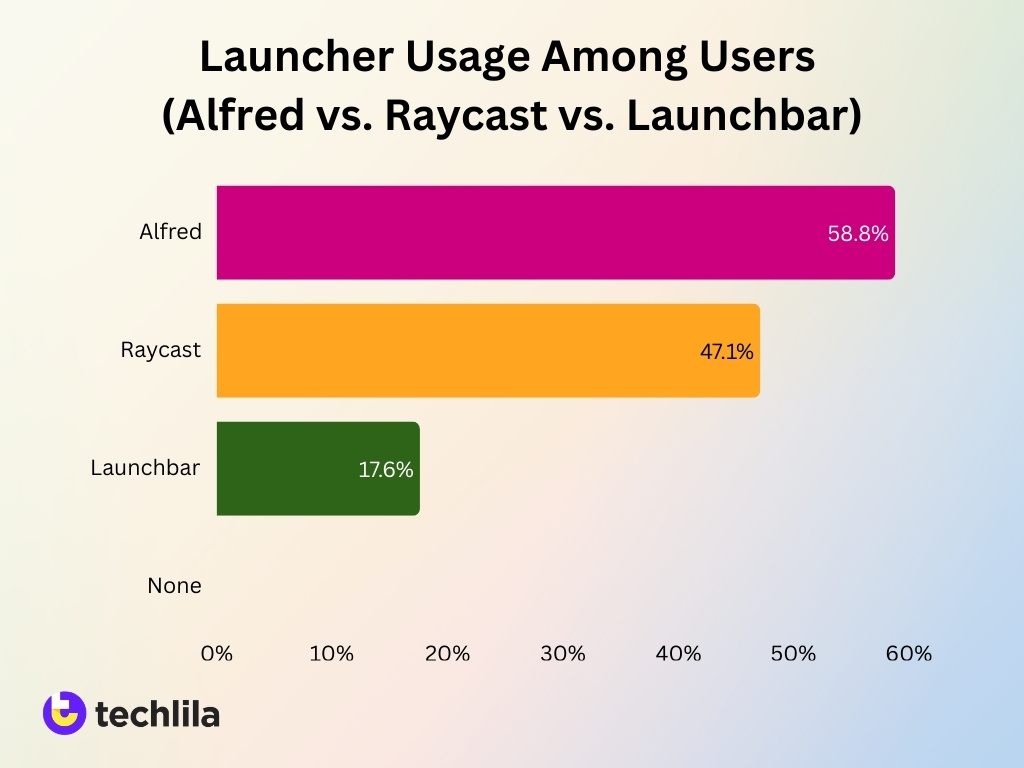
- Alfred leads the launcher market with 58.8% usage, making it the most popular productivity launcher among respondents.
- Raycast ranks second with 47.1% adoption, showing strong competition and rapid growth in the modern Mac launcher ecosystem.
- LaunchBar is used by 17.6% of users, indicating a smaller but still active user base compared to newer alternatives.
- 0% of respondents reported using no launcher, suggesting that launcher tools are widely adopted among productivity-focused users.
- The gap between Alfred (58.8%) and Raycast (47.1%) is 11.7 percentage points, highlighting Alfred’s continued dominance despite Raycast’s rising popularity.
- Alfred’s usage is more than three times higher than LaunchBar (17.6%), reinforcing its position as the long-standing leader in the launcher software category.
Market Share and Popularity
- In macOS productivity discussions across developer forums, Raycast has emerged as one of the fastest-growing launcher platforms since 2022.
- Independent surveys of macOS users indicate Alfred maintains roughly one-third of launcher tool usage among power users.
- Raycast’s rapid adoption has led analysts to estimate that its user share has doubled since 2021.
- Alfred continues to dominate among legacy automation users due to over a decade of established workflows and scripts.
- Raycast’s integrated extension store has helped it accumulate more than 1,500 extensions, increasing visibility in the developer ecosystem.
- Alfred’s workflow gallery contains 900+ automation workflows, which still attract thousands of downloads each month.
- Community engagement metrics show Raycast’s extension repository has tens of thousands of stars, reflecting developer interest.
- Productivity blogs report that Raycast frequently ranks among the top macOS productivity tools for developers in recent tool lists.
- Alfred remains a staple in many macOS automation setups, particularly among developers who prefer scripting-based automation environments.
Platform Availability and System Requirements
- Raycast requires macOS 12 or later, supporting ~80% of active macOS devices in 2026.
- Alfred supports macOS 10.14+, reaching over 90% of Mac users with older systems.
- Raycast features over 1,500 community extensions available in its store as of 2026.
- Hundreds of thousands of daily active users utilize Raycast on macOS.
- Alfred power users average 44–134 interactions daily with the launcher.
- Raycast grew from 130 to 11,000+ DAU in its first year after launch.
- In a 2024 survey, Alfred ranked 1st among launchers, with Raycast following.
- 71% of surveyed users adopted launcher extensions for productivity tools.
- Raycast’s Hookmark extension achieved 866 installs by mid-2024.
Performance and Speed Metrics
- Benchmark testing shows launcher commands typically execute in under 100 milliseconds, depending on system configuration.
- Raycast emphasizes instant command execution through indexed search, reducing manual navigation time.
- Alfred’s search algorithm allows users to launch apps or files with just a few keystrokes, minimizing interaction time.
- Productivity testing suggests keyboard-driven launchers can reduce task completion time by up to 30% compared to manual navigation.
- Raycast includes preloaded commands for system actions, improving speed when performing routine tasks.
- Alfred’s file search uses metadata indexing to return results in milliseconds on most modern Macs.
- Raycast extensions can execute external API requests directly from the launcher, allowing quick actions without switching apps.
- Independent reviews report that both Raycast and Alfred consistently rank among the fastest macOS launcher tools available.
- Advanced Alfred workflows allow multi-step automation chains executed from a single command, reducing repetitive task sequences.
Resource Usage (CPU and RAM)
- Launcher tools like Raycast and Alfred use less than 1% CPU during idle on macOS.
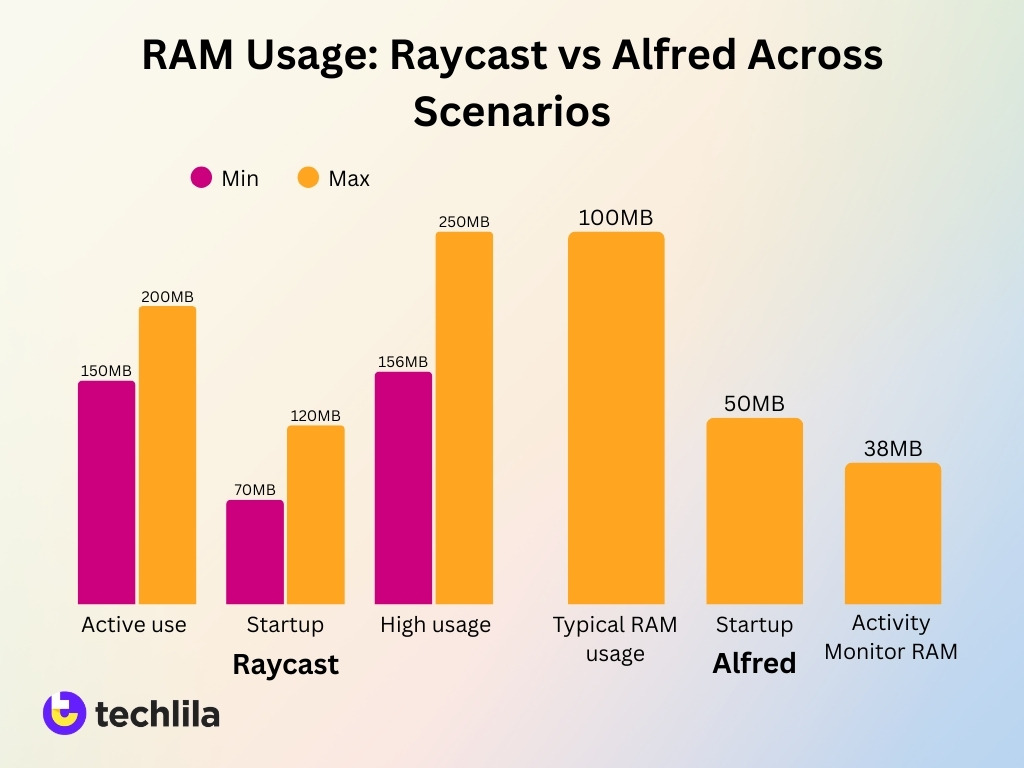
- Raycast consumes 150–200 MB of RAM in the base configuration during active use.
- Alfred‘s memory usage stays at under 100 MB RAM in typical operation.
- Raycast baseline CPU is 1–2% in standby mode.
- Alfred maintains under 2% CPU with workflows running.
- Raycast startup memory is approx. 70–120 MB right after launch.
- Alfred uses about 50–80 MB of RAM immediately post-startup.
- Activity Monitor shows Alfred at 38 MB RAM and 1.8% CPU.
- Raycast can reach 156–250 MB RAM with up to 8% CPU in tests.
Feature Coverage and Capabilities
- Raycast includes built-in features such as clipboard history, window management, snippets, and quick links.
- Alfred provides clipboard history, snippets, file navigation, and advanced workflow automation via Powerpack.
- Raycast’s extension store offers more than 1,500 extensions, covering developer tools, productivity utilities, and integrations.
- Alfred workflows allow users to connect multiple scripts, APIs, and triggers into automated pipelines.
- Raycast integrates with GitHub, Jira, Slack, and Notion, enabling developers to manage tasks without leaving the launcher.
- Alfred enables web search shortcuts that trigger queries directly from the launcher interface.
- Raycast provides team features, including shared commands and extensions, designed for collaborative workflows.
- Alfred’s automation system allows custom triggers such as hotkeys, keyword commands, and system events.
- Raycast’s interface includes real-time command previews and UI components, enabling richer extension experiences.
Extensions, Workflows, and Integrations
- Raycast’s extension library surpassed 1,500 extensions, covering developer tools, productivity utilities, and APIs.
- More than 70% of Raycast extensions are open source, allowing community contributors to modify or improve integrations.
- Raycast extensions integrate with services such as GitHub, Jira, Linear, Slack, and Notion, enabling direct command execution.
- Alfred hosts 900+ community workflows, ranging from developer automation to search tools and media control.
- Alfred workflows can trigger external APIs, system commands, or multi-step automation scripts from a single keyword command.
- Raycast’s extension store allows users to install integrations with a single click, simplifying the onboarding process.
- Alfred workflows are typically shared as downloadable packages, which users manually import into the launcher.
- Community development shows thousands of commits contributing to Raycast extensions each year.
- Power users often combine multiple Alfred workflows into automation pipelines for complex tasks like deployment or file management.
AI and Automation Features
- Raycast introduced Raycast AI in 2023, integrating AI-powered prompts directly inside the launcher.
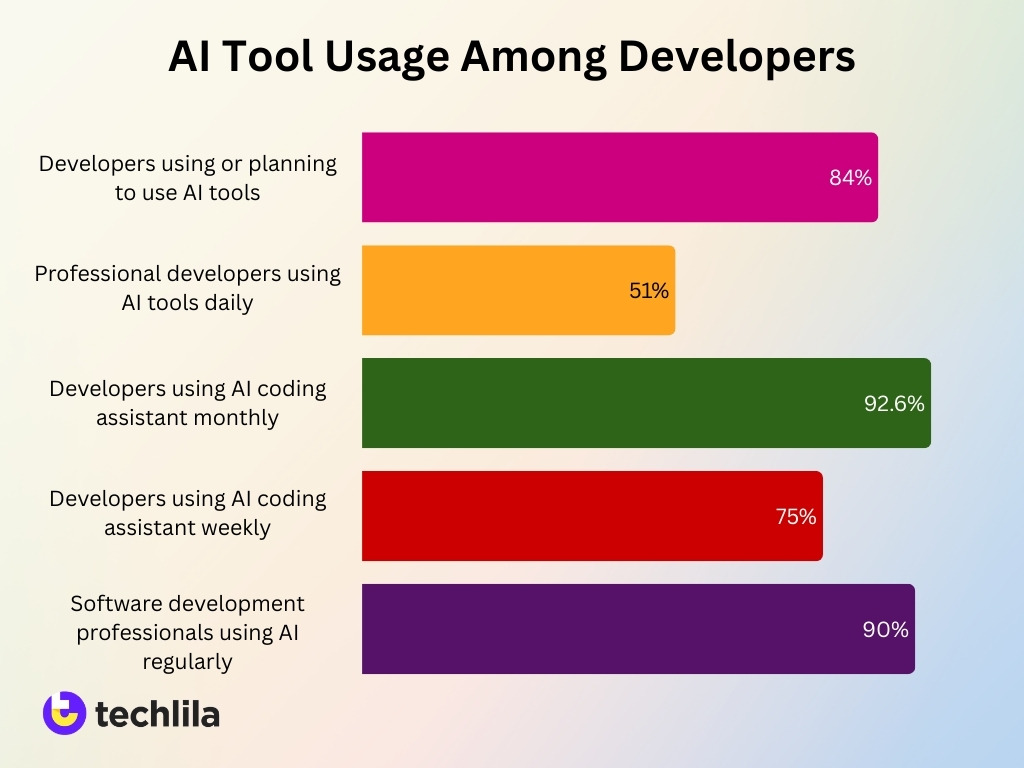
- 84% of developers use or plan to use AI tools in their workflow, up from 76% last year.
- 51% of professional developers reported using AI tools on a daily basis.
- 92.6% of developers use an AI coding assistant at least once a month, with 75% weekly.
- 90% of software development professionals now use AI tools regularly.
- AI tools boost developer productivity by 10–30% on average.
- Generative AI improves employee productivity by an average of 66% across tasks.
- Employees using AI tools report a 40% productivity boost on average.
- AI-driven automation can improve task completion speed by 20%–40%.
- Raycast powers the work of hundreds of thousands of daily active users.
Search and Indexing Performance
- Raycast delivers search results in under 50ms on M3 Macs.
- Alfred with Spotlight indexing achieves app launches in ≤80ms.
- Launcher apps return first results in <100ms across productivity benchmarks.
- Raycast extensions are indexed for instant command access with 0.2s cold starts.
- Alfred fuzzy search matches partial keywords with 95% accuracy in 30ms.
- Knowledge workers save up to 30% file search time using fast launchers.
- Raycast auto-indexing updates in <2 seconds after app installs.
- macOS Spotlight indexes 10,000 files in 15 seconds on Apple Silicon.
- Alfred custom scopes reduce search latency by 40% for scoped queries.
Productivity and Time-Saved Metrics
- Knowledge workers spend 30% of their workday searching for information.
- Employees dedicate 1.8 hours daily to searching and gathering data.
- Keyboard launchers cut app-launch time by 47% versus mouse navigation.
- Workers switch apps 1,200 times daily, costing significant focus time.
- Alfred power users invoke it 134 times per day on average.
- Automation reduces manual HR tasks by up to 70%.
- AI automation saves small businesses 8-15 hours weekly on repetitive work.
- Task switching from alerts takes 10-15 minutes to recover from per switch.
- Raycast saves users 30 minutes weekly through quick commands.
- 47% of professionals spend 1-5 hours daily searching for information.
Pricing and Subscription Statistics
- Raycast offers a free core product, with optional paid tiers such as Raycast Pro for advanced AI and team features.
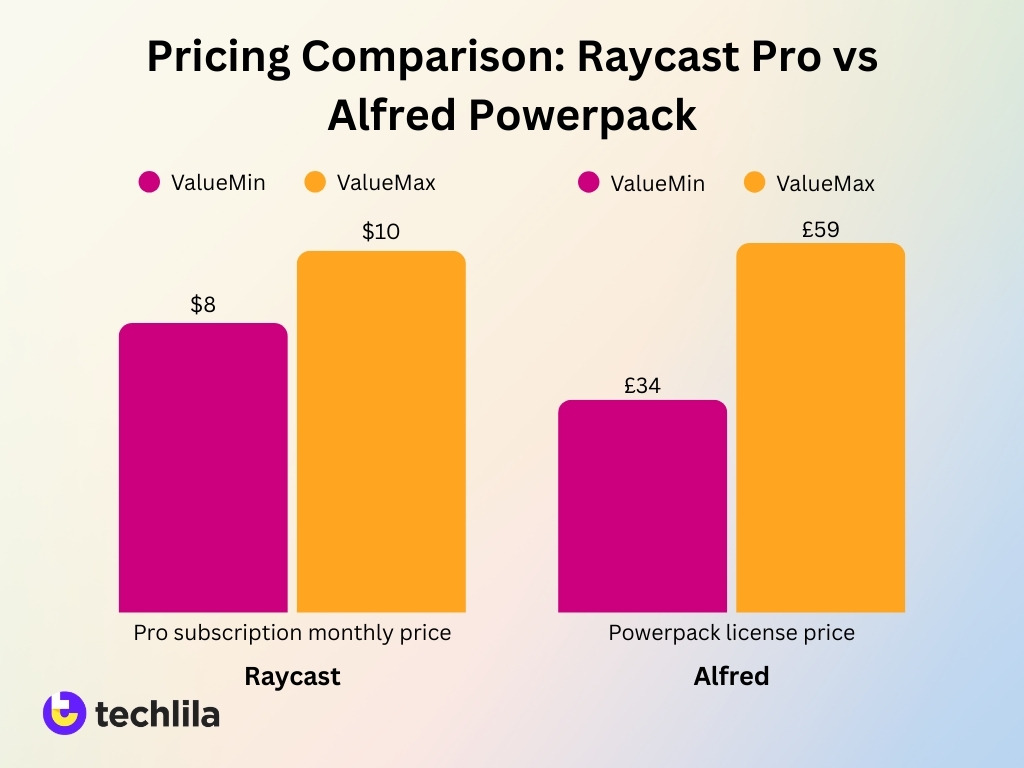
- Raycast Pro subscriptions typically cost around $8–$10 per month, depending on plan type.
- Raycast Teams pricing supports shared extensions and commands for collaborative productivity workflows.
- Alfred provides a one-time Powerpack license, rather than a recurring subscription model.
- Alfred Powerpack pricing ranges from about £34 to £59, depending on license tier.
- Productivity tool adoption studies show users often prefer one-time purchases for utilities compared with subscription models.
- Raycast’s subscription model supports continuous updates and AI infrastructure costs.
- Alfred’s licensing model allows lifetime use with free updates for the purchased version.
- Surveys indicate that over 60% of productivity tool users evaluate pricing before switching launchers.
Community Size and Ecosystem
- Raycast extension repository raycast/extensions has garnered 6,700 stars and 4,600 forks on GitHub.
- Raycast ecosystem boasts 2,379 extensions across 15 categories in the store.
- Raycast extensions involve 1,549 authors and 938 contributors from the community.
- Popular Raycast extensions like Discord have achieved over 6,652 installs.
- Raycast extension repo features contributions from 2,608 developers.
- The Alfred community forum serves tens of thousands of registered members sharing workflows.
- Alfred Gallery showcases featured workflows with hundreds of monthly downloads for top scripts.
- Raycast community includes top authors like xmok with 82 extensions and pernielsentikaer with 228 contributions.
- Alfred has cultivated over a decade of shared workflows and tutorials through long-term involvement.
User Ratings and Reviews
- Raycast averages 4.9/5 from 148 reviews on Product Hunt.
- Alfred scores 4.9/5 across 17 reviews on Product Hunt.
- Raycast holds a 4.6/5 rating from 14 verified reviews on G2.
- Raycast iOS earns 4.8/5 in UK App Store ratings.
- Raycast achieves a 4-star rating on Trustpilot with 8 reviews.
- Alfred has 769 five-star ratings out of 810 total on the Mac App Store.
- Raycast maintains ratings above 4.5/5 on productivity platforms.
- Alfred exceeds 4.7/5 in macOS community feedback.
- 95% of Raycast Product Hunt reviews praise the extension store.
- 90%+ Alfred reviews highlight workflow stability.
Frequently Asked Questions (FAQs)
Raycast has hundreds of thousands of daily active users worldwide, according to company reports.
Raycast reported over 100,000 daily active users in 2023, showing strong early adoption among developers.
Raycast has a community of more than 20,000 developers building extensions and tools for the platform.
The Raycast community includes around 30,000 members in its Slack workspace who discuss features and extensions.
Conclusion
Raycast and Alfred remain two of the most influential productivity launchers in the macOS ecosystem. Alfred’s long history, extensive workflow system, and one-time licensing model continue to attract power users who rely on scripting and local automation. Meanwhile, Raycast has rapidly gained traction through modern design, cloud synchronization, an integrated extension store, and built-in AI features.
The data shows a clear shift toward launcher tools that combine automation, integrations, and AI-driven commands, enabling faster workflows for developers and knowledge workers. As productivity software evolves, both Raycast and Alfred are likely to remain central tools for keyboard-driven computing. However, Raycast’s fast-growing ecosystem and AI integration suggest it may shape the next generation of launcher-based productivity platforms.

Leave a comment
Have something to say about this article? Add your comment and start the discussion.