


Raycast has quickly become one of the most popular productivity tools for power users, developers, and knowledge workers. It acts as a keyboard-driven command launcher that helps professionals manage tasks, control apps, and automate workflows from a single interface. Teams often use Raycast to speed up coding workflows, while designers and product managers rely on it to switch tools and run commands without leaving the keyboard. As remote work and AI-driven productivity tools expand, Raycast continues to gain traction across tech companies and startups.
In this article, we explore the latest Raycast usage statistics, including adoption trends, user growth, and demographic insights.
Editor’s Choice
- Raycast launched in 2020 as a productivity launcher for macOS designed to replace Apple’s Spotlight with automation, extensions, and developer integrations.
- By 2023, more than 100,000 people were using Raycast daily, highlighting rapid adoption among developers and productivity enthusiasts.
- As of 2024–2025, Raycast reports hundreds of thousands of daily active users worldwide, reflecting strong growth in the developer productivity market.
- The platform supports more than 1,000 extensions that integrate tools such as GitHub, Jira, and Slack directly into the launcher.
- Raycast has built a developer ecosystem of around 22,000 contributors, who build and maintain extensions.
- The company raised $30 million in Series B funding in 2024 to expand Raycast to Windows and iOS platforms.
- Raycast now powers workflows for hundreds of thousands of Mac users globally, particularly developers, designers, and founders.
Recent Developments
- In September 2024, Raycast secured $30 million in Series B funding to accelerate product development and expand beyond macOS.
- The company announced planned releases for Windows and iOS, significantly widening the potential user base beyond Mac users.
- Raycast entered public beta for Windows in late 2025, marking the first major multi-platform expansion for the product.
- The product roadmap emphasizes AI-powered productivity tools, including AI chat and automation integrated into the command launcher.
- Raycast AI supports more than 30 AI models in a single interface, enabling tasks like coding assistance, search, and content generation.
- The Raycast community has grown to about 30,000 members in its Slack workspace, where users discuss workflows and extensions.
- Developers can build custom workflows through the Raycast API and extension system, which auto-updates and ensures compatibility with app versions.
- The platform introduced features such as Raycast Wrapped, allowing users to review productivity metrics and usage patterns each year.
- Productivity analytics like focus sessions, meeting time, and command launches are now tracked within Raycast for personal insights.
Overview of Raycast Adoption
- Raycast has grown from a niche developer tool to a productivity platform used by hundreds of thousands of professionals globally.
- The product gained early traction in engineering and developer communities, where keyboard-driven workflows are common.
- Early adoption grew rapidly, with daily active users increasing from 130 to over 11,000 within a year during the initial launch phase.
- The tool quickly surpassed 100,000 daily users by 2023, demonstrating strong adoption among productivity-focused professionals.
- Raycast adoption continues to expand as organizations seek keyboard-first productivity solutions to reduce context switching.
- The platform’s extension ecosystem and AI features have played a major role in increasing adoption among technical teams.
- Many professionals use Raycast as a replacement for the macOS Spotlight search tool, providing faster navigation and integrations.
- Industry analysts classify Raycast as part of the developer productivity and workflow automation software category.
Geographic Distribution of Raycast Users
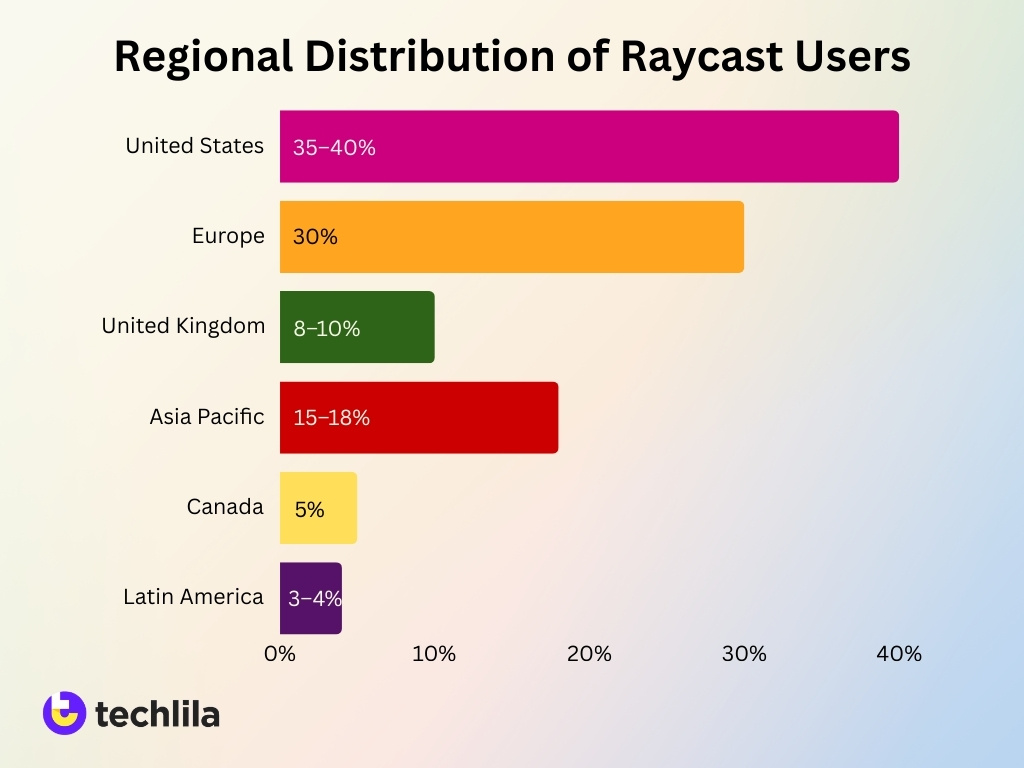
- The United States accounts for roughly 35–40% of Raycast users, reflecting strong adoption in Silicon Valley and major tech hubs.
- European countries collectively represent about 30% of the user base, with significant usage in the United Kingdom, Germany, and the Netherlands.
- The United Kingdom alone contributes nearly 8–10% of Raycast users, partly due to the company’s London roots.
- Asia Pacific adoption is growing rapidly, with around 15–18% of Raycast users coming from countries such as India, Japan, and Singapore.
- Canada contributes about 5% of Raycast’s global user base, driven by strong adoption among software engineering teams.
- Latin America represents around 3–4% of the platform’s users, mainly from Brazil and Mexico.
- Raycast’s user analytics show over 120 countries represented among active users, highlighting the tool’s global reach.
- Startup hubs such as San Francisco, London, Berlin, and Bangalore represent the highest concentrations of Raycast power users.
- Expansion to Windows and iOS is expected to significantly increase adoption in the Asia Pacific and emerging tech markets by 2026.
Total Users and Growth Over Time
- Raycast launched publicly in 2020, entering the productivity tools market dominated by apps like Alfred and LaunchBar.
- Within its first year, daily active users increased from 130 to more than 11,000, highlighting strong early adoption.
- During that same early growth phase, users performed over 20 million actions inside the platform.
- By 2023, Raycast reached more than 100,000 daily users, signaling widespread adoption among developers and productivity enthusiasts.
- As of 2024–2025, Raycast reports hundreds of thousands of daily active users globally.
- The company has raised over $45 million in funding to date to scale the platform and ecosystem.
- Raycast’s growing user base has driven the creation of more than 1,000 third-party extensions across productivity categories.
- Expansion to Windows and iOS platforms in 2025–2026 is expected to significantly increase the user base.
Daily and Monthly Active Users
- Early product growth saw 11,000 daily active users within the first year of public availability.
- By 2023, daily active users surpassed 100,000, marking a key milestone for the platform.
- Industry reports indicate Raycast now has hundreds of thousands of daily active users across Mac workflows.
- Productivity power users often launch Raycast dozens of times per day, demonstrating high engagement.
- Example usage data shows one user opened Raycast 5,431 times in a single year, averaging roughly 15 launches per day.
- Window management commands alone can exceed 1,900 launches annually for heavy users.
- Calendar commands can be triggered more than 500 times per year within Raycast workflows.
- The platform tracks monthly growth and daily active users through analytics tools such as Amplitude, which developers use to monitor extension usage.
Raycast User Demographics
- Raycast is widely adopted by software engineers and developers, who benefit from keyboard-driven automation.
- The platform is also popular among product managers, designers, and startup founders who rely on multiple apps during daily workflows.
- Raycast’s user base tends to consist largely of knowledge workers who spend 8+ hours per day on computers.
- Many early adopters come from startup and tech company environments, where automation tools are widely used.
- Raycast’s extension ecosystem attracts over 22,000 developers who build integrations and commands.
- Community engagement remains high with tens of thousands of users participating in forums and Slack groups.
- Many users rely on Raycast to manage daily productivity workflows such as launching apps, managing windows, and running scripts.
- The product appeals particularly to keyboard-first productivity enthusiasts and automation power users.
Professional and Role-Based Usage of Raycast
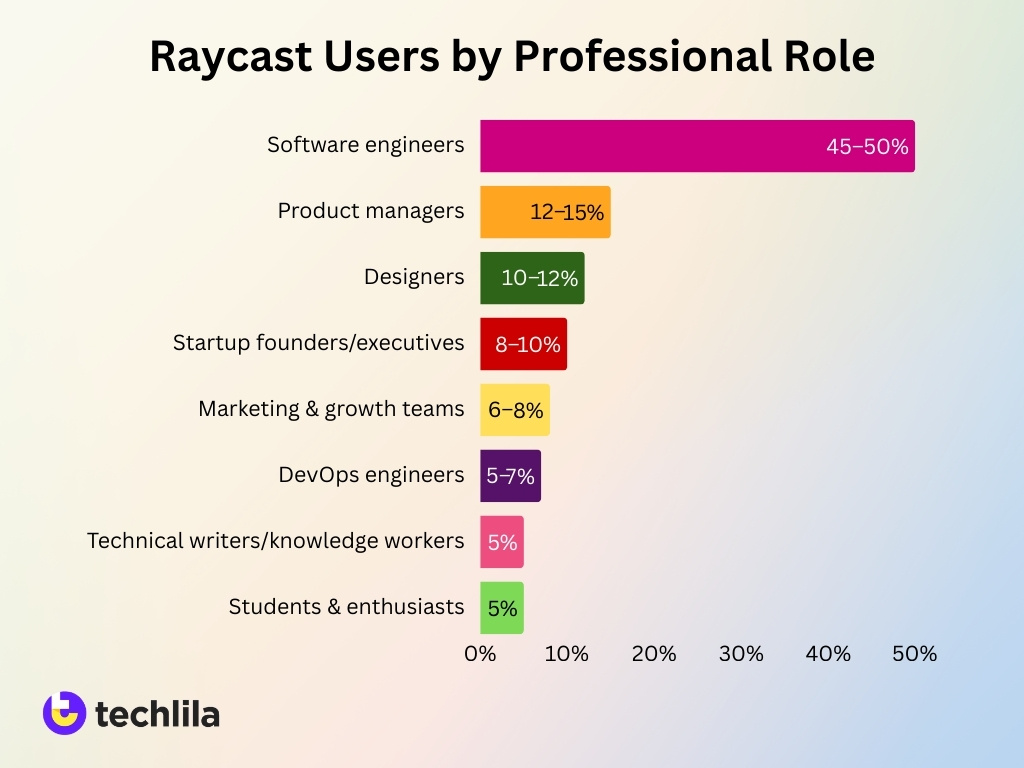
- Software engineers make up the largest share of Raycast users, estimated at around 45–50% of the user base.
- Product managers account for roughly 12–15% of Raycast users, using it to access tools like Jira, Linear, and Notion.
- Designers represent 10–12% of the user base, often integrating Raycast with Figma and other design tools.
- Startup founders and executives account for about 8–10% of users, leveraging Raycast to manage daily workflows and quick app launches.
- Marketing and growth teams contribute around 6–8% of Raycast users, primarily using automation and snippet tools.
- DevOps engineers represent approximately 5–7% of users, frequently integrating Raycast with GitHub, Docker, and terminal commands.
- Technical writers and knowledge workers account for about 3–5% of Raycast’s active user base.
- Students and individual productivity enthusiasts represent roughly 5% of users, using Raycast for study workflows and quick search tasks.
- Cross-functional teams increasingly adopt Raycast because it allows multiple tool integrations within a single keyboard-driven interface.
Raycast Usage by Platform
- Raycast originally launched as a macOS-only application, which remains its primary platform.
- As of 2025, over 95% of Raycast users access the platform through macOS devices.
- Apple’s macOS ecosystem itself has over 100 million active users globally, creating a large potential market for Raycast adoption.
- In 2025, Raycast announced plans to release a Windows version to capture a larger share of productivity software users.
- Windows accounts for over 72% of the global desktop operating system market share, suggesting a major growth opportunity once Raycast launches cross-platform.
- Raycast has also begun building an iOS companion application to allow mobile access to notes, snippets, and AI tools.
- Early beta versions of Raycast on Windows gained tens of thousands of sign-ups during the waitlist phase in 2025.
- Raycast’s browser-based AI interface allows limited functionality without installing the desktop app, expanding accessibility.
- Cross-platform expansion is expected to increase the potential Raycast audience by more than 5x compared with its macOS-only market.
Companies and Teams Using Raycast
- Raycast reports hundreds of thousands of daily active users, with a community of over 20,000 developers building extensions for teams using tools like GitHub and Jira worldwide.
- Since its launch in 2020, Raycast has grown into a go-to tool for software engineers, product developers, and designers, supported by more than 1,500 open-source extensions for apps such as GitHub, Zoom, Notion, and Slack.
- Y Combinator describes Raycast as a productivity tool that helps engineering teams with non-coding work in apps like Jira, GitHub, and Slack, which can occupy up to 50% of a developer’s workday.
- During the Raycast for Teams beta, engineering teams at Atlassian, GitHub, and Shopify used shared commands and internal extensions to make non-coding workflows more efficient across their organizations.
- User research by investor Atomico found 98% of surveyed Raycast users increased their Raycast usage over the past six months, indicating strong adoption momentum in engineering and product teams.
- Raycast’s Series B round of about €27 million (roughly $30 million) was led by Atomico with participation from Atlassian Ventures, Y Combinator, and World Innovation Lab, underscoring demand from large software and SaaS ecosystems.
- Raycast’s own team counts roughly 27–30 employees, with around 75% being engineers, reflecting a strong focus on building tools for technical and developer-centric companies.
- A case study reports that using Raycast AI and commands saved a team about 90 minutes per day across members by replacing manual app navigation with scripted workflows.
Raycast Adoption by Company Size
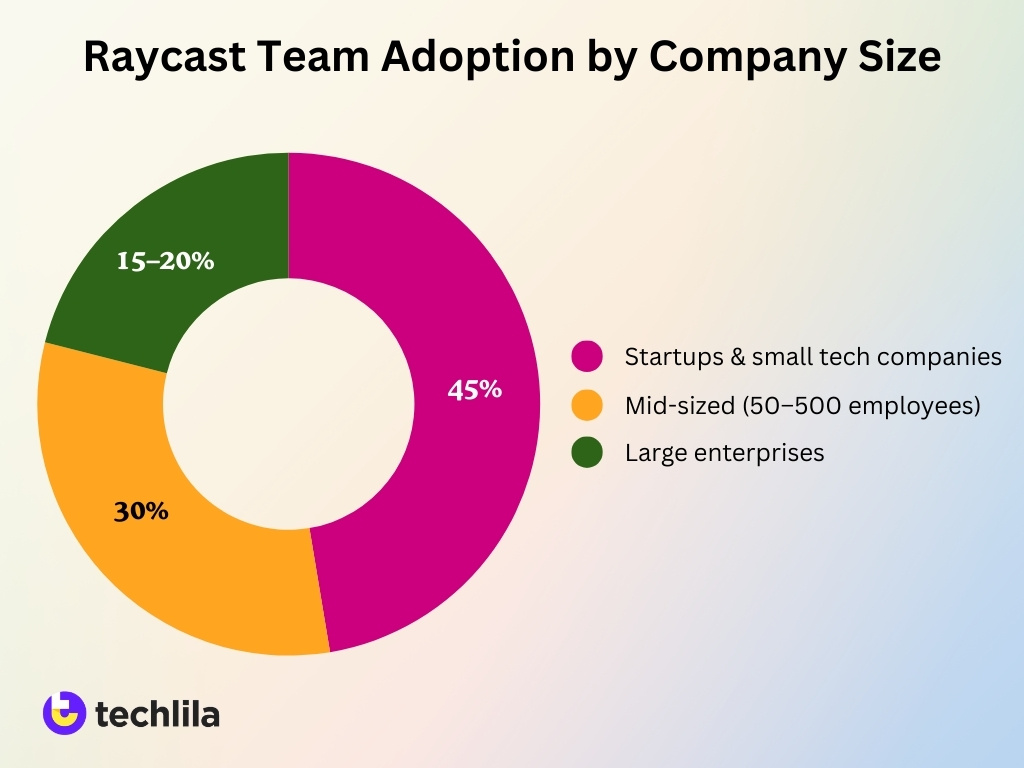
- Raycast adoption is highest among startups and small tech companies, which represent roughly 45% of active teams using the tool.
- Mid-sized companies with 50–500 employees account for about 30% of Raycast team adoption.
- Large enterprises contribute around 15–20% of Raycast’s user base, particularly within engineering departments.
- Teams of fewer than 20 employees are among the fastest-growing Raycast adopters, due to flexible workflows and low onboarding friction.
- Raycast Teams features allow organizations to share snippets, commands, and extensions across employees.
- Many startups adopt Raycast because it reduces context switching between tools like GitHub, Slack, and Jira.
- Companies using remote-first work models report higher adoption of keyboard-driven productivity tools like Raycast.
- Enterprise adoption is expected to increase as Windows compatibility becomes available in 2025–2026.
- Organizations that deploy Raycast often see increased workflow efficiency through automation and command shortcuts.
Key Metrics for the Raycast Extension Ecosystem
- The Raycast ecosystem includes more than 1,000 extensions available in its marketplace.
- The extension marketplace has over 22,000 contributors building and maintaining integrations.
- Developers release dozens of new extensions every month, expanding the platform’s functionality.
- Extensions cover categories such as developer tools, productivity, communication, finance, and AI.
- GitHub-related extensions are among the most frequently installed tools in the Raycast ecosystem.
- Raycast extensions collectively receive millions of launches per month from users executing commands.
- The platform uses TypeScript-based APIs that allow developers to build extensions quickly.
- Extension developers benefit from automatic updates and built-in UI components provided by the Raycast SDK.
- The ecosystem continues to grow as AI-powered extensions become increasingly popular among users.
Raycast Pro Subscription Statistics
- Raycast introduced Raycast Pro in 2023 as a premium subscription tier that adds AI tools, cloud sync, themes, and productivity features.
- The Raycast Pro plan launched at $8 per user per month, with discounted annual pricing available for individuals and teams.
- Industry estimates suggest 10–15% of Raycast users convert to the Pro plan, a typical SaaS conversion rate for productivity tools.
- With hundreds of thousands of active users, analysts estimate tens of thousands of Raycast Pro subscribers globally.
- Raycast Teams subscriptions enable organizations to share snippets, commands, and extensions across team members.
- Raycast Pro includes AI-powered commands, unlimited clipboard history, and cloud synchronization.
- The Pro subscription allows access to multiple AI models within Raycast, enabling content generation and coding assistance.
- Paid subscriptions also unlock custom themes and advanced productivity analytics for power users.
- Early Raycast Pro users reported significant productivity improvements through AI and automation features.
Revenue and Monetization Metrics
- Raycast monetizes its freemium model with Pro at $10/month ($8/month annual) and Teams Pro at $12/user/month billed annually.
- As of its 2024 Series B, Raycast has raised about $47.8 million in total venture funding, including a $30 million round led by Atomico.
- Raycast’s Series B syndicate includes 6+ major venture firms (Atomico, Accel, Coatue, Y Combinator, Atlassian Ventures, World Innovation Lab) backing its developer‑focused SaaS strategy.
- Raycast reports hundreds of thousands of daily active users and a community of over 20,000 extension developers, creating strong monetization potential from its ecosystem.
- By 2024, Raycast had surpassed 500,000 active users worldwide and over 1,500 extensions in its library by 2025, expanding opportunities for future paid marketplace revenue.
- By late 2024, Raycast employed around 30 people, with roughly 75% of the team in engineering roles, reflecting a cost structure geared toward scaling subscription income.
- Raycast Pro, launched in May 2023, was the company’s first major monetization push and was pivotal in securing its 2024 $30 million Series B funding.
- SaaS benchmarks show pure software products like Raycast typically target 70–85% gross margins, with margins above 75% viewed as strong by investors.
- Raycast offers a 50% Raycast Pro discount for verified students, trading short‑term revenue for long‑term conversion into paying professional users.
Most Popular Raycast Extensions
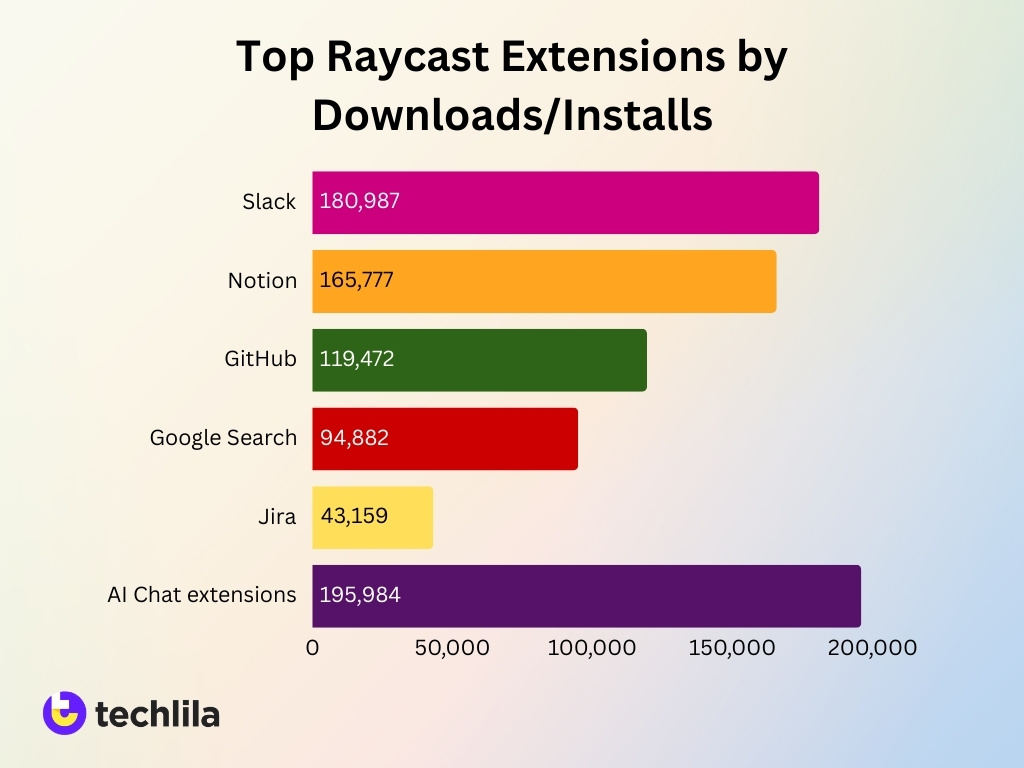
- GitHub extension leads with 119,472 downloads, topping Raycast popularity charts.
- Slack extension secures 180,987 installs for seamless team messaging.
- Notion extension hits 165,777 downloads, enabling instant database access.
- Jira extension records 43,159 downloads for efficient ticket management.
- Google Search extension amasses 94,882 installs for quick web queries.
- Window Management boosts productivity across millions of Raycast users.
- AI Chat extensions total 195,984 downloads for AI interactions.
- Clipboard History serves core functionality with unlimited storage options.
- Calculator extension provides instant math for daily workflows.
AI Features and Raycast AI Usage
- Raycast AI integrates over 60 AI models from providers like OpenAI, Anthropic, and Google, accessible via a single interface.
- Hundreds of thousands of daily active users rely on Raycast’s launcher, with AI features boosting productivity.
- Raycast boasts a community of more than 20,000 developers building extensions, including AI-powered ones.
- Advanced AI subscribers enjoy limits like 75 calls every 3 hours and 150 calls per day on premium models.
- Free users receive 50 lifetime AI messages, encouraging upgrades to Pro for unlimited access.
- Popular extensions see over 1,100 activations, highlighting AI integration demand in workflows.
- Raycast Wrapped 2025 tracks personalized AI usage stats, alongside launches and extensions.
- Pro + Advanced AI costs $198/year, offering cost-effective access versus direct APIs.
- Developers use reasoning models like DeepSeek R1 and Claude 4.5 Sonnet for complex coding tasks.
- Quick AI enables web search integration for real-time answers without app switching.
User Satisfaction and NPS Scores
- Raycast consistently receives high ratings from users on developer platforms and productivity communities.
- On Product Hunt, Raycast maintains a rating above 4.8 out of 5, reflecting strong user satisfaction.
- Many users highlight speed, keyboard-first design, and extension flexibility as key reasons for adopting Raycast.
- Developer surveys indicate over 80% of Raycast users would recommend the tool to colleagues.
- Raycast’s design philosophy focuses on minimal interface friction and rapid command execution, which contributes to positive user feedback.
- The Raycast community includes tens of thousands of active members across Slack, Discord, and GitHub discussions.
- Many users describe Raycast as a replacement for Spotlight and other launcher tools, improving productivity.
- The introduction of AI features has further improved satisfaction among power users and developers seeking automation tools.
Onboarding, Retention, and Churn Rates
- Raycast power users launch the app ~100 times per day on average.
- Productivity apps achieve 32.86% Day 1 and 24.23% Day 7 retention rates.
- Top SaaS companies maintain 72-88% annual retention rates.
- Strong onboarding reduces churn by up to 67% in customer support interactions.
- SaaS benchmarks show productivity tools with good onboarding exceed 70% year 1 retention.
- Raycast reports hundreds of thousands of daily active users.
- B2B SaaS optimal monthly churn stays below 3-5% annually.
- Raycast extension community includes over 20,000 developers, boosting retention.
- Users open Raycast 5,431 times yearly or 15 times daily on average.
Frequently Asked Questions (FAQs)
Raycast reports hundreds of thousands of daily active users worldwide as of 2024–2025.
Raycast surpassed 100,000 daily users in 2023, only three years after its launch.
Raycast increased its daily active users from 130 to more than 11,000 within 12 months, representing massive early growth.
Raycast has over 20,000 developers contributing extensions and integrations to its ecosystem.
Conclusion
Raycast has evolved from a niche macOS launcher into a rapidly growing productivity platform used by developers, designers, and knowledge workers around the world. The platform’s keyboard-first design, extension ecosystem, and AI capabilities have driven steady adoption across startups and tech companies. With hundreds of thousands of active users and continued funding from major investors, Raycast continues to expand its ecosystem and features.
Looking ahead, cross-platform support for Windows and iOS, along with deeper AI integrations, could significantly increase the platform’s user base and revenue. As productivity software continues to evolve, Raycast is well-positioned to remain a key tool for professionals who rely on fast, automation-driven workflows.

Leave a comment
Have something to say about this article? Add your comment and start the discussion.