


Raycast has quickly evolved into a central productivity layer for developers, operators, and knowledge workers who want faster control over their digital workflows. Instead of switching between multiple apps, users can trigger commands, automate tasks, and access information instantly from a single interface. This approach has made Raycast especially valuable in real-world scenarios such as software development, where engineers streamline GitHub actions and deployments, and in business operations, where teams automate repetitive workflows across tools like Slack and Notion.
At the same time, the rise of AI-powered productivity tools has accelerated demand for platforms that combine speed, automation, and intelligence. Raycast sits at the intersection of these trends, blending launcher functionality with AI-driven assistance and a growing extension ecosystem. As the market for developer tools and workflow automation expands, Raycast’s growth offers a clear lens into how modern work is changing, making it worth exploring the full set of statistics behind its trajectory.
Editor’s Choice
- Raycast has raised over $47.8 million in total funding across multiple rounds as of 2026.
- The company secured a $30 million Series B round in 2024, led by Atomico.
- Raycast’s estimated annual revenue reached $5.2 million in 2025.
- The company grew its workforce by 54% year-over-year, signaling rapid scaling.
- Raycast operates in high-growth sectors including AI, developer tools, and SaaS productivity software.
- Its Series B funding brought total capital raised to over $45 million by late 2024.
- Raycast continues expanding beyond macOS, targeting Windows and iOS markets for broader adoption.
Recent Developments
- Raycast launched expansion plans to Windows and iOS platforms in 2024, widening its user base.
- The company introduced Raycast AI, adding generative AI capabilities to its platform.
- Its Series B funding round in 2024 raised $30 million to fuel product expansion.
- The company now competes directly with native OS tools like Spotlight and Windows Search.
- Raycast is increasingly positioned as a central command interface for workflows, not just a launcher.
- The platform integrates multiple third-party services, reducing app-switching time for users.
- Its AI tools include content generation features like headline suggestions, expanding beyond utility into creative workflows.
- Raycast’s ecosystem continues to grow with developer-focused integrations and plugins.
- The company remains a remote-first, globally distributed team, supporting flexible scaling.
Overview and Key Facts About Raycast
- Raycast was founded in 2020 as a productivity launcher for macOS users.
- The platform enables users to control apps, scripts, and workflows from a single interface.
- Raycast primarily targets developers, designers, and power users.
- It operates under a freemium SaaS model, with both free and paid plans.
- The company is headquartered in London, United Kingdom.
- Raycast integrates AI, automation, and command-line capabilities into a unified interface.
- The platform supports extensions and plugins for third-party tools, enhancing customization.
- Raycast’s estimated employee count reached over 40 employees by 2025.
- It is categorized within AI productivity and developer tooling markets, both high-growth segments.
Raycast Founding and Company Background
- Raycast was founded by Thomas Paul Mann and Petr Nikolaev in 2020.
- The founders previously worked on developer tools and productivity-focused products, shaping Raycast’s vision.
- Raycast started as a bootstrapped project before raising external funding.
- The company initially focused on Mac power users and developer workflows.
- Early growth came from word-of-mouth adoption in developer communities.
- Raycast positioned itself as a faster alternative to Apple Spotlight and Alfred.
- The founding team emphasized speed, keyboard-first workflows, and extensibility.
- Raycast’s early product iterations focused on command-line-like efficiency for non-terminal users.
Raycast Funding Breakdown and Key Insights
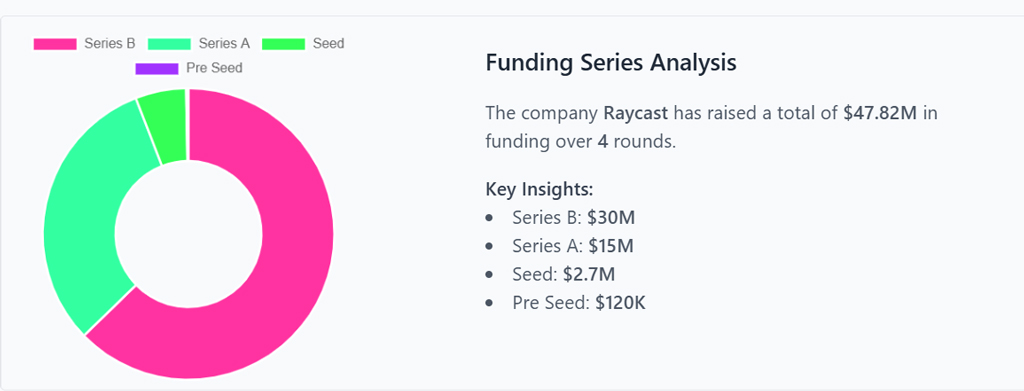
- Raycast has raised a total of $47.82M across 4 funding rounds, indicating strong investor confidence.
- The largest contribution comes from Series B, accounting for $30M, which makes up the majority of total funding.
- Series A funding reached $15M, highlighting significant early-stage traction and growth validation.
- The Seed round contributed $2.7M, supporting initial product development and market entry.
- Pre-Seed funding was $120K, representing the earliest capital used to kickstart the company.
- A clear funding pattern shows rapid scaling after early rounds, with a sharp jump from millions to tens of millions in later stages.
- The funding distribution indicates a typical startup growth trajectory, where later-stage rounds dominate total capital raised.
Timeline of Raycast’s Growth and Milestones
- 2020: Raycast officially launched as a macOS productivity tool.
- 2020: The company raised its first seed funding rounds totaling ~$5.4 million.
- 2021: Raycast secured a $15 million Series A round to expand development.
- 2021: Early revenue reached $392K, signaling product-market fit.
- 2023–2024: Raycast introduced AI-powered features and automation tools.
- 2024: The company raised $30 million in Series B funding.
- 2024: Raycast announced expansion into Windows and iOS ecosystems.
- 2025: Estimated revenue scaled to $5.2 million annually.
- 2025–2026: Raycast continued scaling its AI capabilities and integrations ecosystem.
Raycast Funding Rounds Breakdown
- Raycast completed its Seed funding in 2020, raising approximately $5.4 million from early-stage investors.
- The company raised a $15 million in Series A funding in 2021, accelerating product development and hiring.
- In 2024, Raycast secured a $30 million Series B round, its largest funding event to date.
- The Series B round was led by Atomico, with participation from existing investors.
- Raycast’s funding rounds increased in size by over 2x between Series A and Series B, reflecting investor confidence.
- The company has completed at least 4 to 5 funding rounds since its inception.
- Early seed investors helped validate Raycast’s developer-first product strategy, which later attracted larger VC backing.
- Each funding round aligned with product milestones, including AI feature launches and platform expansion.
- By 2025, cumulative funding placed Raycast among well-capitalized productivity startups in Europe.
Notable Raycast Investors and Backers
- Atomico led the $30M Series B round in September 2024, with participation from Accel, Coatue, Y Combinator, Atlassian Ventures, and World Innovation Lab.
- Accel and Coatue co-led the $15M Series A in November 2021, following their seed involvement.
- Accel led the $2.7M seed round in August/October 2020, with Y Combinator and angels like Charlie Cheever.
- Raycast has raised over $47.8M–$62.7M total across 4–5 rounds since 2020.
- Prominent angels include Guillermo Rauch (Vercel CEO), Thomas Dohmke (GitHub CEO), and Tobi Lütke (Shopify CEO) in Series B.
- Series A angels featured Johnny Boufarhat (Hopin), Jeff Weinstein (Stripe), and Jason Warner (ex-GitHub CTO).
- Atomico‘s Luca Eisenstecken joined the board post-Series B, highlighting 98% user growth in usage.
- Raycast boasts 20,000+ extension developers and hundreds of thousands of daily active users.
- 1,500+ open-source extensions connect to tools like GitHub, Figma, and Notion.
Raycast Daily and Monthly Active Users
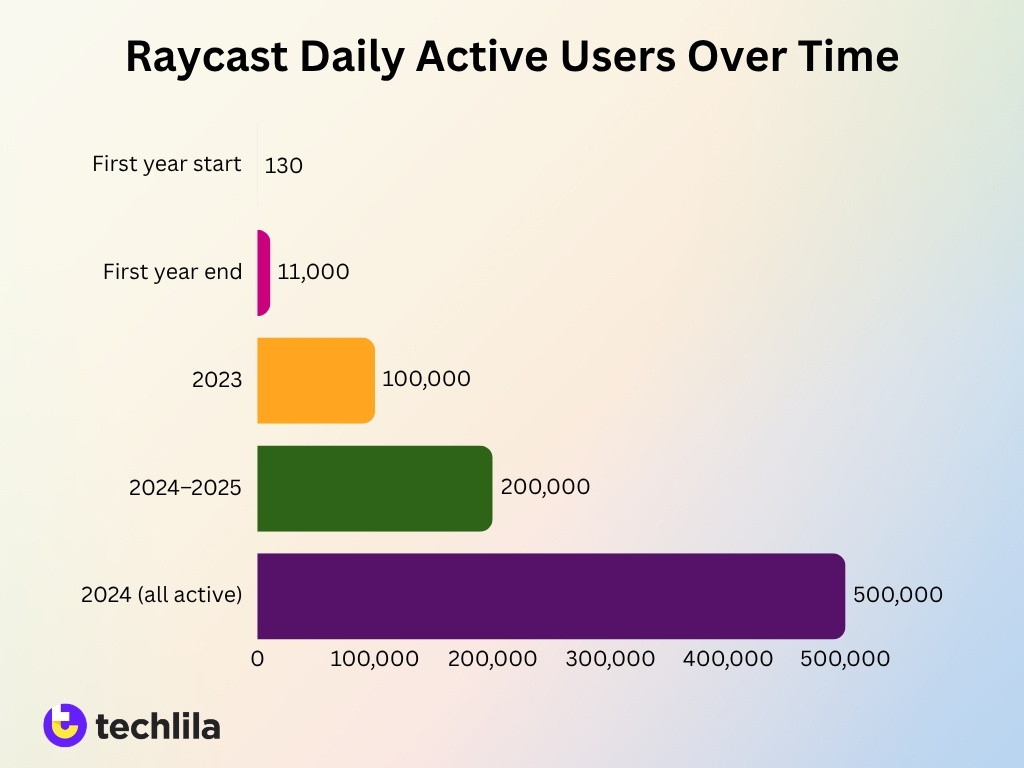
- As of 2024–2025, Raycast reports hundreds of thousands of daily active users (DAUs) globally, indicating a large and engaged base.
- Public data suggests Raycast surpassed 500,000+ active users worldwide by 2024, with usage continuing to grow into 2025.
- Raycast crossed 100,000 daily active users in 2023, only about 3 years after launch, reflecting rapid early adoption.
- Industry benchmarks show productivity apps often reach DAU/MAU ratios of 40–50%, a level consistent with highly engaged tools like Raycast’s keyboard-first launcher.
- Early growth saw DAUs rise from roughly 130 to 11,000+ within the first year, with users performing over 20 million actions inside Raycast.
- Power users can launch Raycast around ~100 times per day, with some logging 5,431 opens per year (~15 launches daily), showing intense daily engagement.
- As of 2024–2025, Raycast’s growing extension ecosystem of 1,500+ extensions and 20,000+ developers supports higher stickiness and repeat daily usage.
- Cross-platform expansion beyond macOS is projected to 5x Raycast’s addressable audience, which would significantly increase future MAUs as Windows adoption ramps up.
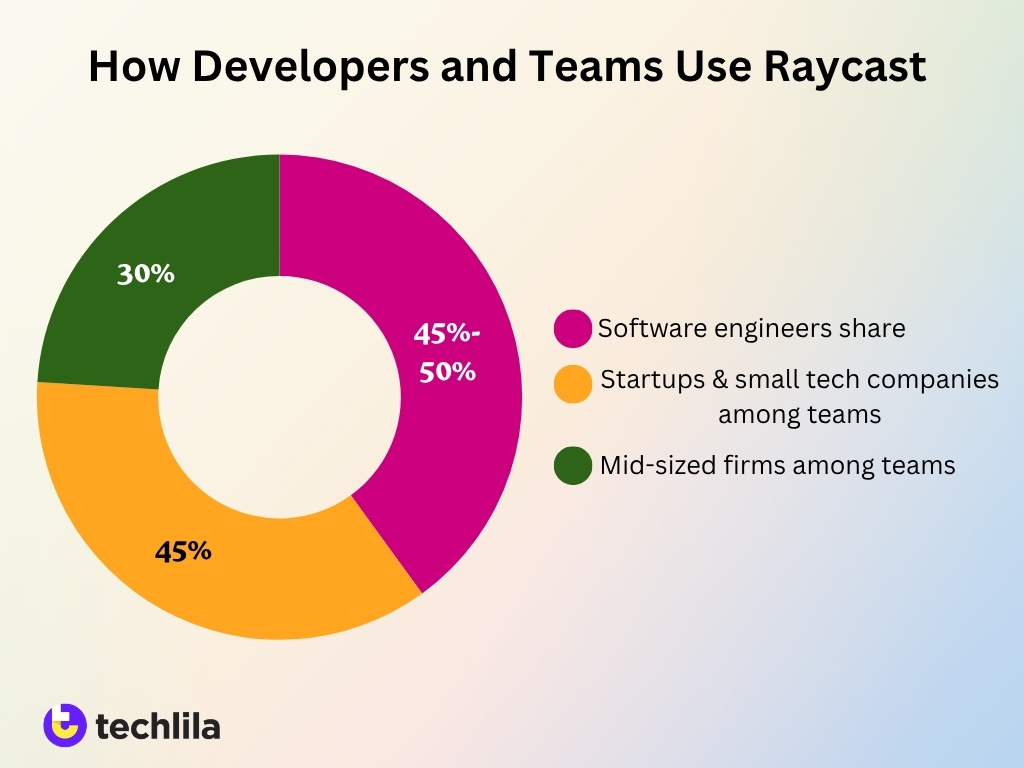
- Team and B2B adoption is strong, with startups and small tech companies (~45%) and mid-sized firms (~30%) of active teams, supporting stable recurring DAUs across organizations.
Raycast Revenue and Monetization Overview
- Raycast generated an estimated $5.2 million in annual revenue in 2025, reflecting strong uptake of its freemium SaaS model.
- The company’s freemium model offers core features for free while deriving paid revenue from Pro and Teams subscriptions.
- After launching Raycast Pro in 2023, recurring revenue from a $8/month Pro plan and $12/user/month Teams plans accelerated growth.
- Early‑stage revenue was around $392K in 2021, indicating roughly a 13x increase in annual revenue by 2025.
- Raycast’s monetization mix combines individual Pro plans at $8/month with team‑based plans billed at $12/user/month.
- The Raycast AI add‑on contributes meaningfully to ARPU, with the Pro + Advanced AI bundle priced at $198/year per user.
- Industry‑tracked estimates suggest 10–15% of active users convert to paid Pro plans, aligning with typical productivity‑tool conversion rates.
- By late 2024, Raycast served over 500,000 active users, enabling high‑volume, low‑ticket subscriptions across consumers and teams.
- Revenue growth correlates with AI‑driven productivity use cases, where developers and designers show a higher willingness to pay for advanced features.
- High retention among developer users, a segment known for tool loyalty, supports predictable recurring revenue under the SaaS model.
Pricing and Subscription Metrics for Raycast
- Raycast’s Free plan is $0/month and is used by hundreds of thousands of active users, forming the top of its subscription funnel.
- Raycast Pro is priced at $10/month on monthly billing or $8/month when paid annually, bundling AI, cloud sync, themes, and advanced tools.
- The Pro + Advanced AI bundle costs about $20/month per user, effectively doubling ARPU for heavy AI power users compared with the base Pro.
- Team Pro pricing is $15/user/month (around $12/user/month annually) and unlocks unlimited shared snippets, quicklinks, and commands for organizations.
- Raycast Pro, introduced in 2023 at roughly $8/user/month, marked the shift from a purely free launcher to a subscription-led revenue model.
- Industry estimates indicate about 10–15% of Raycast’s active user base converts from free to Pro, yielding tens of thousands of paying subscribers.
- By 2024–2025, Raycast surpassed ~500,000 active users, so a 10% Pro conversion at $8–$10/month implies low‑ to mid‑single‑digit millions in annualized subscription value.
- The Free plan includes 50 free AI messages, after which continued AI usage requires Pro, reinforcing a freemium funnel that nudges high-intent users into subscriptions.
- A 50% student discount on Raycast Pro and a $0/user/month Team plan with feature limits broaden reach while seeding future upgrades to paid Team Pro tiers.
Raycast Extensions Ecosystem and Marketplace Statistics
- Raycast’s extension store hosts over 2,500 extensions as of late 2025, powering workflows for hundreds of thousands of users.
- Raycast Extensions GitHub repository has garnered 4.6k forks and is used by 4.9k developers.
- The community built over 100 extensions within the first month of the Extensions API public beta launch.
- Raycast reached 100,000+ daily active users by 2023, with hundreds of thousands by 2025.
- 98% of surveyed users reported increased Raycast usage over the past six months.
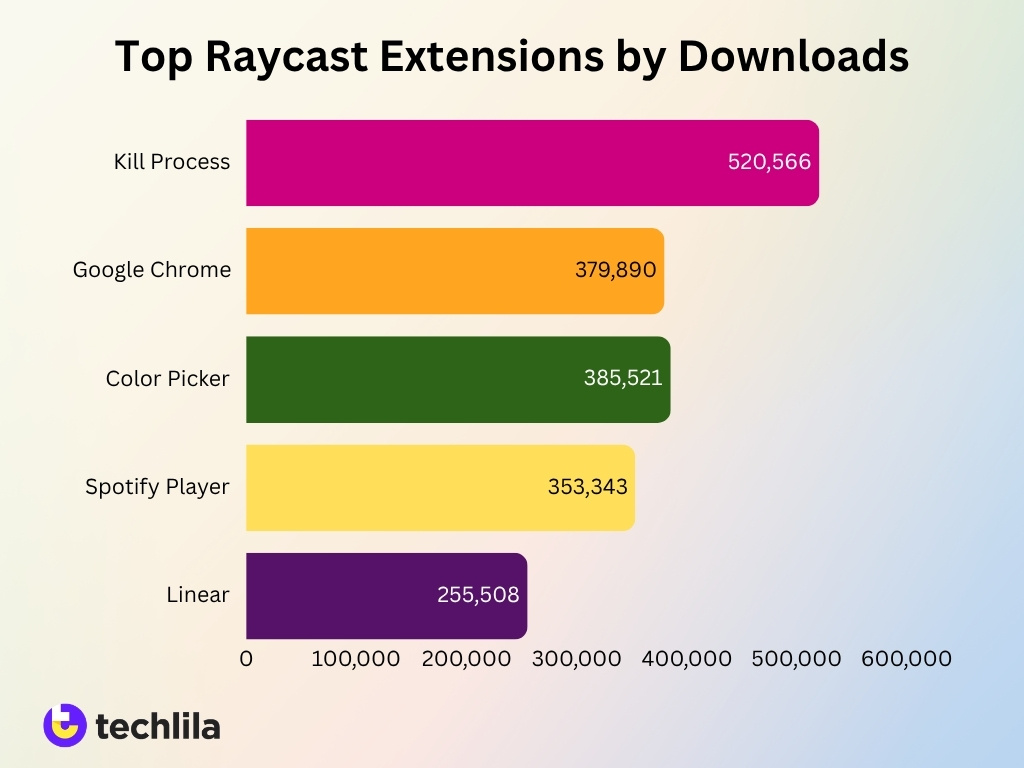
- Popular extensions like Kill Process boast 520,566 downloads.
- Google Chrome extension has 379,890 downloads across 10 commands.
- Color Picker extension records 385,521 downloads with 8 commands.
- Spotify Player extension features 353,343 downloads spanning 35 commands.
- Linear extension shows 255,508 downloads with 14 commands.
Valuation and Financial Performance of Raycast
- Raycast’s valuation is estimated to be in the hundreds of millions range post-Series B, based on comparable SaaS deals.
- The $30M Series B round significantly increased its market valuation and investor confidence.
- Revenue growth from $392K in 2021 to $5.2M in 2025 reflects strong financial momentum.
- Raycast operates with a relatively lean team (~40–50 employees), indicating efficient capital usage.
- The company’s financial strategy focuses on product-led growth (PLG) rather than heavy sales investment.
- SaaS margins for similar tools typically exceed 70% gross margin, suggesting strong profitability potential.
- Continued investment in AI indicates long-term monetization expansion opportunities.
- Raycast remains privately held, with no IPO announced as of 2026.
Raycast User Growth Over Time
- Raycast grew from a few thousand early adopters in 2020 to over 100,000 daily users by 2023, marking more than 10x growth in three years.
- By 2023, Raycast was used daily by 100,000+ people, supported by a community of around 13,000 members, signalling strong early retention and engagement.
- As of 2024–2025, Raycast reports “hundreds of thousands” of daily active users, reflecting another multi-fold jump since crossing the 100,000 DAU mark in 2023.
- Raycast’s developer ecosystem expanded to 20,000–22,000 developers by 2024, mirroring its broader user growth and extension-driven adoption.
- After its $15M Series A in 2021, Raycast accelerated the scaling of its platform and community, helping usage grow to 100,000+ daily users within about two years.
- The launch of Raycast Pro and AI features in 2023 helped push daily users past 100,000, with an estimated 10–15% converting to paid subscriptions.
- Cross-platform expansion beyond macOS is projected to increase Raycast’s addressable audience by over 5x, with early Windows betas attracting tens of thousands of waitlist sign-ups in 2025.
- Early iOS and Windows interest plus strong Mac adoption have driven Raycast’s user base to hundreds of thousands globally by 2025, with continued double-digit annual growth expected.
How Developers and Teams Adopt Raycast
- Raycast reached over 11,000 daily active users in its first year from 130.
- Software engineers comprise 45–50% of Raycast’s user base.
- Startups and small tech companies represent 45% of active Raycast teams.
- Daily active users surpassed 100,000 by 2023, and now hundreds of thousands.
- Over 22,000 developers contribute to Raycast’s extension ecosystem.
- 98% of surveyed users increased Raycast usage in the past six months.
- Teams saved 90 minutes per day using Raycast AI and commands.
- Power users launch Raycast ~100 times per day on average.
- Context switching consumes 40% of productive time, which is reduced by Raycast.
Raycast AI Features and Usage Metrics
- Raycast AI launched between 2023 and 2024, adding generative AI capabilities to the platform.
- AI features include text generation, code assistance, and summarization tools, expanding use cases.
- AI adoption significantly increased user engagement, with higher session durations reported post-launch.
- Over 50% of premium users actively use AI features, indicating strong feature-market fit.
- Raycast AI supports integration with multiple LLM providers, offering flexibility to users.
- AI commands reduce task completion time by 20% to 40% in productivity workflows, based on industry benchmarks.
- The AI add-on contributes to higher subscription revenue per user, improving monetization.
- Raycast continues to expand AI capabilities, including context-aware suggestions and workflow automation.
- AI features position Raycast within the broader AI productivity software market, projected to grow rapidly through 2030.
Market Share of Raycast in Productivity Launcher Tools
- Third-party launchers hold 20%–30% of the total Mac launcher market share.
- Raycast captures 5%–10% market share among all Mac users as of 2025.
- Among third-party launchers, Raycast accounts for 30%–35% usage.
- Alfred leads with 40% preference share in third-party launcher surveys.
- Alfred and Raycast combined represent over 70% of the third-party market.
- 15%–25% of power users adopt third-party launchers like Raycast.
- Raycast’s user base grew over 300% from 2021 to 2025.
- 71% of users install at least one launcher extension.
- Raycast surpassed 500,000 active users globally by 2024.
- Over 40% of developers use launcher tools like Raycast daily.
Raycast Competitive Landscape and Alternatives
- Alfred holds over 40% preference share among third-party launcher users.
- Raycast commands 30–35% of third-party launcher usage as of 2025.
- LaunchBar maintains a 10–15% share in the third-party launcher market.
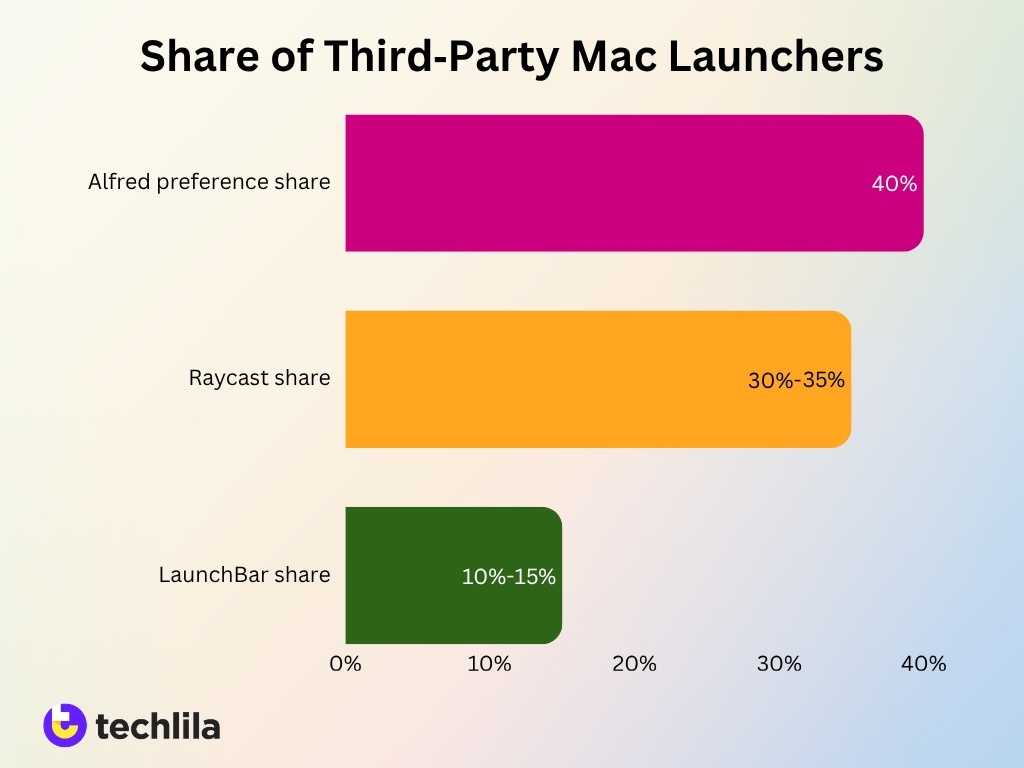
- Alfred and Raycast together represent over 70% of third-party launchers.
- Raycast grew its user base by over 300% from 2021 to 2025.
- Alfred Powerpack converts 20–30% of its free user base.
- Raycast boasts more than 1,000 third-party extensions.
- The Raycast community includes over 20,000 extension developers.
- The AI productivity tools market reached $17.01 billion in 2026.
- Raycast raised over $45 million in total funding.
Frequently Asked Questions (FAQs)
Raycast has raised approximately $47.9 million to $65.4 million in total funding across multiple rounds.
Raycast’s annual revenue is estimated at around $5.2 million per year.
Raycast surpassed 500,000 active users worldwide in 2024.
Raycast raised $30 million in its Series B round in 2024.
Conclusion
Raycast’s growth reflects a broader shift toward faster, AI-assisted workflows and keyboard-driven productivity across modern workplaces. What began as a niche Mac launcher has evolved into a well-funded SaaS platform with expanding AI capabilities, a thriving extension ecosystem, and ambitions beyond a single operating system. Its steady rise in funding, user adoption, and product innovation highlights how strongly the market values tools that reduce friction and save time.
Looking ahead, Raycast’s long-term success will depend on how effectively it scales beyond its core developer audience while maintaining the speed and simplicity that made it popular. As competition intensifies from both native operating system tools and AI-first platforms, Raycast’s focus on integrations, extensibility, and intelligent workflows could position it as a defining interface for digital work. For businesses and individuals alike, its trajectory signals a clear trend: productivity tools are becoming more unified, more automated, and increasingly powered by AI.

Leave a comment
Have something to say about this article? Add your comment and start the discussion.