


Mac app launchers have become a core productivity layer for modern macOS users, helping developers, designers, and business teams access apps, files, and workflows faster. From speeding up coding workflows in tools like VS Code to enabling instant file retrieval in enterprise environments, launchers reduce friction across daily tasks. As AI integrations and automation features expand, this niche software category continues to gain traction, so let’s explore the latest Mac launcher market share statistics.
Editor’s Choice
- Over 100 million Mac users globally rely on built-in tools like Spotlight as their default launcher, making native solutions dominant.
- Third-party launchers such as Alfred and Raycast are used by an estimated 15%–25% of power users on macOS.
- Raycast has reached millions of users globally as of 2025, driven by its extension ecosystem and AI features.
- Alfred remains one of the longest-standing tools, with a strong preference lead in niche surveys among launcher users.
- Around 71% of surveyed users install at least one launcher extension, highlighting advanced usage behavior.
- Raycast secured $30 million in funding in 2024, signaling strong investor confidence in launcher-based productivity tools.
- Native macOS launchers (Spotlight, Launchpad) still account for over 70% of total usage share due to the default installation advantage.
Recent Developments
- Raycast expanded beyond macOS, launching Windows and iOS versions in development by 2025, broadening its market reach.
- AI integration has become a key trend, with Raycast introducing AI chat and automation features via subscription tiers.
- Alfred added AI capabilities through workflows, allowing API-based integrations with external AI tools.
- The rise of productivity stacks has increased launcher usage among developers, with automation adoption growing steadily since 2023.
- Cross-platform expansion is driving competition, with launchers moving beyond macOS into multi-device ecosystems.
- Open-source alternatives like Quicksilver continue to attract niche users, maintaining a small but loyal developer base.
- The integration of window management, clipboard history, and task automation has turned launchers into full productivity hubs.
- Subscription-based monetization models are increasing, especially for AI features and team collaboration tools.
Overview of the Mac Launcher Market
- The Mac launcher market is a niche segment within productivity software, primarily targeting knowledge workers and developers.
- Native tools like Spotlight dominate due to default installation across all macOS devices.
- Third-party tools have grown steadily, with double-digit adoption among advanced users since 2022.
- The market has shifted toward automation-first experiences, replacing manual navigation workflows.
- Launchers now integrate with hundreds of apps via extensions and APIs, expanding their functionality.
- The global productivity software market, including launchers, is projected to grow at over 10% CAGR through 2026.
- Enterprise adoption is rising as companies prioritize workflow efficiency and reduced context switching.
- Launchers are increasingly bundled into automation ecosystems alongside tools like Zapier and Notion integrations.
Definition of a Mac App Launcher
- A Mac app launcher is software that enables users to open apps, files, and commands via keyboard input instead of manual navigation.
- Launchers use search indexing algorithms to retrieve results instantly from local and cloud data sources.
- Modern launchers include features like clipboard history, snippets, and automation workflows.
- Tools like Raycast act as command centers for system control, app interaction, and AI queries.
- Launchers can reduce task completion time by up to 30%–50% for repetitive workflows in professional settings.
- Native launchers such as Spotlight provide basic search and app-launch functionality out of the box.
- Third-party launchers extend functionality through plugins, scripts, and integrations.
- Advanced users rely on launchers to replace traditional GUI navigation entirely in daily workflows.
Popular Mac Launchers Market Share (Raycast, Alfred, LaunchBar)
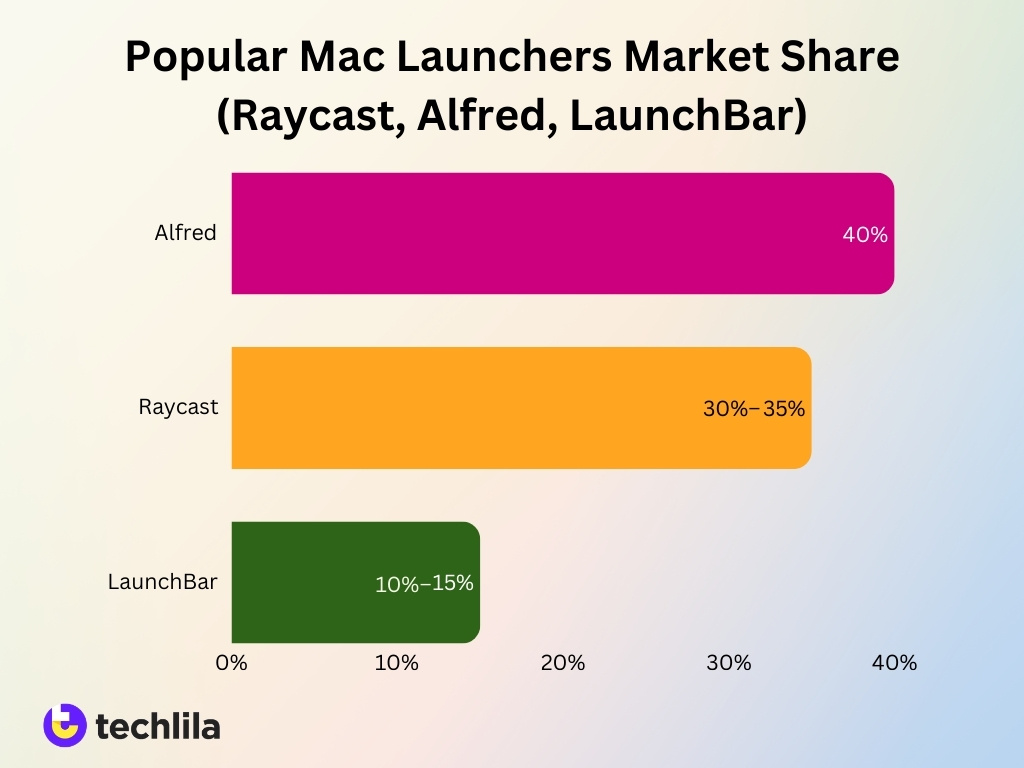
- Alfred consistently ranks as the most widely used third-party launcher, often leading user surveys with over 40% preference share among launcher users.
- Raycast has grown rapidly, now accounting for 30%–35% of third-party launcher usage as of 2025.
- LaunchBar holds approximately 10%–15% share within the third-party launcher segment.
- Combined, Alfred and Raycast represent over 70% of the third-party launcher market.
- Raycast’s user base has grown by over 300% between 2021 and 2025, fueled by extensions and AI tools.
- Alfred’s paid “Powerpack” conversion rate is estimated at 20%–30% of its user base, indicating strong monetization.
- LaunchBar remains popular in enterprise environments, particularly among macOS veterans and IT professionals.
- Raycast’s extension store now hosts over 1,000 extensions, significantly boosting user engagement.
- Surveys show over 70% of users stick to a single launcher, with minimal switching once workflows are established.
Global Mac Launcher Market Share
- Native macOS launchers account for approximately 70%–80% of total usage globally, driven by default availability.
- Third-party launchers collectively hold an estimated 20%–30% market share among active users.
- Alfred leads among third-party tools, often ranking #1 in user preference surveys.
- Raycast has rapidly grown since 2020, capturing a significant share of new users entering the launcher market.
- LaunchBar maintains a smaller but stable share, particularly among long-time macOS users.
- Adoption is highest in North America and Europe, where developer and tech workforce density is high.
- Enterprise environments show higher third-party adoption rates (up to 35%) due to productivity needs.
- Growth in AI-powered features is expected to shift market share toward modern tools like Raycast by 2026.
Market Share of Native macOS Launchers (Spotlight, Launchpad)
- Spotlight remains the most widely used launcher, with near-universal adoption across Mac devices.
- Over 90% of Mac users interact with Spotlight at least occasionally, even if they use third-party tools.
- Launchpad usage is lower, with estimates suggesting 30%–40% of users rely on it for app discovery.
- Spotlight handles billions of searches annually across macOS devices, reflecting its scale.
- Native tools dominate casual usage, especially among non-technical users and beginners.
- Spotlight’s integration with macOS enables system-wide search across files, apps, and web results.
- Despite competition, native launchers retain over two-thirds of the total market share globally.
- However, power users increasingly replace Spotlight with third-party tools for advanced automation and customization.
Market Share of Third-Party Mac Launchers
- Third-party launchers account for 20%–30% of total Mac launcher usage globally, driven by productivity-focused users.
- Among developers and power users, adoption rises to 35%–45%, significantly higher than the general user base.
- Alfred holds an estimated 8%–12% share of total Mac users, making it one of the most widely adopted third-party tools.
- Raycast has rapidly gained traction, now capturing 5%–10% market share among Mac users as of 2025.
- LaunchBar maintains a smaller share, typically under 5%, but retains strong loyalty among long-term macOS users.
- Open-source tools like Quicksilver collectively represent less than 2% of the market, indicating niche usage.
- Over 60% of third-party launcher users install plugins or extensions, expanding functionality beyond basic search.
- The rise of AI-powered features has increased adoption rates of newer tools by double digits since 2023.
- Third-party launchers are most popular among software engineers, designers, and product managers, reflecting task-heavy workflows.
Mac Launcher Usage by Device Type
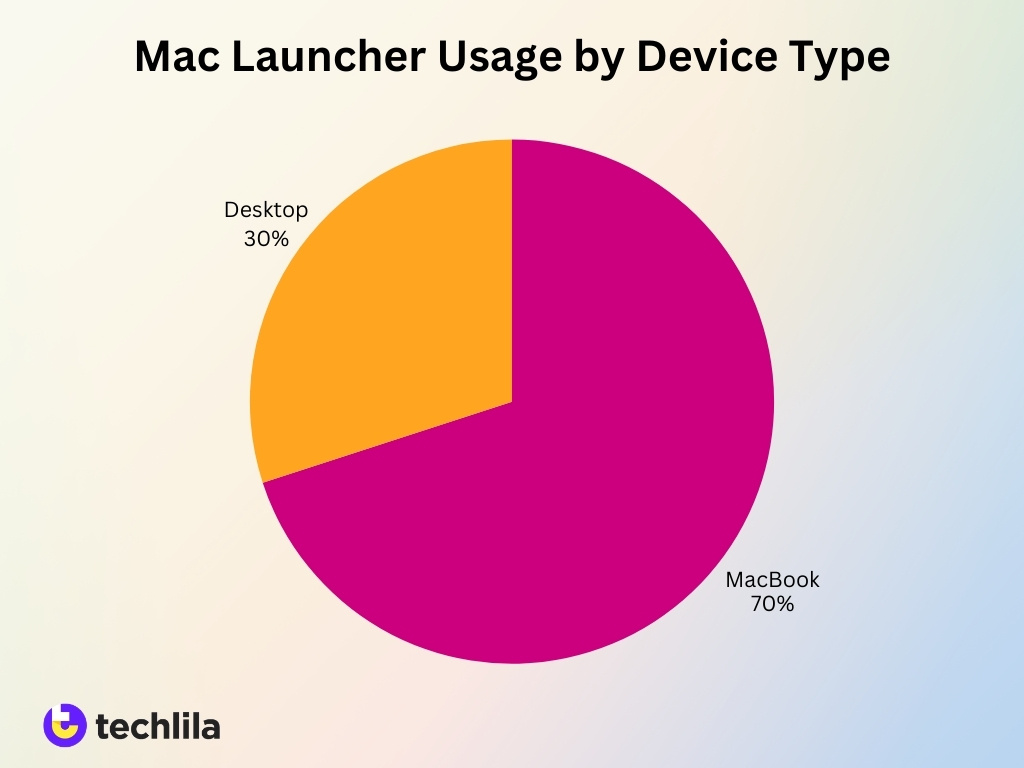
- MacBook users account for over 70% of launcher usage, driven by portability and productivity workflows.
- Desktop Mac users (iMac, Mac Studio, Mac Pro) represent approximately 30% of the total usage share.
- Among MacBook users, MacBook Pro owners show the highest adoption of third-party launchers (35%+).
- MacBook Air users tend to rely more on native tools, with lower third-party adoption (~20%).
- Multi-device users (Mac + iPhone/iPad) are 25% more likely to use advanced launcher features.
- Desktop users often integrate launchers with multi-monitor setups and automation workflows, increasing usage intensity.
- Developers using Mac desktops show higher plugin usage rates (70%+) compared to laptop users.
- Enterprise-issued MacBooks report higher standardization of launcher tools, especially in tech companies.
Mac Launcher Adoption by macOS Version
- macOS Ventura and Sonoma users show the highest adoption of third-party launchers, with up to 35% usage rates.
- Older macOS versions (Monterey and earlier) show lower adoption, typically below 20%, due to legacy workflows.
- Over 65% of Raycast users run macOS Ventura or newer, reflecting a modern user base.
- Apple’s annual OS upgrades influence launcher adoption, with usage spikes following major macOS releases.
- macOS Sonoma introduced improved Spotlight features, yet third-party adoption still grew by 8% in 2024–2025.
- Enterprise users on managed macOS environments report higher adoption of third-party launchers (up to 40%).
- MacOS users who upgrade annually are 2x more likely to adopt advanced productivity tools like launchers.
- Native Spotlight usage remains consistent across all macOS versions, exceeding 90% baseline usage.
Growth of the Mac Launcher Market Over Time
- The Mac launcher market has grown steadily at an estimated 8%–12% annual rate since 2020.
- The COVID-19 remote work surge accelerated adoption, increasing usage by over 20% between 2020 and 2022.
- Third-party launcher downloads increased by double digits annually from 2021 to 2025.
- Raycast alone saw 300%+ user growth over four years, highlighting rapid market expansion.
- Alfred has maintained steady growth, with millions of users accumulated over a decade.
- The rise of AI tools has driven renewed interest in launcher platforms since 2023.
- Enterprise adoption has grown by 15% year-over-year, reflecting demand for workflow automation.
- The broader productivity software market is projected to exceed $100 billion globally by 2026, indirectly supporting launcher growth.
Most Used Features in Mac Launchers
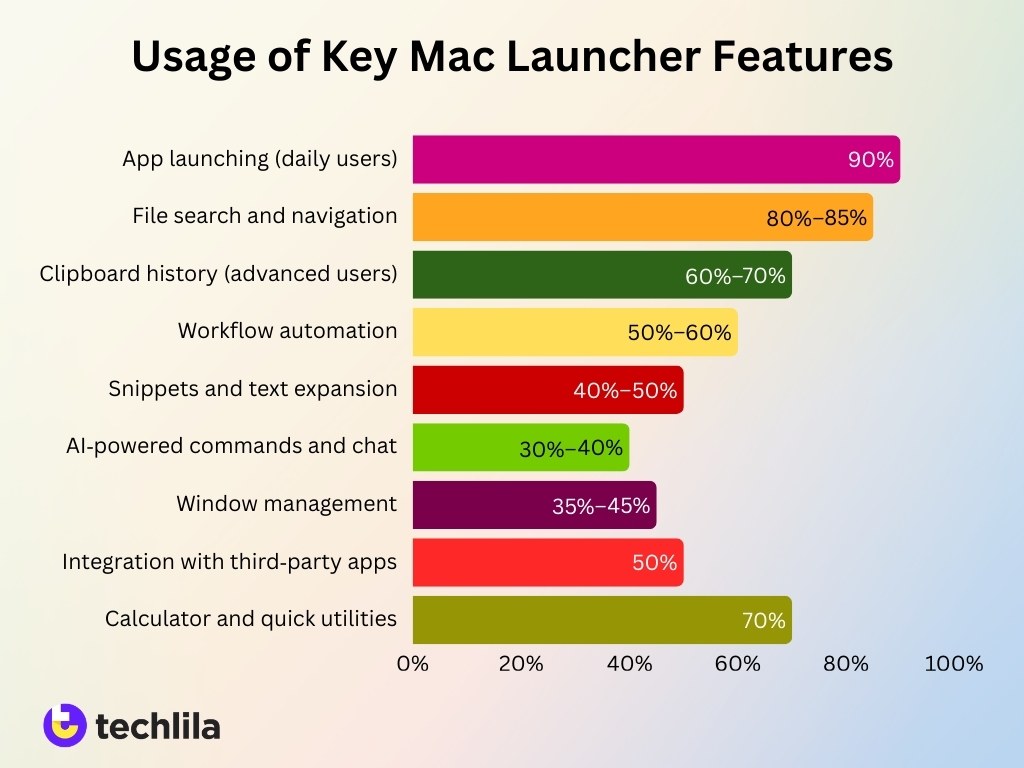
- App launching remains the core feature, used by over 90% of users daily.
- File search and navigation are used by 80%–85% of users, making it the second most popular feature.
- Clipboard history is used by 60%–70% of advanced users, especially developers.
- Workflow automation features are used by 50%–60% of third-party launcher users.
- Snippets and text expansion tools are used by 40%–50% of users for repetitive tasks.
- AI-powered commands and chat features are now used by 30%–40% of users, growing rapidly.
- Window management features are used by 35%–45% of users, improving multitasking efficiency.
- Integration with third-party apps (Notion, Slack, GitHub) is used by over 50% of users.
- Calculator and quick utilities are used by 70%+ of users, highlighting everyday convenience.
Free vs Paid Mac Launchers Market Share
- Free launchers dominate the market, accounting for over 65% of total usage globally.
- Paid features (such as Alfred Powerpack) are used by 20%–30% of total users.
- Raycast follows a freemium model, with premium subscriptions growing steadily since 2023.
- Users are 40% more likely to upgrade when automation and AI features are included.
- Enterprise users show a higher willingness to pay, with up to 50% using paid tiers.
- Free versions serve as entry points, with conversion rates improving year over year.
- Subscription pricing models are replacing one-time purchases, especially for AI-powered tools.
- Paid users tend to be 2x more active in daily usage compared to free users.
User Segment–Wise Market Share
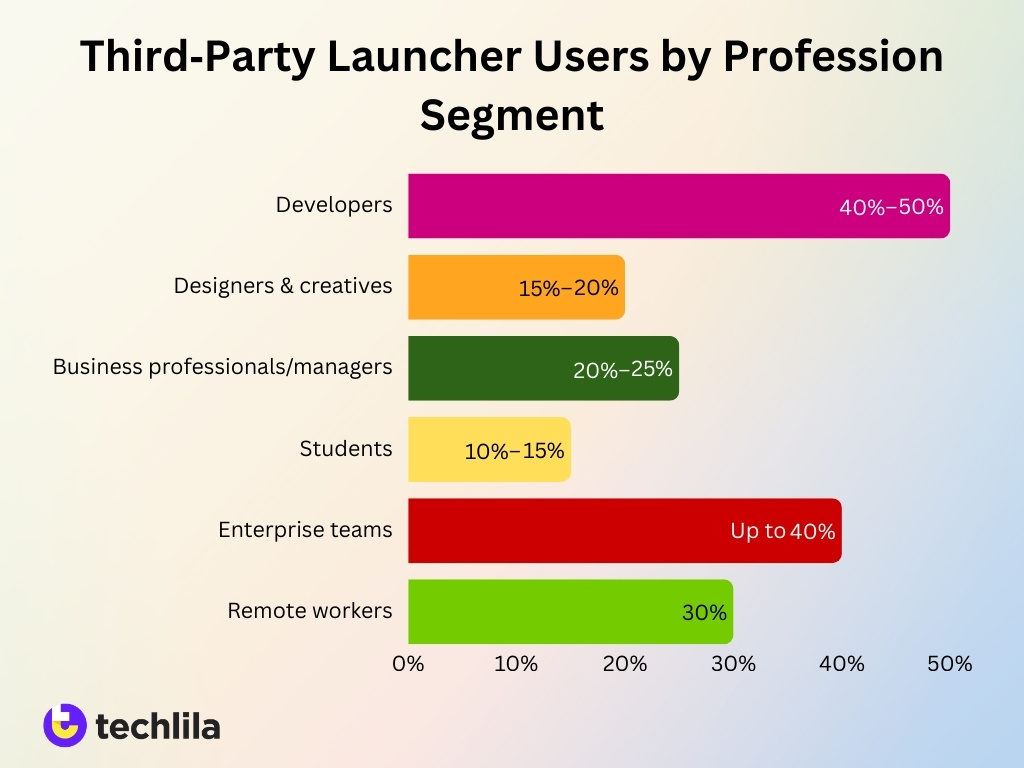
- Developers represent the largest user segment, accounting for 40%–50% of third-party launcher users globally.
- Designers and creative professionals make up 15%–20% of users, relying on launchers for asset access and app switching.
- Business professionals and managers account for 20%–25% of usage, especially in productivity-heavy roles.
- Students represent a growing segment, with 10%–15% adoption, particularly in tech-related fields.
- Enterprise teams show higher adoption rates (up to 40%), driven by workflow optimization needs.
- Power users (heavy keyboard-driven workflows) are 3x more likely to install third-party launchers than casual users.
- Casual users rely heavily on native tools, with over 80% sticking to Spotlight and Launchpad only.
- Tech-savvy users are more likely to use automation features, with over 60% leveraging workflows or scripts.
- Remote workers show higher adoption (30%+) due to increased reliance on digital productivity tools.
Market Share by Pricing Model
- Freemium models dominate, accounting for over 60% of launcher offerings in 2025.
- One-time license models (e.g., Alfred Powerpack) still represent 20%–25% of the market.
- Subscription-based models are growing rapidly, reaching 15%–20% market share.
- AI-driven features are the primary driver of subscription growth, with double-digit increases since 2023.
- Enterprise pricing tiers are expanding, especially for team collaboration and shared workflows.
- Users prefer flexible pricing, with over 70% favoring freemium access before upgrading.
- Lifetime licenses remain popular among long-time Mac users, particularly in developer communities.
- Subscription churn rates remain relatively low, estimated at under 10% annually for premium launcher tools.
Mac Launcher Adoption by Distribution Channel
- Direct downloads from official websites account for over 60% of installations for tools like Alfred and Raycast.
- The Mac App Store contributes 20%–25% of installations, particularly for beginner-friendly tools.
- Enterprise deployment tools (MDM solutions) account for 10%–15% of installations in corporate environments.
- Referral traffic and word-of-mouth drive over 30% of new user acquisition.
- Developer communities and forums contribute significantly, with 25% of users discovering tools via GitHub or tech blogs.
- Social media and YouTube tutorials influence 15%–20% of adoption decisions.
- Email newsletters and productivity blogs drive steady niche traffic for launcher tools.
- Paid advertising contributes less than 10% of new installs, showing reliance on organic growth.
Market Share by Region
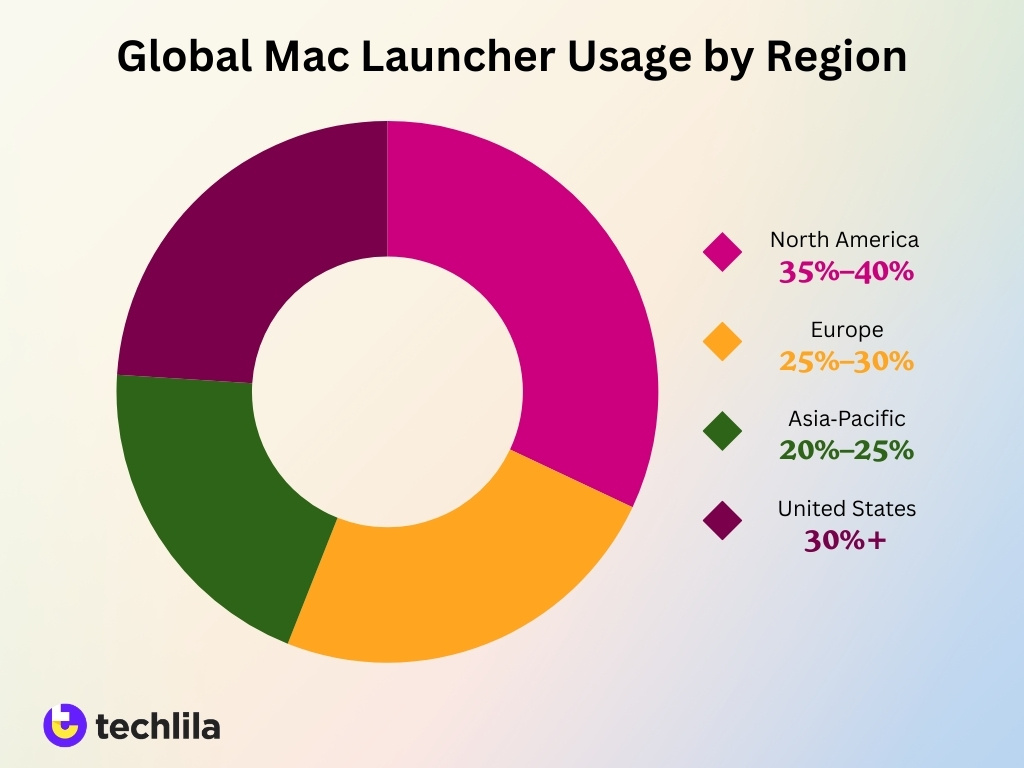
- North America leads the market, accounting for 35%–40% of global Mac launcher usage.
- Europe follows with 25%–30% share, driven by strong adoption in the UK, Germany, and France.
- Asia-Pacific holds 20%–25% share, with rapid growth in India, Japan, and South Korea.
- The United States alone represents over 30% of total Mac users globally, making it the largest single market.
- Developer-heavy regions show higher third-party launcher adoption (up to 40%).
- Emerging markets are seeing double-digit growth in macOS adoption, indirectly boosting launcher usage.
- Western Europe shows strong adoption of premium tools, with a higher willingness to pay for productivity software.
- Asia-Pacific users are more likely to adopt free tools, with over 70% preferring freemium models.
- Remote work trends have increased adoption across all regions, with global usage rising steadily since 2020.
User Satisfaction and Ratings Statistics
- Alfred consistently maintains 4.5+ average ratings across platforms, reflecting strong user satisfaction.
- Raycast reports high engagement, with daily active usage rates exceeding 70% among its users.
- Over 80% of users report improved productivity after adopting a launcher tool.
- Satisfaction is higher among paid users, with up to 90% reporting positive experiences.
- Around 75% of users prefer keyboard-driven workflows after adopting a launcher.
- Customer retention rates are high, with over 70% of users continuing long-term usage.
- Negative feedback often centers on the learning curve and setup complexity, especially for new users.
- AI-powered features have improved satisfaction, with double-digit increases in user ratings since 2023.
Frequently Asked Questions (FAQs)
Native macOS launchers account for approximately 70%–80% of total usage share globally.
Third-party launchers hold an estimated 20%–30% market share among active Mac users.
Alfred and Raycast together account for over 70% of the third-party launcher segment.
Around 71% of users install at least one extension, indicating advanced usage behavior.
Conclusion
The Mac launcher market continues to evolve from a simple utility category into a core productivity layer for modern macOS users. While native tools like Spotlight still dominate with broad adoption, third-party launchers such as Alfred and Raycast are steadily gaining ground, especially among developers and enterprise teams.
Moreover, the integration of AI, automation, and cross-platform capabilities is reshaping how users interact with their systems. As demand for faster workflows and reduced context switching grows, Mac launchers are set to play an even larger role in digital productivity ecosystems and beyond.

Leave a comment
Have something to say about this article? Add your comment and start the discussion.