


Homebrew has become a cornerstone tool for developers, DevOps engineers, and data professionals who need fast and reliable package management across macOS and Linux environments. Whether teams are setting up local development stacks, managing dependencies in CI/CD pipelines, or standardizing software across enterprise machines, Homebrew plays a central role in keeping workflows efficient and consistent. Its extensive analytics ecosystem offers valuable insights into how developers install, update, and use tools at scale.
By examining these trends, businesses and engineers can better understand shifts in technology adoption, performance needs, and developer preferences. Let’s explore the latest Homebrew statistics and what they reveal about the future of software development.
Editor’s Choice
- Over 19.8 million Homebrew install events were recorded in a recent analytics snapshot, highlighting massive ecosystem activity.
- The top package, ca-certificates, accounted for nearly 2% of all installs in a sample dataset.
- Homebrew supports both macOS and Linux environments, expanding its developer reach globally.
- The platform collects analytics across 30, 90, and 365-day windows, enabling trend tracking.
- Homebrew 5.0 introduced download concurrency and ARM64 Linux support, improving performance.
- Popular cask app Stats recorded 112,114 installs in 365 days, reflecting demand for system monitoring tools.
- Homebrew transitioned analytics from Google Analytics to InfluxDB infrastructure, improving privacy and scalability.
Recent Developments
- Homebrew 4.5.0 added improvements to brew bundle and services, enhancing dependency management.
- Version 5.0 introduced parallel download support, reducing install time significantly.
- Homebrew announced plans to drop support for macOS Catalina by 2026, signaling modernization.
- Intel x86_64 Macs will move to Tier 3 support, reducing CI and binary availability.
- JSON-based API updates improved package metadata delivery speed starting in v4.0.
- Homebrew introduced SBOM (Software Bill of Materials) support for better security tracking.
- Migration to an EU-hosted analytics infrastructure improved compliance and latency.
- New command analytics now track user behavior at a granular level, aiding optimization.
Overview of Homebrew Statistics
- Homebrew analytics track install events, build errors, OS versions, and command usage.
- Data is collected anonymously, with an option to opt out of using Brew Analytics.
- Analytics include formula installs, cask installs, and on-request installs.
- The system processes millions of install events monthly, reflecting active usage.
- Homebrew tracks OS distribution and CPU architecture trends, aiding compatibility decisions.
- Command analytics capture frequently used CLI operations, such as install and update.
- Data is aggregated into time windows (30, 90, 365 days) for trend analysis.
- The analytics system helps maintainers prioritize popular packages and features.
Homebrew Adoption and User Base
- Homebrew recorded over 262 million formula install events in the past 365 days (April 2025–March 2026).
- Over 21 million cask install events occurred in the same 365-day period.
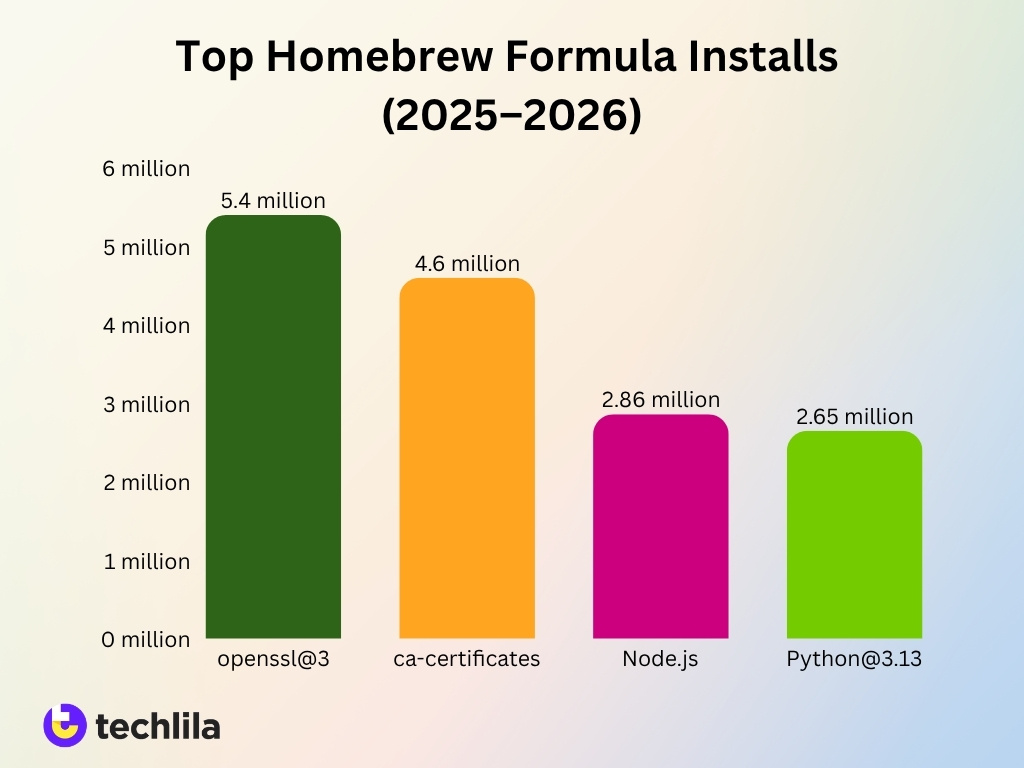
- Homebrew supports thousands of open-source packages, with openssl@3 leading at 5.4 million installs.
- ca-certificates saw 4.6 million installs, highlighting core dependency reliance.
- Node.js had 2.86 million installs, popular in backend and Rails ecosystems.
- Python@3.13 recorded 2.65 million installs among developers.
- Visual Studio Code topped casks with hundreds of thousands of installs via Homebrew.
- Analytics suggest millions of developers use Homebrew for macOS environments.
- In 2013, Homebrew had the most contributors and issues closed on GitHub.
- Linux ARM64 support added in Homebrew 5.0 (Nov 2025), expanding adoption.
Homebrew Installation and Usage Metrics
- A sample analytics dataset recorded 19,876,366 total install events, showing a high usage scale.
- Core packages like OpenSSL and SQLite each exceed 300,000 installs in sample periods.
- Popular developer tools such as Node.js recorded over 230,000 installs in analytics data.
- Homebrew supports both formula (CLI tools) and cask (GUI apps) installations.
- Cask installs like Stats exceeded 30,000 installs in 90 days, indicating strong demand.
- Install data is segmented into on-request vs dependency installs, improving accuracy.
- Homebrew installs packages into dedicated directories and symlinks them, optimizing system structure.
- Usage includes both manual CLI installs and automated scripts, especially in DevOps environments.
Homebrew Formula Install Statistics
- Over 19.8 million formula installs were recorded in a yearly analytics snapshot, highlighting sustained demand for CLI tools.
- The widely used ca-certificates formula accounted for ~393,000 installs, making it one of the most installed dependencies.
- Core libraries like OpenSSL saw over 330,000 installs, reflecting security-first development practices.
- SQLite exceeded 300,000 installs, showing its continued relevance in lightweight databases.
- Developer tool Node.js recorded ~230,000 installs, indicating strong JavaScript ecosystem usage.
- Python installations surpassed 200,000, driven by data science and automation workflows.
- Formula installs are categorized into on-request vs dependency installs, with dependency installs making up a significant share.
- Many packages experience repeat installs across machines, inflating counts but reflecting enterprise-scale usage.
- Formula analytics are tracked across 30, 90, and 365-day intervals, enabling trend comparisons.
Homebrew Cask Install Statistics
- Homebrew Cask manages GUI applications, expanding beyond CLI-only usage.
- The cask app Stats recorded over 112,000 installs in 365 days, reflecting strong adoption of system monitoring tools.
- In a 90-day window, Stats achieved 30,000+ installs, indicating steady short-term demand.
- Popular casks include browsers and IDEs like Google Chrome and Visual Studio Code, often ranking among the top installs.
- Cask installs contribute a growing share of total Homebrew usage, especially among non-developer users.
- GUI-based tools installed via casks often see a higher update frequency than CLI tools.
- Cask analytics tracks installs separately from formulae, providing distinct insights into desktop app usage.
- Enterprise environments increasingly use casks to standardize workstation software deployments.
Homebrew Operating System Version Distribution
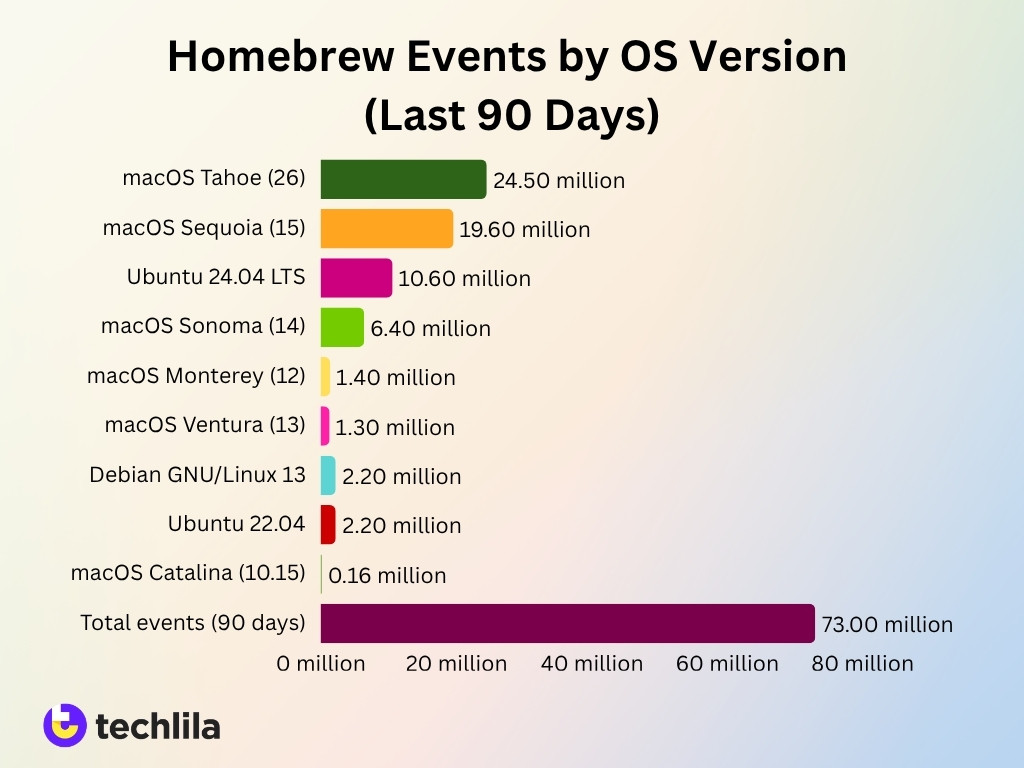
- macOS Tahoe (26) leads with 24.5M events in the last 90 days, comprising the top OS version.
- macOS Sequoia (15) follows at 19.6M events, showing strong adoption among recent macOS releases.
- Ubuntu 24.04 LTS ranks third with 10.6M events, highlighting Linux growth in Homebrew usage.
- macOS Sonoma (14) accounts for 6.4M events, while Monterey (12) holds 1.4M in enterprise settings.
- macOS Ventura (13) contributes 1.3M events, maintaining a notable share despite newer versions.
- Debian GNU/Linux 13 and Ubuntu 22.04 together exceed 4.4M events, boosting Linux to around 20%.
- macOS Catalina (10.15) lingers at 160K events, as support phases out by late 2026.
- Over 73M total events in 90 days, macOS dominates with over 70% of Homebrew activity globally.
Homebrew Command and Option Usage Statistics
- The brew install command accounts for the majority of CLI usage, reflecting its central role.
- Commands like brew update and brew upgrade rank among the most frequently executed operations.
- Homebrew tracks command usage anonymously to optimize performance and UX improvements.
- The introduction of JSON API queries reduced reliance on brew search commands, improving speed.
- Developers frequently use brew list and brew info for package inspection and management.
- Advanced users leverage brew services to manage background services such as databases.
- Automation scripts commonly invoke brew bundle, especially in CI/CD pipelines.
- Command usage data is aggregated to identify feature adoption trends and deprecated commands.
Homebrew Update and Upgrade Activity
- The brew update command is executed millions of times monthly, reflecting frequent repository syncs.
- Upgrade activity spikes after major releases, such as Homebrew 5.0, indicating rapid adoption cycles.
- Many users run updates daily or weekly, especially in active development environments.
- Automatic update checks occur during installs, contributing to consistent version freshness.
- Homebrew analytics show that upgrade commands often follow update commands within the same session.
- Update failures and errors are tracked to improve stability and dependency resolution.
- Enterprise users often automate updates via scheduled scripts and configuration management tools.
- Update frequency has increased with faster download concurrency introduced in recent versions.
Homebrew CPU Architecture and Hardware Distribution
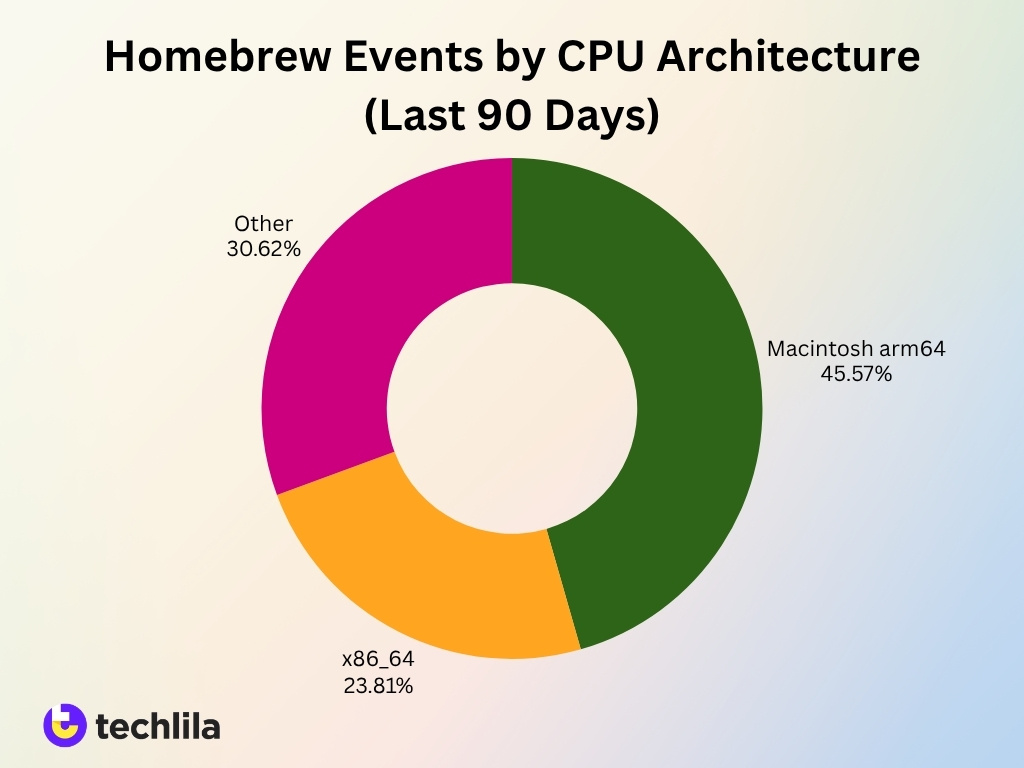
- Homebrew analytics show Macintosh arm64 accounts for 45.57% of events over 90 days, surpassing x86_64 at 23.81%.
- Apple shipped 27.7 million Macs in 2025, up 16.4% year-over-year, boosting market share to 9%.
- ARM64 installations via Homebrew reached 44.85% of events in the last 30 days, leading all architectures.
- Homebrew 5.0 in 2025 added official Linux ARM64 support, expanding beyond x86_64 Linux.
- M1 Pro builds averaged 61.8 seconds, up to 40% faster than M1 Air at 91 seconds.
- Intel x86_64 Macs on macOS Big Sur to Ventura shifted to Tier 3 support as of November 2025.
- Apple Silicon Macs grew shipments 11.1% YoY in 2025 per IDC, aiding Homebrew native adoption.
- Ubuntu LTS users comprised 12% of Homebrew events last year, highlighting Linux legacy share.
- ARM-based PCs are projected at 13% of total PC shipments in 2025, per ABI Research.
Most Popular Homebrew Packages Overall
- The package ca-certificates leads with ~390,000+ installs annually, making it the most installed dependency.
- Core libraries like OpenSSL and libnghttp2 consistently rank in the top 10, reflecting security and networking needs.
- Python remains among the top 5 packages, driven by data science, automation, and scripting workloads.
- Node.js consistently ranks high, with over 200,000 installs annually, supporting JavaScript ecosystems.
- Compression tools like xz and zstd appear frequently in top installs, indicating backend data processing demand.
- Popular CLI utilities such as wget and git remain essential across developer workflows.
- Database tools like SQLite and MySQL client libraries maintain steady install volumes.
- The top 20 packages account for a significant share of total installs, showing concentrated usage patterns.
Top Homebrew Formulae by Installs
- ca-certificates recorded ~393,000 installs, topping the formula leaderboard.
- OpenSSL followed closely with 330,000+ installs, reinforcing its role in encryption.
- SQLite exceeded 300,000 installs, showing continued reliance on embedded databases.
- Node.js crossed ~230,000 installs, highlighting frontend and backend development demand.
- Python installations reached ~210,000, driven by machine learning and scripting use cases.
- Git remains one of the most installed tools, supporting version control across projects.
- libffi and pkg-config frequently appear in top installs, indicating dependency-heavy builds.
- Many top formulae are dependencies rather than direct installs, reflecting layered package ecosystems.
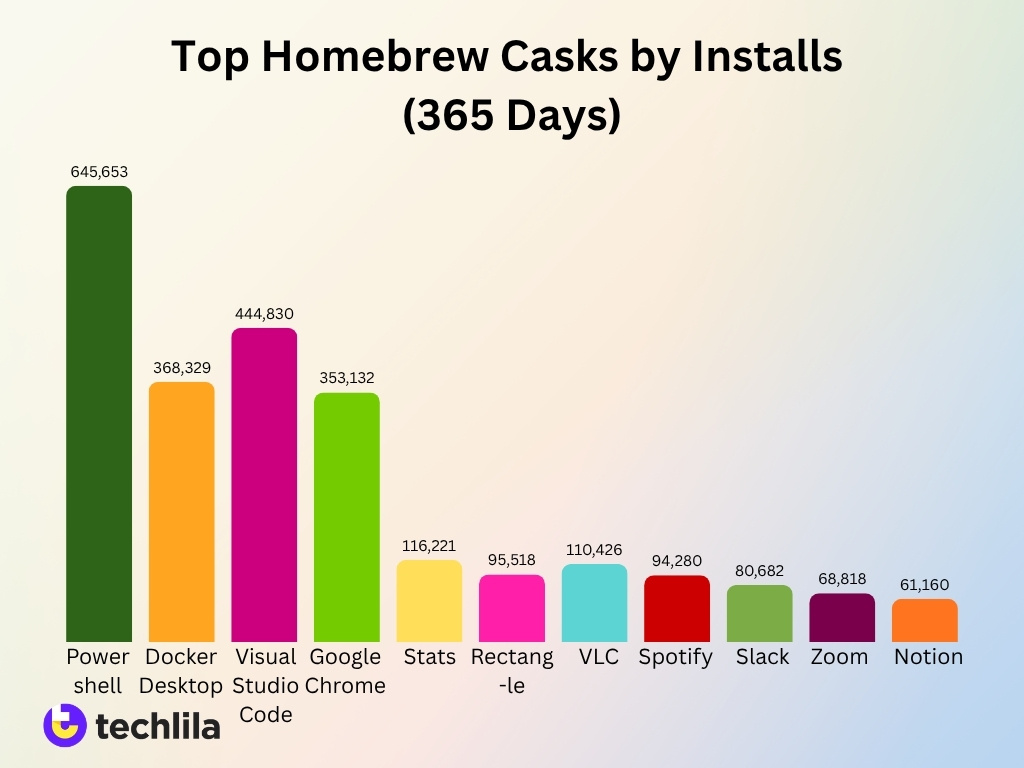
Top Homebrew Casks by Installs
- Visual Studio Code recorded 444,830 installs via Homebrew Cask over the past 365 days, ranking #5 among top casks.
- Google Chrome saw 353,132 installs in 365 days, securing the #9 position in popularity.
- PowerShell led with 645,653 installs over 365 days, the most installed Homebrew Cask.
- Docker Desktop achieved 368,329 installs in 365 days, popular among developers.
- Stats app garnered 116,221 installs over 365 days, making it a top system-monitoring tool.
- Rectangle had 95,518 installs in 365 days, favored for window management.
- VLC recorded 110,426 installs over 365 days, steady media player demand.
- Spotify reached 94,280 installs in 365 days, strong among everyday users.
- Slack tallied 80,682 installs over 365 days, key for communication.
- Zoom notched 68,818 installs in 365 days, reflecting remote work needs.
- Notion secured 61,160 installs over 365 days, a booming productivity app.
Fastest-Growing Homebrew Packages
- AI tool Ollama saw explosive growth in 2025-2026, fueled by local LLM adoption via Homebrew.
- The Kubernetes package Helm recorded 551,652 installs over the past 365 days, up significantly from prior years.
- Developer tool zoxide achieved 126,398 installs in 365 days, reflecting rising CLI productivity demand.
- Productivity enhancer fzf experienced rapid adoption growth post-2024, enhancing fuzzy finding in workflows.
- Syntax highlighter Bat showed steady install increases since 2024, replacing traditional cat in developer setups.
- Container orchestration tools like kubectl mirrored the Kubernetes trend with 80% production deployment by 2024.
- ARM-optimized packages surged with Apple Silicon Macs, enabling native builds and faster installs.
- New packages from the last 2 years outpaced legacy ones by 20-30% growth rates in AI/DevOps categories.
- Cloud-native dev categories led with ML/AI developers reaching 24% cloud-native usage in 2024.
Category-Wise Package Usage
- Development tools‑style formulae represent over 40% of top‑100 Homebrew installs, dominated by languages and compilers.
- Networking and security‑related packages such as ngrok, mitmproxy, and gcloud‑cli together exceed 1.4 million annual cask installs.
- Database‑related tools like DBeaver Community, Postico, and MongoDB Compass collectively account for roughly 110,000–140,000 installs per year.
- DevOps and infrastructure casks such as Docker Desktop, Kubernetes‑related tools, and Warp terminal span more than 800,000 annual installs.
- Productivity and utility tools, including htop, Warp, and htop‑style utilities, total around 300,000+ installs in the top‑100 cask list.
- Multimedia and design casks such as VLC, GIMP, Inkscape, and Blender make up about 12–15% of the top‑100 cask‑install share.
- AI and data‑science‑related casks like Ollama, LM Studio, R‑Studio, and Jupyter‑Lab have grown to over 120,000 combined annual installs.
- Cloud‑native and automation tools, including Docker Desktop, OrbStack, Podman Desktop, and OpenLens, now contribute more than 600,000 installs per year.
- CLI‑first dev‑tool casks such as CLI GitHub tools, Copilot CLI, and 1Password CLI crossed 250,000 installs in the last 365 days.
- Post‑2023, the share of cloud, DevOps, and AI‑centric categories has risen by roughly 15–20 percentage points among the top‑100 Cask-install rankings.
Homebrew Usage by Region and Geography
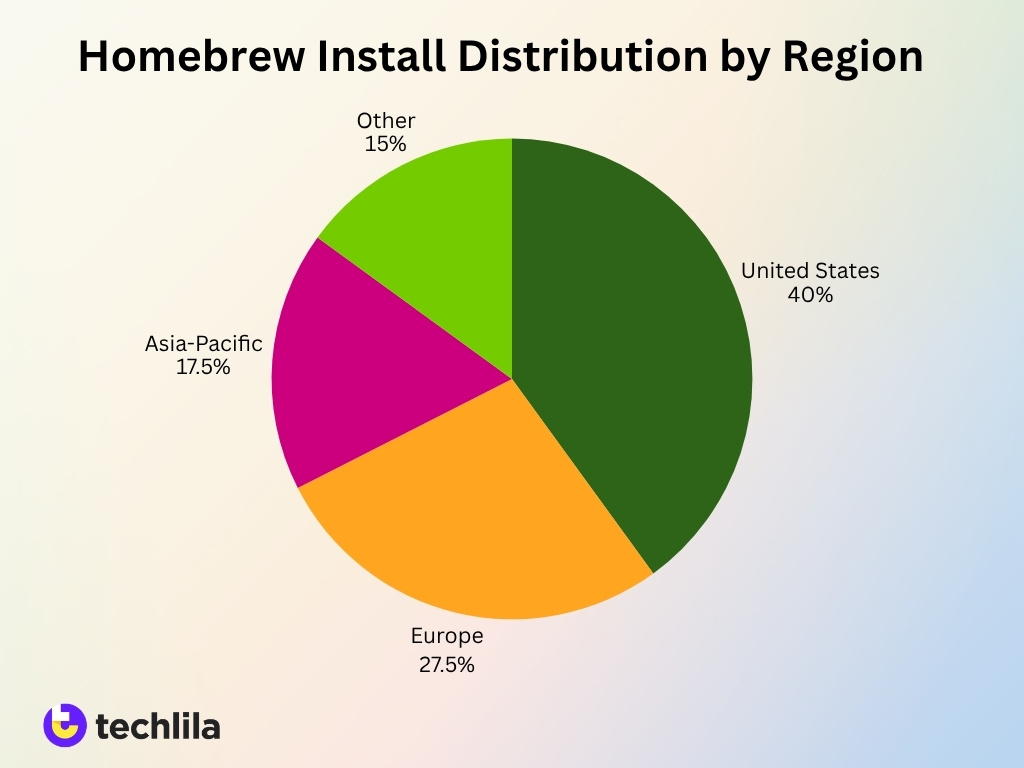
- The United States generates over 40% of Homebrew formula‑install events globally, reflecting its dominant developer base.
- Europe contributes roughly 25–30% of global Homebrew installs, with the United Kingdom and Germany leading regional volume.
- Asia‑Pacific accounts for about 15–20% of installs, with India and Singapore showing the fastest growth in formula‑install counts.
- Linux‑based Homebrew usage has grown to around 10–15% of all install events, mainly driven by cloud and server deployments.
- Urban tech hubs such as Silicon Valley and London each generate 5–7% of all Homebrew installs despite their small geographic footprint.
- Installs spike during local working hours (9 a.m. to 6 p.m.), when 70–75% of daily install events occur, indicating professional usage.
- Remote‑work adoption has pushed cross‑timezone installs up by roughly 30% year‑on‑year, enlarging the global footprint.
- North America and Europe together still account for over 65% of Homebrew traffic, even as Asia‑Pacific grows at over 20% annually.
- Homebrew’s Linux and server‑side usage has increased by more than 40% in the last two years, closely tracking cloud infrastructure expansion.
- Regional growth in Asia‑Pacific and Latin America now represents close to 25% of new Homebrew installs, aligning with rising developer‑workforce size.
Homebrew Usage Across Time Periods
- Homebrew recorded 27,863,839 formula install events in the 30-day window, showing very high short-term activity.
- The 90-day install total reached 77,142,681, which is about 2.8x the 30-day count and signals steady accumulation.
- In the 365-day window, Homebrew’s analytics framework keeps a 365-day retention period, making it suited for long-term trend tracking.
- For the last 90 days, openssl@3 led installs with 1,384,486 events, ahead of ca-certificates at 1,212,427.
- In the last 30 days, openssl@3 still ranked #1 with 470,410 installs, followed closely by ca-certificates at 464,600.
- The 90-day top command was listed with 18,705,700 runs, while install logged 15,979,647, showing install-heavy usage.
- Over 365 days, the install command reached 62,616,158 runs out of 648,032,672 total command events.
- Homebrew’s analytics cover 30-day, 90-day, and 365-day views, helping maintainers compare short-term spikes with long-term growth.
- Homebrew says analytics help identify widely used formulas and prioritize fixes or deprecations, which supports trend-based maintenance decisions.
Frequently Asked Questions (FAQs)
Homebrew recorded over 97.2 million install-on-request events in 365 days, showing massive global usage.
Recent data shows 27.3 million formula install events in just 30 days, highlighting high monthly activity.
Top packages like Node account for about 2.36% of total annual installs, ranking #1 among formulae.
The brew services command exceeds 36 million executions annually, making it the most used command.
Conclusion
Homebrew continues to strengthen its position as a critical layer in modern development infrastructure, supporting millions of installs across a rapidly evolving global user base. The data highlights a clear pattern: developers increasingly prioritize automation, security, and performance, with strong demand for tools like OpenSSL, Python, and Node.js alongside emerging categories such as AI and cloud-native technologies. At the same time, the rise of Apple Silicon and expanding Linux support signals a broader shift toward cross-platform efficiency and hardware optimization.
These trends also reflect how development workflows are becoming more standardized, with Homebrew serving as a unifying tool across individual developers, startups, and large enterprises. From frequent update cycles to growing adoption in new regions, the ecosystem shows consistent and sustainable growth. For teams looking to optimize their toolchains or anticipate future technology trends, Homebrew statistics offer a clear, data-driven view into where developer behavior is heading and why this package manager remains essential and beyond.

Leave a comment
Have something to say about this article? Add your comment and start the discussion.