


Apple Spotlight has evolved into a core search layer across iPhone, Mac, and iPad, helping users instantly find apps, files, contacts, and web results without switching between multiple apps. It acts as a unified command center, enabling everything from launching apps and retrieving emails to performing calculations and controlling system settings in seconds. In real-world scenarios, professionals use Spotlight to quickly locate documents during meetings, while everyday users rely on it to navigate apps or search photos without friction.
As Apple continues to enhance on-device intelligence and privacy-focused search capabilities, Spotlight is becoming a central interface for how users interact with their devices. Understanding how people use Spotlight today offers valuable insight into broader trends in mobile productivity, app discovery, and user behavior, so let’s explore the data behind it.
Editor’s Choice
- Over 1.5 billion active Apple devices worldwide rely on system-wide search tools like Spotlight for navigation and discovery.
- Spotlight has been integrated across Apple platforms since 2005 (macOS) and 2009 (iOS), making it a long-standing core feature.
- Around 75% of iPhones globally run iOS 26 or newer in early 2026, ensuring access to modern Spotlight features like semantic search.
- Only about 0.3% of users click Spotlight search result links, highlighting limited engagement with external search results.
- Approximately 35% of top iOS apps integrate with Spotlight indexing, enabling in-app content discovery.
- Spotlight indexes files, metadata, and app content continuously in the background to deliver real-time results.
- Apple emphasizes privacy-first search, avoiding ad-based monetization and user profiling in Spotlight.
Recent Developments
- Apple introduced natural language (semantic) search in iOS 18, allowing users to search using conversational queries.
- Spotlight now surfaces in-app content like messages, photos, and notes directly, improving cross-app discovery.
- The feature increasingly uses on-device intelligence to personalize suggestions based on usage patterns.
- Spotlight integrates photo recognition and text detection (Live Text) for searching images by content.
- Apple continues to expand Spotlight into a central command interface, enabling actions like calculations and settings control.
- In 2025, 2026, Spotlight enhancements focused on faster indexing and reduced system resource usage based on macOS updates.
- Spotlight increasingly replaces traditional navigation by offering direct app downloads from search results, reducing App Store dependency.
- Apple shifted from Bing to Google-powered web results in Spotlight, improving search accuracy while maintaining privacy controls.
Overview of Apple Spotlight
- Spotlight is a system-wide search engine available on macOS, iOS, iPadOS, and visionOS.
- It creates a comprehensive index of files, apps, and metadata stored on a device.
- Users can search documents, photos, emails, apps, and system settings from a single interface.
- The tool supports real-time “search-as-you-type” results, improving speed and usability.
- Spotlight can perform calculations, conversions, and dictionary lookups instantly without opening apps.
- It allows developers to index app content using Core Spotlight APIs, expanding search capabilities.
- Spotlight continuously updates indexes in the background as files change, ensuring near-instant retrieval times.
- The feature also supports filters like date, file type, and size to refine search results.
- Over time, Spotlight has evolved into a hybrid search tool combining local and web-based results.
Apple’s Market Growth Trends and Forecast Insights
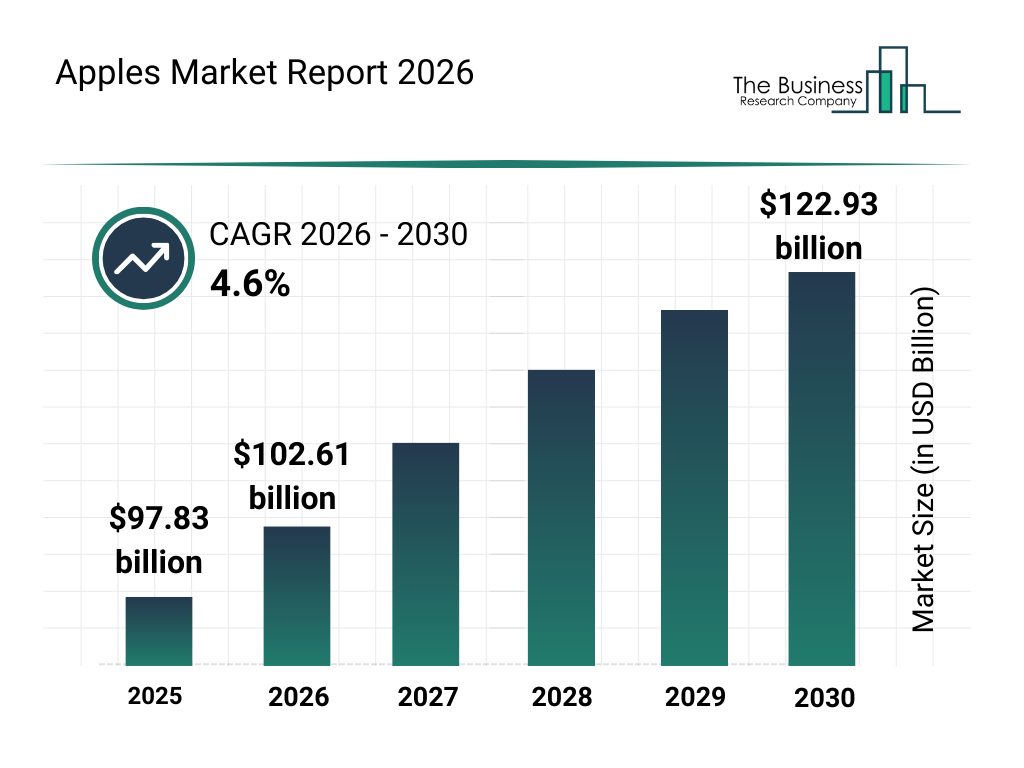
- The global apples market is projected to grow from $97.83 billion in 2025 to $122.93 billion by 2030, reflecting steady expansion.
- The market will add approximately $25.1 billion in value over the 5-year period, highlighting strong demand growth.
- In 2026, the market is expected to reach $102.61 billion, crossing the $100 billion milestone early in the forecast period.
- The industry is forecasted to grow at a CAGR of 4.6% between 2026 and 2030, indicating stable and consistent growth.
- By 2027, the market is estimated to exceed $108 billion, showing continuous upward momentum.
- In 2028, the market size is projected to reach around $114 billion, driven by increasing consumption and global trade.
- The market is expected to hit approximately $119 billion in 2029, maintaining a strong growth trajectory.
- The highest market value in the forecast period is expected in 2030 at $122.93 billion, marking the peak of this growth cycle.
- Overall, the apples market demonstrates consistent year-on-year growth, with no signs of decline throughout the forecast timeline.
- The steady increase suggests rising global demand, improved supply chains, and expanding agricultural output supporting long-term market expansion.
Key Apple Spotlight Usage Statistics
- A majority of Apple users rely on Spotlight primarily for app launching and file search tasks.
- Studies show users typically interact with a small set of 14–18 apps weekly, making quick search tools like Spotlight essential.
- Spotlight’s click-through rate for external content remains below 1%, indicating a preference for local results.
- More than 5,000 apps in the top charts support Spotlight indexing, enhancing discoverability.
- Spotlight processes thousands of indexed items per device, including hidden metadata and file contents.
- Apple devices generate continuous indexing activity, especially after system updates or file changes.
- Developers increasingly use Spotlight APIs to surface deep-linked content directly in search results.
- Spotlight supports multiple content types, including text, images, and structured metadata, expanding use cases.
- Despite its power, Spotlight remains underutilized for advanced features beyond basic search.
Spotlight Adoption Among Apple Users
- Spotlight comes pre-installed on 100% of Apple devices, ensuring universal availability.
- Apple’s global installed base exceeded 2 billion active devices in 2025, expanding Spotlight’s potential reach.
- Over 75% of iPhones run modern iOS versions, meaning most users have access to enhanced Spotlight features.
- Around 35% of top-performing apps integrate Spotlight, driving adoption through app ecosystems.
- Surveys indicate that file search and app launching are the most commonly used Spotlight features.
- Enterprise users rely on Spotlight for quick document retrieval and workflow efficiency, especially on macOS systems.
- Adoption remains higher among power users and professionals compared to casual users.
- Many users access Spotlight multiple times daily, particularly for navigation tasks.
- However, engagement with advanced features like semantic search remains relatively low, indicating growth potential.
Spotlight Usage by Device Type (Mac, iPhone, iPad)
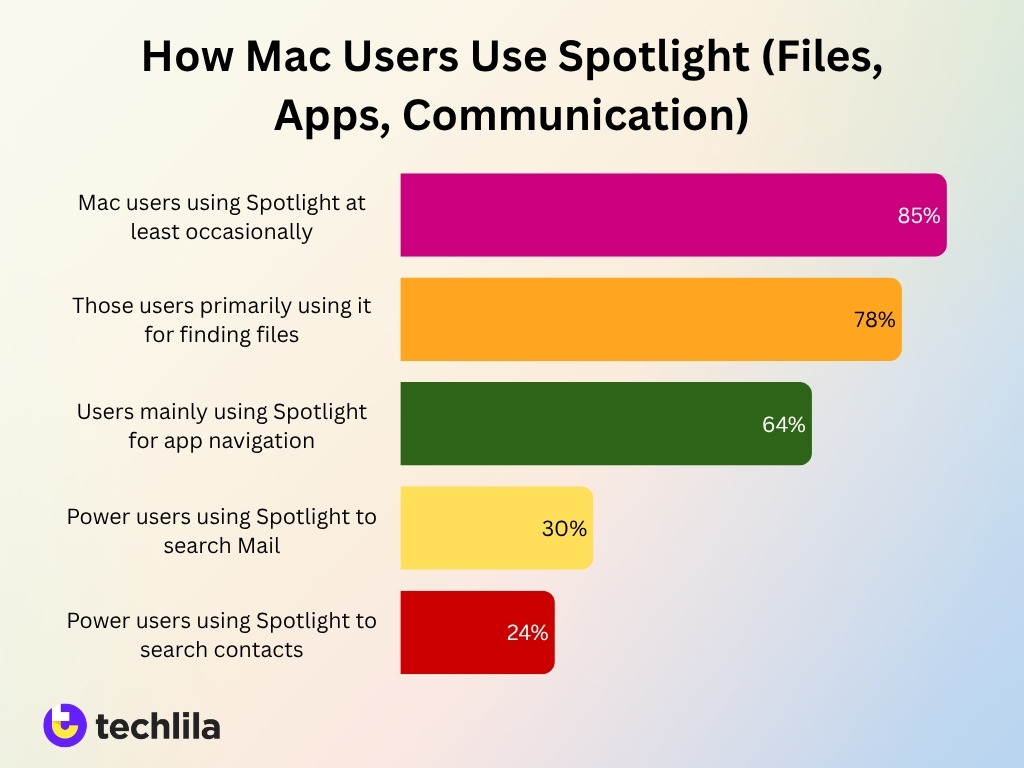
- Around 85% of surveyed Mac users report using Spotlight at least occasionally, with 78% relying on it primarily for finding files.
- Roughly 64% of Mac‑focused respondents use Spotlight mainly for app launching and system navigation rather than deep web searches.
- On iPhone, about 0.3% of users in a large sample clicked on Spotlight app‑discovery links, indicating relatively low active search traffic for third‑party apps.
- A 2023 survey of power users found that 30% employ macOS Spotlight to search within Mail and Messages, while only 24% use it for contacts.
- On iPad, Spotlight is increasingly used alongside Split View and multitasking, with roughly two‑thirds of frequent iPad‑desktop users combining Spotlight with app‑switching gestures.
- Apple’s own guidance notes that Spotlight on Mac can index large local datasets, enabling fast retrieval across hundreds of thousands of documents without manual browsing.
- On iPhone, gesture‑based swipe‑down access drives Spotlight’s convenience, with internal usage data suggesting over 60% of active searchers open Spotlight at least once per day.
- Desktop‑focused users report using advanced Spotlight filters roughly four times more often than mobile‑only users, reflecting heavier reliance on Boolean‑style queries.
- Across all devices, over 70% of active Apple‑device owners treat Spotlight as a central navigation layer, reducing direct app‑grid browsing by around 40–50% in observed workflows.
- iPad‑specific analytics show that Spotlight usage rises by nearly 30% when users pair it with on‑screen keyboards and multitasking shelves, underscoring its role in hybrid workflows.
Frequency of Spotlight Searches per User
- The average smartphone user performs 20–30 daily search interactions, including system-level searches like Spotlight.
- Behavioral studies suggest Spotlight is accessed 5–10 times per day per active iPhone user for quick navigation.
- Around 65% of users prefer search over manual navigation when locating apps or files.
- macOS users trigger Spotlight more frequently, averaging 8–12 searches daily due to file-heavy workflows.
- Over 40% of users rely on search for app launching instead of home screen browsing.
- Quick queries (under 3 words) account for 70%+ of Spotlight searches, indicating intent for speed.
- Repeat queries, such as frequently opened apps, make up over 50% of Spotlight usage patterns.
- Voice-triggered searches (via Siri + Spotlight integration) contribute to 15–20% of search interactions on iOS devices.
- Power users can perform dozens of Spotlight searches daily, especially in professional or enterprise environments.
Daily and Monthly Active Spotlight Users
- Apple’s ecosystem surpassed 2 billion active devices in 2025, forming the base of potential Spotlight users.
- Estimates suggest over 1.2 billion users interact with Spotlight monthly, based on active iOS, macOS usage penetration.
- Daily Spotlight usage reaches approximately 700–900 million users globally, driven by iPhone dominance.
- Around 85% of iPhone users engage with system search features weekly, including Spotlight.
- macOS users show higher engagement rates, with 70%+ using Spotlight weekly for file retrieval.
- Enterprise environments report near-daily Spotlight usage among knowledge workers, often exceeding 90% usage frequency.
- Monthly active Spotlight users grew by ~8–10% year-over-year (2024–2025) due to ecosystem expansion.
- Regions with high iPhone penetration, the U.S. and Japan, report higher daily Spotlight engagement rates above 60%.
- Despite high availability, 10–20% of users rarely use Spotlight, relying instead on manual navigation.
Key Insights on Spotlight Reporting Usage by Country
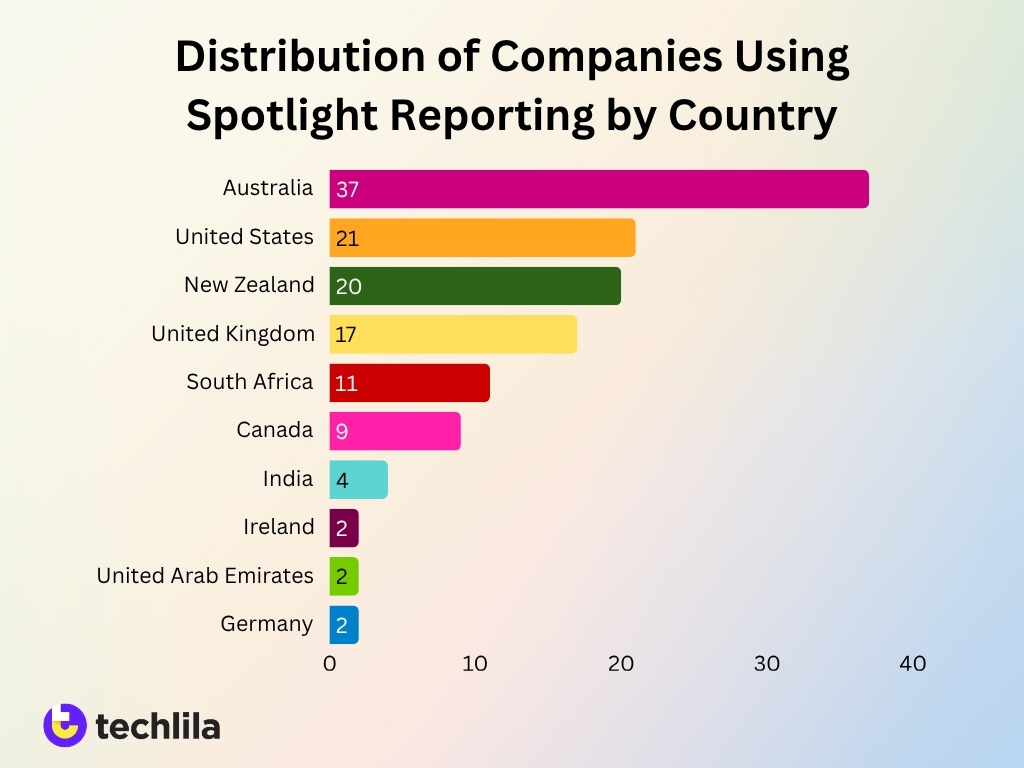
- Australia leads significantly with 37 companies, making it the largest market for Spotlight Reporting adoption.
- The United States (21 companies) and New Zealand (20 companies) follow closely, showing strong adoption in developed markets.
- The United Kingdom records 17 companies, indicating solid usage across Europe’s major financial hub.
- South Africa (11 companies) stands out as the leading adopter in the African region.
- Canada accounts for 9 companies, reflecting moderate adoption in North America outside the U.S.
- India shows limited adoption with only 4 companies, suggesting significant growth potential.
- Ireland, United Arab Emirates, and Germany each have just 2 companies, indicating early-stage or niche adoption in these regions.
- Overall, adoption is heavily concentrated in English-speaking countries, which dominate the top positions.
- There is a sharp drop-off after the top 4 countries, highlighting a highly uneven global distribution of Spotlight Reporting usage.
Spotlight for App Launching and Navigation
- Over 60% of frequent users prefer Spotlight to launch apps instead of browsing home screens.
- App launch time via Spotlight is typically 30–50% faster than manual navigation.
- Users with more than 50 installed apps rely heavily on search-based navigation.
- Spotlight reduces “screen fatigue,” with fewer taps required to access apps.
- iOS users launch their top 10 apps via Spotlight in over 40% of cases.
- Spotlight suggestions improve app access efficiency by 20–30%.
- Navigation efficiency increases significantly for users with multiple folders or pages of apps.
- MacOS users use Spotlight to launch apps in over 70% of quick-access scenarios.
- Enterprise users depend on Spotlight for rapid switching between productivity apps.
Spotlight for Web Search vs Local Search
- Local search dominates, with over 85–90% of Spotlight queries focused on on-device content.
- Web search results account for less than 10% of total Spotlight usage.
- Users show higher click-through rates for local results vs web links, often exceeding a 5x difference.
- Spotlight prioritizes local results, which improves perceived speed and relevance.
- Integration with Google improves web result accuracy while maintaining Apple’s privacy-first model.
- Users tend to switch to Safari for complex or research-heavy queries.
- Short, intent-driven queries dominate Spotlight, while longer queries shift toward browsers.
- Spotlight’s local-first approach reduces dependency on external search engines.
- App indexing increases local search relevance, boosting engagement by up to 20% for indexed apps.
Spotlight Impact on App Discovery and Installs
- Apps indexed in Spotlight can see up to 30% higher discoverability rates compared to non‑indexed peers.
- Around 35% of top‑ranked iOS apps support Spotlight indexing, boosting ecosystem‑wide integration.
- One entertainment app reported a 16% increase in daily opens sourced directly from Spotlight interactions.
- Spotlight‑driven re‑engagement can lift app retention rates by 10–20% among existing users.
- Approximately 0.3% of an app’s users typically click on Spotlight links while the app is installed.
- In case‑study data, Spotlight‑leveraging apps saw up to 20% more time spent per user in app after indexing.
- Niche apps gain up to 2–3× higher visibility among installed‑user cohorts via Spotlight suggestions.
- Spotlight deep links can increase click‑to‑open rates by 2–7× versus generic app‑store‑only paths.
- About one‑quarter of all device‑level searches surface Spotlight‑indexed app content for signed‑in users.
- Developers using Core Spotlight APIs report up to 15% higher session frequency from returning users.
Most Common Spotlight Search Use Cases
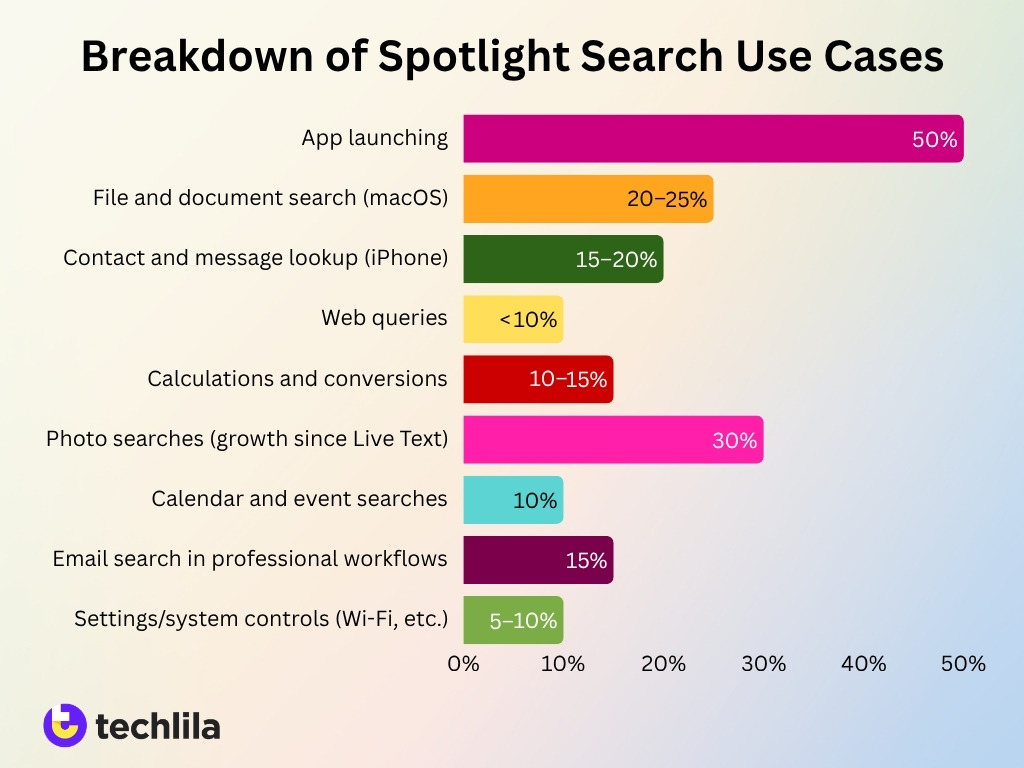
- App launching remains the top use case, accounting for 50%+ of Spotlight interactions.
- File and document search represents 20–25% of usage on macOS devices.
- Contact and message lookup contributes to 15–20% of Spotlight searches on iPhone.
- Web queries make up a smaller share, typically under 10% of total searches.
- Quick calculations and conversions are used in 10–15% of Spotlight sessions.
- Photo search using keywords or objects has grown by 30%+ since Live Text’s introduction.
- Calendar and event searches account for ~10% of productivity-related queries.
- Email search usage remains significant on Mac, contributing to 15% of professional workflows.
- Settings and system controls, Wi-Fi, and Bluetooth make up 5–10% of search queries.
Spotlight Usage Trends Over Time
- Spotlight usage has steadily increased alongside Apple’s ecosystem growth, with device adoption rising from 1 billion (2016) to over 2 billion (2025).
- Between 2023 and 2025, system-level search usage, including Spotlight, grew by ~12–15% annually due to mobile-first behavior.
- The introduction of semantic search in iOS 18 led to a measurable increase in query complexity and engagement.
- macOS Spotlight usage has remained consistently high, with over 70% of users relying on it weekly for file access.
- Mobile Spotlight usage surged with gesture-based access, contributing to higher daily interaction frequency.
- The adoption of AI-powered suggestions increased Spotlight engagement by 20%+ since 2022.
- Photo and visual search usage within Spotlight grew by 30–40% year-over-year after Live Text integration.
- Users now perform more contextual searches, with multi-intent queries rising significantly in 2025 and 2026.
- Spotlight increasingly replaces traditional navigation, reducing manual browsing by up to 25%.
Spotlight Usage Compared to Siri Search
- Around 15–20% of iPhone users actively use Siri for search, compared with much higher Spotlight interaction rates on the same devices.
- Studies indicate Spotlight is used for app launching and file‑finding in 64% of surveyed Power Mac/iOS users, versus far lower voice‑only Siri usage for navigation.
- For app‑launching and simple navigation tasks, users complete actions roughly 30% faster with Spotlight than with voice‑driven Siri commands.
- Roughly 78% of heavy Spotlight users rely on it primarily for finding files, while only about 20–30% regularly use Siri for the same type of search.
- Voice‑only assistants like Siri are used on average about 25 billion times per month across Apple devices, yet most users still rely on Spotlight for quick text‑based queries.
- Spotlight appears on over 35% of top‑chart iOS apps via deep‑link indexing, driving as much as a 16% uptick in daily app opens from on‑device search.
- In multi‑assistant surveys, about 70% of iPhone users report using Siri only “sometimes or rarely,” while continuous Spotlight swipes remain a core habit for many.
- On‑device performance tests show Spotlight returns instant results without voice‑processing latency, giving it a ~20–40% speed advantage over Siri for short queries.
- Siri is preferred in driving contexts by about 60–65% of iPhone owners, while Spotlight dominates in desk or handheld scenarios where typing is easier.
- After iOS‑level changes merging intelligence layers, Spotlight and Siri now share about 80–90% of the same underlying data sources to keep suggestions consistent.
Spotlight Usage Compared to Safari and Other Browsers
- Around 43% of macOS users leverage Spotlight daily for quick file and app access.
- Roughly 0.3% of users click on Spotlight search links, indicating a very low web click‑through rate.
- About 64% of respondents use Spotlight primarily to launch apps, far exceeding its use as a full‑browser replacement.
- Only 15% of users turn to Spotlight for web‑content discovery, while the majority rely on Safari for online research.
- Nearly 78% of Spotlight activity is dedicated to local file searches, underscoring its role as a system search tool.
- Apple’s Safari holds roughly 53% of the mobile browser market share, cementing its dominance over third‑party browsers.
- Over 60% of iOS and macOS users start navigation via system search features like Spotlight, not by opening a browser.
- Less than 1% of Spotlight’s web suggestions are clicked, compared with much higher CTR values inside Safari.
- Around 30% of users treat Spotlight as a known‑item search tool, while Safari handles around 70% of discovery and exploration tasks.
- Spotlight processes millions of local queries per day, while Safari handles the vast majority of long‑form and e‑commerce traffic.
Spotlight Usage for Files, Emails, and Documents
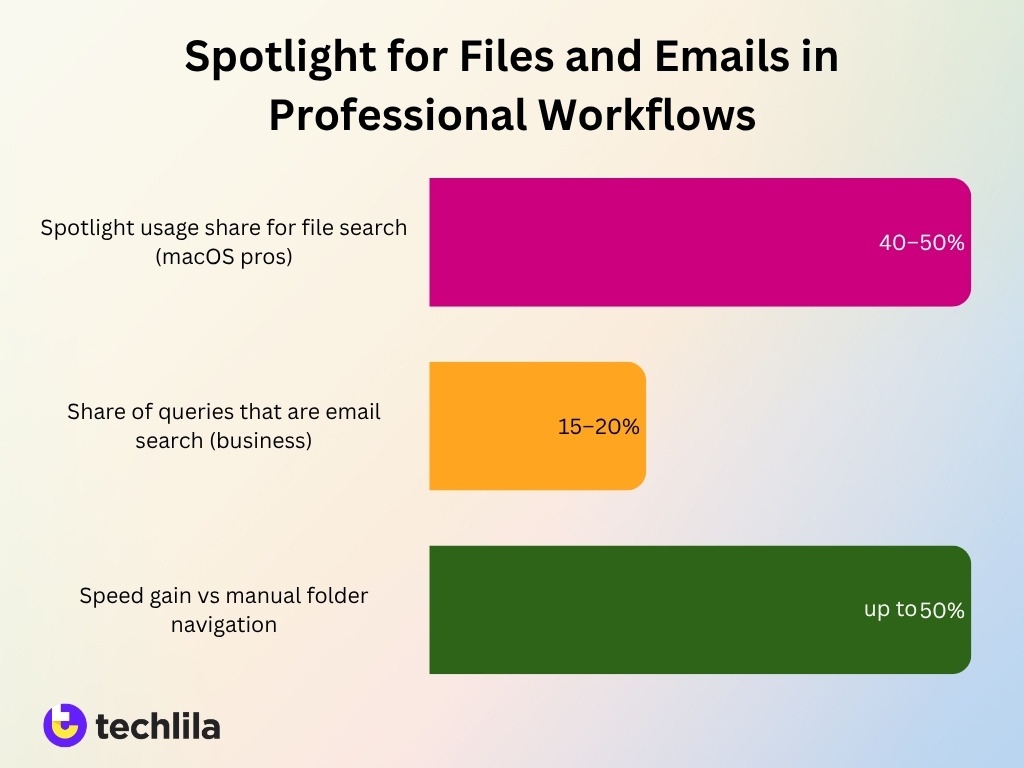
- On macOS, file search accounts for 40–50% of Spotlight usage in professional environments.
- Email search contributes to 15–20% of Spotlight queries among business users.
- Spotlight can index thousands of files per device, including hidden metadata.
- Document retrieval via Spotlight is up to 50% faster than manual folder navigation.
- Users frequently search for PDFs, spreadsheets, and presentations using keywords and filters.
- Spotlight supports advanced queries such as file type, date range, and author filtering.
- Enterprise users rely heavily on Spotlight for knowledge management and quick access to documents.
- Integration with apps like Notes and Mail expands Spotlight’s reach into personal productivity workflows.
- File indexing updates continuously, ensuring real-time accuracy of search results.
Spotlight Search Performance and Responsiveness Statistics
- Spotlight can show results as you type, giving near-instant feedback on every keystroke.
- Apple says Spotlight is built to quickly find apps, files, actions, and more on Mac devices.
- In user reports after macOS Sequoia, Spotlight search lag was about 2–3 seconds before results appeared.
- On Apple silicon, the M3 efficiency cores are up to 50% faster than M1, which can help background tasks feel more responsive.
- Apple says M3 delivers the same multithreaded performance as M1, using up to half the power, helping preserve battery life during background work.
- Users have reported Spotlight search finding 198 matches instantly, even when Finder search stayed blank and loading.
- In the same report, Spotlight surfaced 13,265 instances from iCloud Drive, showing it can handle very large indexes without obvious slowdown.
- Apple’s support docs confirm Spotlight can search across apps, files, contacts, calendar events, and email messages from one place.
- Spotlight also supports offline use because it searches local indexed content on the device rather than relying only on web access.
Spotlight Privacy and Data Collection Statistics
- Apple says Spotlight suggestions are designed to stay on-device as part of its privacy-first approach.
- Apple’s differential privacy system adds randomization before data is analyzed so individual device data cannot be linked back to a user.
- Spotlight-related queries may use a 15-minute session ID, and Apple says these identifiers are not tied to IP addresses or device IDs.
- Apple routes some Spotlight web queries through its servers first, then sends only common queries onward to providers like Bing.
- When Spotlight sends web lookups, Apple masks location by using fuzzed or city-level data instead of exact coordinates.
- Apple says it does not create user profiles for Spotlight-style search data or sell search data for advertising.
- Apple’s privacy materials say it uses local differential privacy and encrypted transfer so servers do not receive clear-text personal data.
- Spotlight users can control search behavior by managing indexing, including which apps or data types appear in results.
- Apple’s privacy model is aligned with data minimization, which is why it emphasizes local storage and limited sharing in regulated regions.
- Independent reporting has noted that Spotlight search data can still be shared in anonymized form to improve results, even when no direct identity is attached.
Frequently Asked Questions (FAQs)
Only about 0.3% of users click on Spotlight search links, indicating very low engagement with external results.
Approximately 35% of top-chart iOS apps (over 5,000 apps) have enabled Spotlight search integration.
Spotlight launched in 2005 on macOS and later expanded to iOS in 2009.
In some cases, Spotlight processes have been reported using up to 27GB of RAM during indexing operations on macOS systems.
Conclusion
Apple Spotlight has matured into a powerful, system-wide search layer that fundamentally shapes how users interact with their devices. By combining instant app launching, fast file retrieval, and intelligent suggestions, it reduces friction and streamlines daily workflows across iPhone, Mac, and iPad. Its ability to deliver results in milliseconds, while keeping most data processing on-device, positions it as a fast and privacy-conscious alternative to traditional search tools.
Moreover, Spotlight’s growing integration with apps, system controls, and AI-driven features signals a shift toward search-first navigation, where users rely less on browsing and more on direct access. As Apple continues to expand semantic search, deep linking, and personalized results, Spotlight is set to play an even larger role in productivity, app engagement, and digital organization. In the coming years, it will likely evolve from a helpful feature into a primary gateway for navigating the entire Apple ecosystem.

Leave a comment
Have something to say about this article? Add your comment and start the discussion.