


AI-powered productivity tools now shape how modern software teams build, test, and maintain applications. From AI coding assistants that generate boilerplate code to intelligent agents that automate debugging and documentation, these tools reduce repetitive work and accelerate development cycles. For example, engineering teams use AI copilots to speed up feature development, while DevOps teams rely on AI for automated testing and code reviews.
The statistics below reveal how fast adoption is growing, how developers actually use these tools, and what impact they have on software engineering workflows.
Editor’s Choice
- 84% of developers now use or plan to use AI tools in their development workflow in 2025, up from 76% in 2024, showing rapid adoption across the global developer community.
- Between 80% and 85% of developers use AI coding assistants regularly, indicating these tools have moved from experimentation to everyday productivity utilities.
- AI coding assistants help developers save an average of 3.6 hours per week, primarily by automating boilerplate code, documentation, and debugging tasks.
- 78% of developers report improved productivity when using AI coding assistants such as GitHub Copilot or ChatGPT.
- In 2025, around 41% of all code produced globally is AI-assisted or AI-generated, highlighting the growing role of automation in software engineering.
- 90% of Fortune 100 companies now use AI coding tools in some capacity across engineering teams.
- Despite high adoption, only about 33% of developers fully trust AI-generated code, indicating ongoing concerns about accuracy and reliability.
Recent Developments
- AI code assistants are now a $4.7 billion market in 2025, projected to reach $14.6 billion by 2033, reflecting strong enterprise demand.
- GitHub Copilot has grown to over 15 million users, representing roughly 400% growth within a year.
- Enterprise deployments of GitHub Copilot increased by 142% year over year, showing strong corporate adoption of AI coding assistants.
- In the Stack Overflow 2025 developer survey, ChatGPT (82%) and GitHub Copilot (68%) emerged as the most widely used AI tools among developers.
- AI review agents experienced rapid adoption, rising from 14.8% usage in January 2025 to 51.4% by October 2025.
- AI coding assistants can generate up to 46% of the code written by developers, with certain languages reaching even higher levels.
- Java developers using AI coding assistants report AI generating up to 61% of their code, highlighting the high automation potential in some ecosystems.
- Research analyzing 129,000 GitHub projects found AI coding agents already used in 15.8% to 22.6% of repositories, despite being a relatively new category of tooling.
AI Productivity Tools Adoption Overview in Software Engineering
- 63% of professional developers were already using AI tools in development by 2024, with another 14% planning to adopt them, indicating early momentum before the 2025 surge.
- By 2025, adoption rose to 84% of developers using or planning to use AI tools, confirming rapid industry-wide uptake.
- 51% of professional developers now use AI tools daily, making AI a routine part of development workflows.
- Around 82% of developers use AI coding assistants weekly or daily, demonstrating consistent usage patterns across teams.
- The adoption rate of AI development agents in open-source repositories ranges from 15.85% to 22.60%, showing rapid experimentation across GitHub projects.
- AI-assisted development contributed 30% to 40% of production code in some enterprise teams, according to longitudinal enterprise studies.
- Organizations using AI productivity tools saw 28% increases in code shipment volume to production.
- Gartner predicts 90% of enterprise software engineers will use AI code assistants by 2028, up from less than 14% in early 2024.
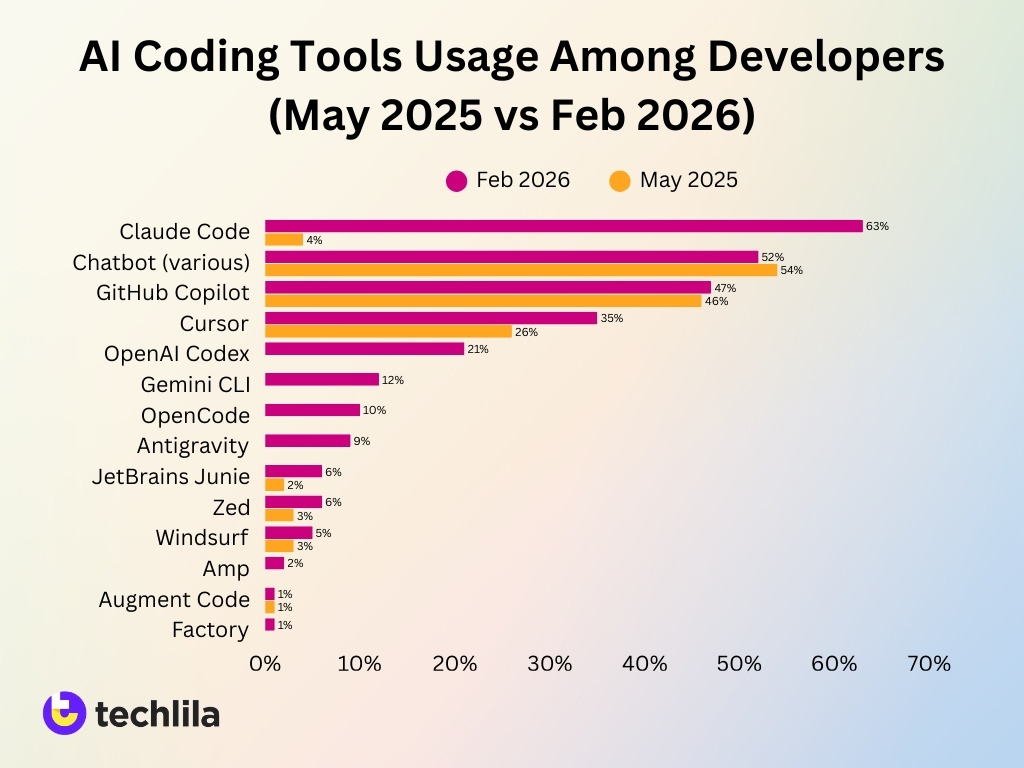
AI Coding Tools Usage Among Developers
- Claude Code emerged as the fastest-growing AI coding tool, rising dramatically from just 4% of developers in May 2025 to 63% in February 2026, making it the most widely used tool for coding assistance.
- General AI chatbots remain highly popular among developers, with 52% of respondents using them in Feb 2026, slightly down from 54% in May 2025, indicating continued reliance on conversational AI for coding help.
- GitHub Copilot maintains strong adoption, used by 47% of developers in Feb 2026, nearly unchanged from 46% in May 2025, showing its stable position as a core AI coding assistant.
- Cursor saw significant growth in developer adoption, increasing from 26% in May 2025 to 35% in Feb 2026, highlighting its rising role as an AI-powered coding IDE.
- OpenAI Codex is used by about 21% of developers in Feb 2026, reflecting continued interest in AI models specialized for code generation and automation.
- New developer-focused tools are gaining traction, including Gemini CLI (12%), OpenCode (10%), and Antigravity (9%), indicating a growing ecosystem of AI-powered developer tools.
- Several emerging AI coding environments and assistants show smaller but notable adoption levels, including JetBrains Junie (6%), Zed (6%), and Windsurf (5%).
- Niche AI development tools such as Amp (2%), Augment Code (1%), and Factory (1%) currently see limited adoption but signal experimentation with new AI-driven development workflows.
- Overall, the data shows that AI coding tools are rapidly becoming mainstream in software development, with multiple platforms now used by more than one-third of developers for programming tasks.
Adoption Rates of AI Coding Assistants Among Software Engineers
- 76% of professional developers reported using AI coding assistants in 2025, a major increase from 44% in 2023.
- 64% of developers use ChatGPT for coding-related tasks, making it the most widely adopted AI assistant.
- 49% of developers use GitHub Copilot as their primary AI coding assistant.
- GitHub Copilot alone has over 20 million users globally, demonstrating large-scale adoption.
- AI coding assistants achieve 15.8% acceptance rates for suggested code lines, indicating real usage within production environments.
- 39% of developers actually commit AI-suggested code into repositories during development tasks.
- 58% of developers say they would not want to return to coding without AI assistants, showing strong perceived value.
- Nearly 39% believe their productivity would decline if AI assistants were removed from their workflow.
Growth of AI Productivity Tools Usage Over Time
- AI tool adoption among developers increased from 70% in 2023 to 76% in 2024, reflecting early acceleration.
- By 2025, adoption rose to 84%, marking one of the fastest technology adoption curves in software engineering.
- GitHub Copilot usage increased by 400% within a year, driven by widespread developer interest in AI coding tools.
- Enterprise AI tool adoption among engineering teams grew 142% year over year in 2025.
- Adoption of AI code review agents increased dramatically from 14.8% to 51.4% within 10 months in 2025.
- AI-generated code now accounts for around 41% of total code output, compared to significantly lower levels just a few years earlier.
- In enterprise trials, developer engagement with AI tools grew from 4% in the first month to 83% by month six.
- After scaling, AI tool usage stabilized at around 60% active engagement among developers in long-term enterprise deployments.
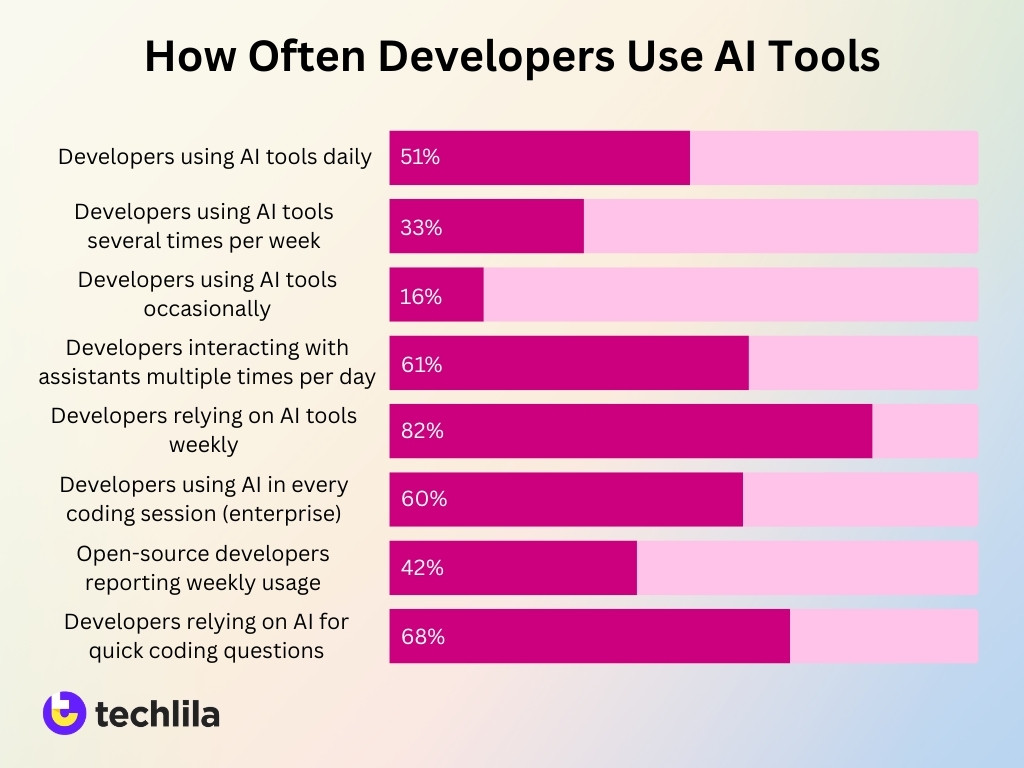
Frequency of AI Tool Usage Among Developers
- 51% of professional developers report using AI tools daily, making AI-assisted coding a routine part of modern development workflows.
- Around 33% of developers use AI tools several times per week, while another 16% use them occasionally, indicating broad adoption across varying usage levels.
- A 2025 enterprise engineering survey found 61% of developers interact with AI coding assistants multiple times per day when actively developing new features.
- Developers using GitHub Copilot accept approximately 30% of AI-generated suggestions, meaning a significant portion of AI outputs make it directly into codebases.
- Nearly 82% of developers rely on AI tools weekly for tasks such as code generation, debugging, and documentation.
- AI coding assistants save developers 3 to 4 hours per week on average, largely due to automated suggestions and boilerplate generation.
- In enterprise engineering teams, over 60% of developers use AI during every coding session, especially during early-stage development.
- Developers working on open-source projects use AI tools slightly less frequently, with about 42% reporting weekly usage.
- A 2025 developer productivity survey shows 68% of engineers rely on AI for quick coding questions instead of searching documentation or forums.
Share of AI-Assisted and AI-Authored Code in Production
- Studies show 41% of newly written code in 2025 is AI-assisted, meaning developers relied on AI suggestions while writing the code.
- In GitHub Copilot enterprise deployments, up to 46% of code written by developers comes directly from AI suggestions.
- Java developers using AI coding assistants report AI generating up to 61% of their code, particularly for repetitive backend tasks.
- A large-scale GitHub analysis found AI-generated code acceptance rates between 15% and 40%, depending on the programming language.
- In enterprise trials, AI-generated code contributed about 30% of production commits in engineering teams after six months of deployment.
- Roughly 38% of developers say AI generates entire functions or modules during certain development tasks.
- In organizations adopting AI copilots at scale, over half of developers submit at least one AI-generated code block per day.
- AI code suggestions have the highest acceptance rate in Python, JavaScript, and TypeScript, where acceptance often exceeds 40%.
- Analysts estimate that by 2030, up to 80% of routine code may be AI-generated, with developers focusing primarily on architecture and validation.
Adoption of AI-Powered IDEs and Extensions
- 85% of developers regularly use AI tools for coding, with 62% relying on AI coding assistants daily.
- GitHub Copilot reached 20 million users by mid-2025, with extensions in millions of IDEs worldwide.
- Visual Studio Code holds ~79% usage share among developers, dominating AI extension environments.
- 81.4% of developers install Copilot IDE extensions on the same day they receive licenses.
- 90% of AI users report time savings from IDE-integrated features, averaging up to 8 hours weekly for 20%.
- GitHub Copilot boosts task completion by 55% and generates 46% of developers’ code.
- AI coding assistants increase developer productivity by 26%, with 13.5% more code commits.
- 84% of developers have experience with AI code generators embedded in IDEs.
- VS Code remains the top IDE for AI development tools, used by nearly 80% globally.
- 74% of developers report higher productivity from AI-powered IDE autocomplete.
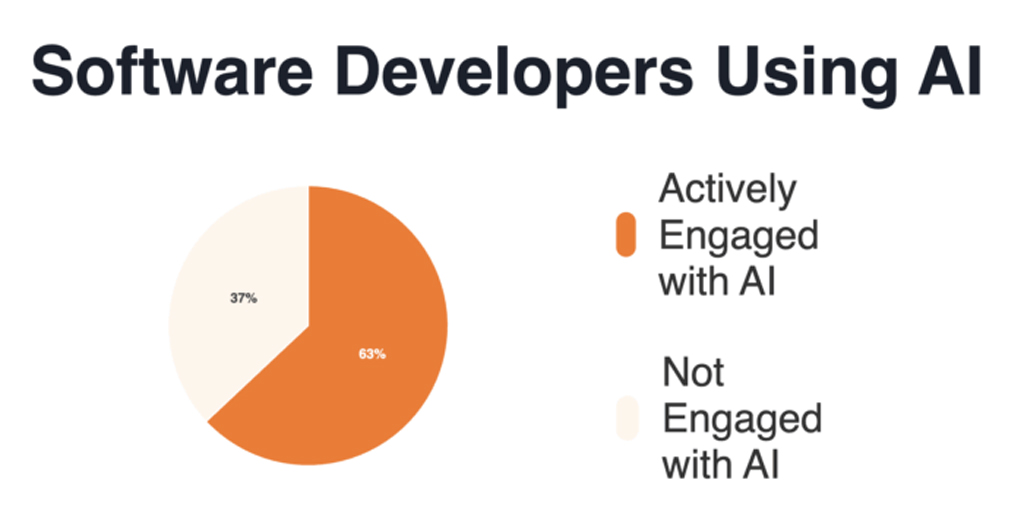
AI Adoption Trends Among Software Developers
- 63% of software developers are actively engaged with AI, highlighting the rapid integration of AI tools into modern software development workflows.
- Meanwhile, 37% of developers are not engaged with AI, showing that a sizeable segment of the developer community has yet to adopt AI-powered tools.
- With nearly two-thirds (63%) of developers already using AI, the technology is becoming increasingly common in activities such as code generation, debugging, and development assistance.
- The difference between AI users (63%) and non-users (37%) reflects a strong industry shift toward AI-assisted programming and automation in software engineering.
- As AI capabilities continue to evolve, the majority adoption level of 63% suggests that AI is quickly becoming a standard tool in the software development ecosystem.
Use of AI Agents vs AI Assistants in Engineering Workflows
- Traditional AI assistants such as copilots are used by about 76% of developers, while AI agents are used by roughly 18% of engineering teams.
- AI agents capable of autonomous coding tasks are now present in 15.8% to 22.6% of open-source repositories analyzed in recent research.
- Enterprise engineering teams using AI agents report up to 35% reductions in manual debugging tasks.
- Around 41% of developers say they expect AI agents to automate large portions of coding workflows within five years.
- AI agents performing automated pull-request analysis increased from 14.8% adoption to 51.4% within 10 months in 2025.
- Early adopters report AI agents can autonomously complete 15% to 20% of small development tasks without developer input.
- Companies implementing AI agents in CI/CD pipelines saw 23% faster code review cycles.
- About 37% of developers say AI agents will eventually replace some junior-level development tasks.
Top AI Productivity and Coding Tools Used by Software Engineers
- ChatGPT is used by about 82% of developers who rely on AI tools, making it the most widely used AI assistant for coding and troubleshooting.
- GitHub Copilot is used by roughly 68% of developers, positioning it as the leading AI-native coding assistant integrated into development environments.
- Google’s Gemini-based developer tools are used by around 22% of developers, especially in cloud-based development workflows.
- Amazon CodeWhisperer adoption among AWS developers reached about 17% in 2025, largely due to integration with AWS services.
- JetBrains AI Assistant usage increased to around 15% of developers, primarily among IntelliJ-based IDE users.
- Replit’s Ghostwriter AI tool has been adopted by over 1 million developers, particularly among startups and indie developers.
- Tabnine AI coding assistant serves more than 1 million users globally, focusing on enterprise code privacy and on-prem deployment.
- Codeium surpassed 1 million developers using its free AI coding assistant platform within two years of launch.
- Around 58% of developers report using more than one AI coding tool simultaneously, combining assistants depending on the task.
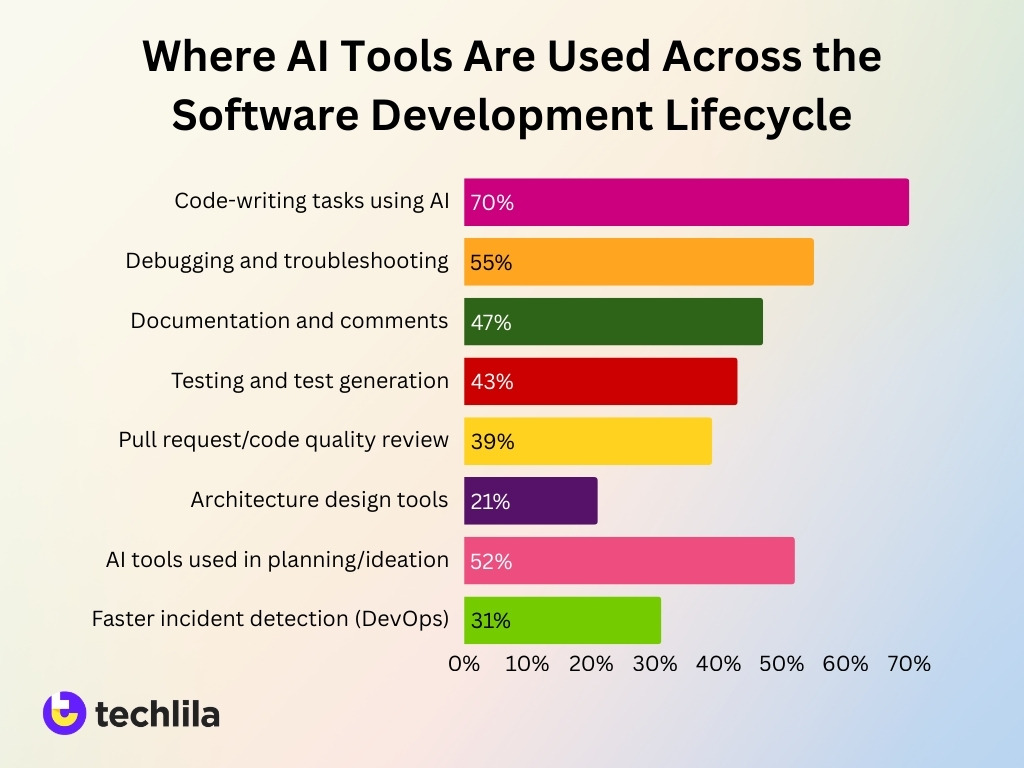
AI Tools Usage Across the Software Development Lifecycle
- AI tools are used in over 70% of code-writing tasks, making code generation the most common use case.
- 55% of developers use AI tools for debugging and troubleshooting, highlighting their role in problem resolution.
- Around 47% of engineers rely on AI for writing documentation or comments, improving maintainability and knowledge sharing.
- AI tools assist with 43% of testing and test-case generation tasks across modern development teams.
- Nearly 39% of developers use AI to review pull requests or analyze code quality.
- AI-assisted architecture design tools are used by around 21% of software teams, particularly in cloud-native systems.
- DevOps teams using AI monitoring tools report 31% faster incident detection times.
- Around 52% of developers use AI tools during the planning or ideation stage, including generating technical approaches or architecture ideas.
- Engineering teams that integrate AI tools throughout the SDLC report 28% higher development throughput compared with teams that do not use AI.
AI Tools for Code Generation, Refactoring, and Completion
- Developers using AI code assistants complete programming tasks 55% faster on average compared with those coding without AI assistance.
- Around 74% of developers rely on AI for code generation or auto-completion, making it the most common use case for AI productivity tools.
- GitHub Copilot users accept about 30% of AI-generated suggestions, meaning nearly one in three suggestions becomes part of the final codebase.
- Approximately 43% of developers use AI tools to refactor legacy code, improving readability and maintainability.
- Developers report that AI tools generate entire functions or code blocks in 38% of coding sessions.
- AI-assisted auto-completion reduces the time required to write repetitive code patterns by up to 35%.
- Python, JavaScript, and TypeScript show the highest AI code acceptance rates, often above 40% for suggested code snippets.
- Enterprise engineering teams report a 28% increase in development throughput after integrating AI coding assistants into their workflow.
- Analysts estimate that by 2030, 80% of routine code generation tasks could be handled by AI tools.
AI Tools for Testing, Debugging, and Code Review
- 55% of developers use AI tools for debugging tasks, including identifying logic errors and runtime issues.
- AI-powered test generation tools can automatically create 30% to 50% of the unit tests required for modern applications.
- Developers using AI-assisted debugging report up to 25% faster bug resolution times.
- AI tools analyzing pull requests help engineering teams complete code reviews 23% faster.
- Nearly 39% of developers rely on AI to review code quality or suggest improvements during pull-request reviews.
- AI-driven test automation tools increase automated test coverage by around 20% to 40% in enterprise projects.
- Developers report 31% fewer manual debugging steps when AI tools provide contextual error explanations.
- AI-based static code analysis tools help detect over 30% more potential vulnerabilities compared with traditional rule-based scanners.
- Engineering teams that adopt AI for debugging and testing experience a 17% reduction in production incidents.
AI Tools for Documentation, Knowledge Search, and Code Understanding
- 47% of developers use AI tools to generate documentation or code comments, improving maintainability across teams.
- AI-powered documentation tools reduce the time required to write technical documentation by about 50%.
- Around 52% of developers rely on AI tools for searching internal knowledge bases or code repositories.
- AI systems capable of code explanation help developers understand unfamiliar codebases up to 37% faster.
- Developers working with legacy systems report 29% faster onboarding times when AI tools assist with code understanding.
- AI-based semantic search tools allow engineers to locate relevant code snippets 60% faster than traditional keyword search.
- Around 41% of developers use AI tools to summarize large code files or pull requests before reviewing them.
- AI-generated documentation systems can automatically update documentation after every major commit, improving accuracy and consistency.
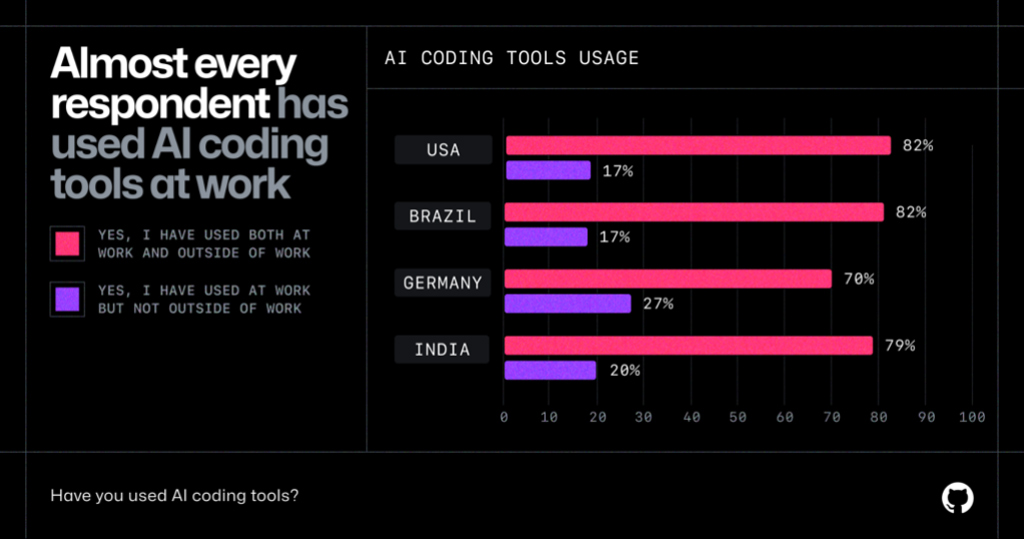
AI Coding Tools Are Widely Used by Developers Across Major Markets
- AI coding tools adoption is extremely high among developers, with 70% to 82% of respondents across surveyed countries saying they use AI coding tools both at work and outside of work.
- The United States and Brazil show the highest adoption, with 82% of developers reporting they use AI coding tools both professionally and personally.
- In India, a strong 79% of developers say they use AI coding tools both at work and outside of work, highlighting rapid AI adoption among Indian software professionals.
- Germany shows comparatively lower but still strong adoption, with 70% of developers using AI coding tools both at work and outside of work.
- A smaller share of developers report using AI coding tools only at work, including 27% in Germany, 20% in India, and 17% in both the United States and Brazil.
- The data suggests that AI coding assistants are not limited to workplace usage, as a majority of developers in most countries also use them for personal projects, learning, or experimentation outside of work.
- Overall, the findings indicate that AI coding tools have become a mainstream part of the developer workflow globally, with most developers integrating them into both professional and personal coding environments.
Impact of AI Tools on Developer Productivity and Throughput
- Developers using AI coding assistants complete tasks 55% faster on average, according to controlled productivity experiments.
- 78% of developers report increased productivity after adopting AI coding assistants.
- AI-assisted workflows allow developers to ship code up to 28% more frequently in enterprise engineering teams.
- Developers using AI tools save 3.6 hours per week on average, primarily on repetitive coding tasks.
- Around 60% of developers say AI tools reduce context switching, allowing them to focus on complex engineering problems.
- Teams integrating AI coding assistants report 20% to 30% faster feature development cycles.
- Companies adopting AI productivity tools experience up to 33% faster project delivery timelines.
- Enterprise deployments show 83% developer engagement with AI tools after six months, indicating sustained usage rather than short-term experimentation.
Impact of AI Tools on Code Quality, Bugs, and Incidents
- Developers report 17% fewer production incidents after integrating AI tools for code generation and review.
- AI-assisted code review tools detect 30% more potential vulnerabilities compared with manual review processes.
- Around 45% of developers say AI tools help reduce simple coding mistakes, particularly syntax or logic errors.
- However, some studies show that up to 27% of AI-generated code snippets may contain security vulnerabilities if not reviewed carefully.
- Developers using AI tools report 20% fewer repetitive bugs, especially in boilerplate-heavy codebases.
- AI tools can automatically identify up to 70% of known vulnerability patterns during static analysis.
- Around 33% of developers remain cautious about AI-generated code quality, highlighting ongoing trust concerns.
- Engineering teams that combine AI tools with manual reviews achieve higher code quality scores in internal audits.
Developer Trust Levels in AI Coding and Productivity Tools
- Only 33% of developers fully trust AI-generated code, while the majority still prefer human validation.
- Around 60% of developers say they verify AI-generated code carefully before committing it to repositories.
- 68% of developers believe AI coding assistants improve productivity, even if they do not fully trust the outputs.
- Approximately 45% of engineers worry about hidden security vulnerabilities in AI-generated code.
- Developers with more than 10 years of experience report lower trust levels in AI tools compared with junior developers.
- Around 37% of developers say AI-generated code often requires significant editing before it can be used in production.
- Despite concerns, 58% of developers say they would not want to return to coding without AI assistants.
- AI trust levels improve when tools integrate with IDEs and enterprise security workflows, increasing acceptance by about 22%.
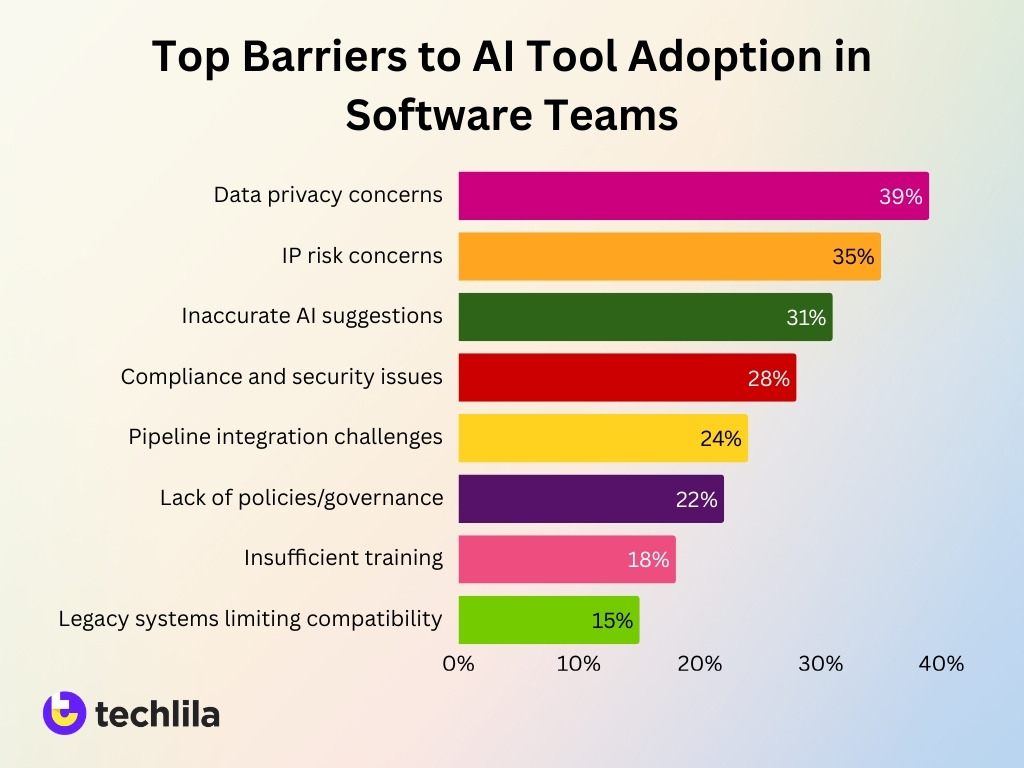
Barriers to AI Tool Adoption in Software Teams
- 39% of organizations cite data privacy concerns as the primary barrier to adopting AI coding tools.
- Around 35% of developers worry about intellectual property risks associated with AI-generated code.
- 28% of engineering leaders report compliance and security issues slowing AI adoption in enterprise environments.
- Approximately 31% of developers say AI suggestions are sometimes inaccurate, requiring manual correction.
- Organizations report integration challenges with existing development pipelines as a barrier for about 24% of teams.
- 22% of companies lack internal policies or governance frameworks for AI-generated code.
- Around 18% of developers report insufficient training on AI tools, limiting adoption in some teams.
- Legacy systems and older programming environments limit AI tool compatibility for about 15% of development teams.
Future Adoption Intentions and Investment in AI Productivity Tools
- 90% of enterprise software engineers are expected to use AI coding assistants by 2028, according to industry forecasts.
- Global spending on AI developer tools is projected to grow from $4.7 billion in 2025 to over $14 billion by 2033.
- Around 76% of companies plan to increase investment in AI development tools within the next two years.
- 65% of engineering leaders expect AI agents to automate large parts of development workflows by 2030.
- Nearly 70% of developers say AI tools will become essential for future software development.
- About 58% of organizations plan to deploy AI agents in CI/CD pipelines within the next three years.
- AI-powered development environments are expected to reduce manual coding workloads by up to 40% in the next decade.
- Venture funding for AI developer tools exceeded $1.5 billion in 2024 alone, reflecting strong investor interest.
Frequently Asked Questions (FAQs)
About 84% of developers use or plan to use AI tools in their development workflows as of 2025.
Roughly 51% of professional developers use AI tools daily for coding, testing, debugging, or documentation tasks.
Around 78% of developers report improved productivity, and many save about 3.6 hours per week using AI coding tools.
AI tools generate or assist with about 26.9% to 46% of production code, depending on the project and programming language.
Conclusion
AI productivity tools have rapidly transformed software engineering workflows. From generating code and automating testing to improving documentation and debugging, AI now supports developers throughout the entire software development lifecycle. The data shows that adoption continues to accelerate, with most developers already using AI assistants and enterprises investing heavily in advanced AI agents.
However, the statistics also reveal ongoing challenges. Developers still question the reliability of AI-generated code, and organizations must address governance, security, and compliance concerns. As AI models improve and development environments integrate these tools more deeply, the role of developers will likely shift toward architectural design, validation, and complex problem-solving rather than routine coding tasks.
Overall, AI productivity tools are becoming a core component of modern software engineering, reshaping how developers write, review, and maintain code.

Leave a comment
Have something to say about this article? Add your comment and start the discussion.